

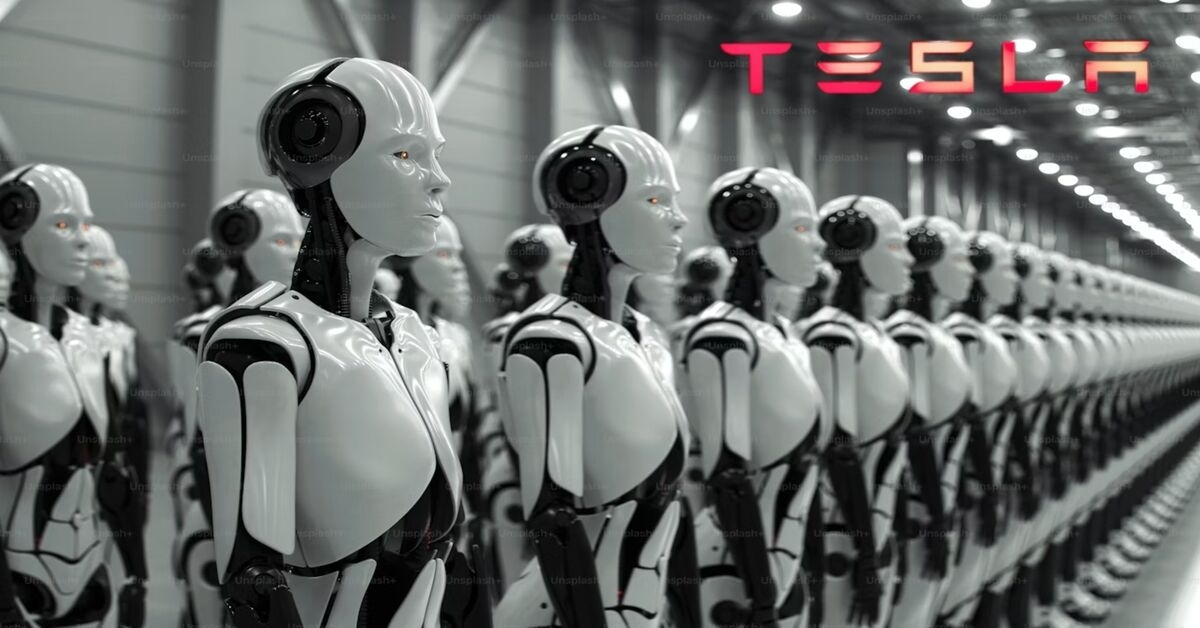

Tesla’s future may depend less on what it drives and more on what it builds. According to CEO Elon Musk, Tesla humanoid robots could eventually become the company’s most transformative product, reshaping its identity beyond electric vehicles and redefining Tesla as a leader in artificial intelligence and automation.
The growing emphasis on robotics reflects Musk’s long-held belief that physical AI machines capable of operating safely in human environments will define the next major technological shift.
Tesla Humanoid Robots Move to the Center of Tesla’s AI Strategy
For years, Tesla has been associated primarily with electric vehicles and self-driving software. That focus is now expanding. Musk has increasingly highlighted Tesla humanoid robots as a long-term cornerstone of the company’s strategy, suggesting their economic potential could exceed that of cars.
The humanoid robot program, known as Optimus, is designed to perform general-purpose tasks that typically require human labor. Tesla envisions robots that can work in factories, warehouses, and eventually homes, addressing labor shortages and reducing reliance on repetitive or hazardous human work.
From Self-Driving Software to Physical Intelligence
Tesla’s robotics initiative builds directly on its autonomous driving research. The same neural networks trained to interpret roads, vehicles, and human behavior are now being adapted for real-world physical tasks.
Optimus relies on computer vision, reinforcement learning, and real-time decision-making systems to move, grasp objects, and interact with its surroundings. Unlike traditional industrial robots that operate in controlled settings, Tesla humanoid robots are intended to function in unpredictable environments designed for people.
Company executives argue that advances in AI not mechanical engineering alone make this new generation of robots possible.
Leveraging Tesla’s AI and Hardware Stack
Tesla believes its vertically integrated technology stack gives it a competitive advantage in robotics. Rather than relying on expensive sensors, the company uses vision-based AI combined with custom inference chips and end-to-end neural network training.
Large volumes of real-world data collected across Tesla’s ecosystem are used to train these systems. Musk has repeatedly emphasized that data scale and rapid iteration are critical advantages in AI-driven development.
This integrated approach, Tesla argues, allows Tesla humanoid robots to improve faster and potentially reach commercial viability sooner than competing designs.
Technical and Regulatory Challenges Remain
Despite visible progress, humanoid robotics remains one of the most complex engineering challenges in modern computing. Robots must safely balance perception, motion control, adaptability, and reliability in environments that constantly change.
Even minor system errors can result in physical damage or injury, making safety standards and regulatory approval significant hurdles. Many experts caution that consumer-ready humanoid robots are still several development cycles away.
Regulators are also expected to scrutinize deployment closely, particularly in public or residential settings where liability and safety concerns are highest.
Why Tesla Is Doubling Down on Robotics
As competition intensifies across electric vehicles, batteries, and vehicle software, Tesla’s robotics efforts offer a path to long-term differentiation. Automakers worldwide are narrowing the gap in EV technology, pushing Tesla to look beyond transportation.
Robots capable of performing repetitive or dangerous tasks could reshape industries such as manufacturing, logistics, healthcare support, and elder care. Tesla plans to deploy early versions of Optimus within its own factories, using internal operations as controlled testing environments.
If successful, Tesla humanoid robots could become both a productivity tool and a new revenue stream.
The Road to Commercialization
Tesla has not announced pricing or firm timelines for large-scale deployment. Early versions of Optimus are expected to remain internal, serving as platforms for continued AI and hardware refinement.
According to industry analysts cited by Reuters, widespread adoption of humanoid robots will depend on cost reduction, regulatory clarity, and proven safety at scale. These factors are likely to determine how quickly robots move from experimental tools to commercial products.
A Broader Shift in Tesla’s Identity
If Musk’s vision plays out, Tesla could evolve into a major AI robotics platform rather than a car company expanding into automation. That shift would place Tesla closer to AI infrastructure leaders than traditional automakers.
Whether Tesla humanoid robots ultimately deliver on that promise will depend on execution, regulatory acceptance, and the company’s ability to translate ambition into reliable real-world systems. For now, the strategy signals that Tesla’s next chapter may be driven as much by intelligence as by horsepower.