

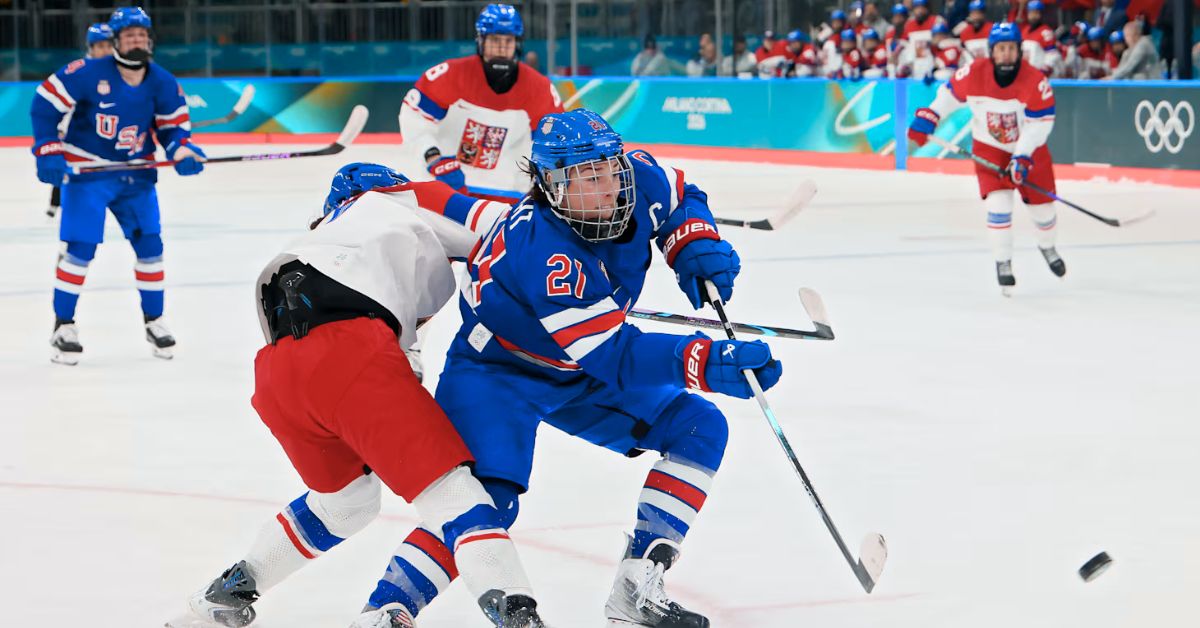

MILAN — The women’s hockey rivalry that has defined Olympic competition for nearly three decades delivered another dramatic chapter Tuesday night, as the United States overwhelmed Canada in a commanding performance at the 2026 Winter Games.
The result immediately reshaped early tournament narratives and intensified speculation about a potential championship rematch.
Team USA Defeats Canada.
That simple headline carried enormous weight inside the Milan arena, where a 5-0 scoreline stunned a crowd accustomed to razor-thin margins between the two North American powers.
The victory does not determine gold medal placement. But in Olympic rivalry terms, it sends a message.
Early Momentum Sets the Tone
From the opening puck drop, the American squad played with urgency.
Just under four minutes into the first period, a defensive breakdown by Canada created space at the blue line. The United States capitalized quickly, converting the turnover into the game’s first goal and forcing its longtime rival to chase from behind.
In Olympic hockey, early goals shift more than the scoreboard. They alter rhythm and decision-making.
The Americans controlled zone entries through crisp passing and disciplined neutral-zone coverage. Canada struggled to generate sustained offensive pressure during the opening frame, managing limited high-quality scoring chances.
By the end of the first period, momentum had firmly tilted.
The second period expanded that advantage.
Two quick scoring bursts stretched the lead to three goals before Canada could fully reset its defensive shape. The United States displayed balanced scoring depth, with multiple lines contributing rather than relying on a single star unit.
By the midpoint of the game, the outcome felt increasingly decisive, reinforcing how Team USA Defeats Canada was not a narrow escape but a structured and calculated performance.
Team USA Defeats Canada in Historic Rivalry Clash
The phrase has echoed across Olympic history before. But rarely by a five-goal margin.
For decades, the United States and Canada have defined women’s hockey on the Olympic stage. Since the sport’s introduction in 1998, every gold medal has been claimed by one of the two nations. Championship games have often required overtime, shootouts, or last-minute heroics.
This time was different.
The five-goal differential represents one of the most dominant Olympic performances in the modern era of this rivalry. It signals a tactical and structural execution that left little room for counterattack.
While the game occurred in group-stage play, the psychological weight remains significant. Players from both sides acknowledged the intensity that accompanies every meeting between these two programs.
The Americans did not celebrate as if the tournament were over. Instead, their reactions reflected focus — an understanding that Olympic success demands consistency across multiple rounds.
Canada Adjusts Without Key Leadership
Canada entered the matchup facing adversity.
A key veteran forward was sidelined due to injury, altering line combinations and special teams chemistry. In high-stakes rivalry games, leadership and composure can define outcomes.
Without that stabilizing presence, Canada appeared hesitant in transitional play. Decision-making in the defensive zone lacked the precision typically associated with its Olympic pedigree.
Coaching staff members emphasized postgame that the tournament structure allows for recalibration. Group-stage results influence seeding, but they do not eliminate medal opportunities.
Historically, Canada has responded strongly to early setbacks.
Adjustments in defensive coverage, line rotations, and offensive tempo are expected before the knockout rounds begin.
Defensive Structure and Goaltending Strength
The American defensive blueprint played a decisive role in the shutout.
Neutral-zone traps disrupted Canada’s ability to enter cleanly. When the puck did cross the blue line, defenders collapsed quickly to limit passing lanes and second-chance rebounds.
Goaltending remained steady throughout.
Clear sightlines and disciplined rebound control prevented extended scrambles in front of the net. The shutout was not the product of luck; it was the result of layered defensive execution.
Special teams also contributed to stability. While penalties were limited, the United States avoided costly infractions that could have shifted momentum.
Tournament hockey rewards discipline.
Psychological Impact on the Tournament
When Team USA Defeats Canada in Olympic play, the implications extend beyond statistics.
Confidence builds quickly in short tournaments. A commanding performance against the sport’s primary rival can elevate locker-room belief and influence tactical aggression in subsequent matches.
American players described the game as composed rather than emotional.
They emphasized structure, preparation, and tempo over spectacle.
That tone reflects experience.
Veteran leadership within the squad has navigated Olympic finals before. Younger players bring speed and creativity, but the group’s identity appears grounded in discipline.
Canada, meanwhile, faces a different psychological equation.
Resilience has long been a hallmark of its program. Past Olympic cycles have included losses followed by championship recoveries. The ability to compartmentalize and adjust remains critical.
Statistical Breakdown Reveals Control
Preliminary metrics underscore the dominance displayed on the ice.
Shot attempts favored the United States throughout most periods, particularly in the second frame when momentum peaked. Faceoff percentages also leaned toward the American side, granting immediate possession advantages.
Puck retrievals in the defensive zone were swift and organized.
Transition play moved efficiently from defense to offense, limiting Canada’s ability to sustain forechecking pressure.
Balanced scoring further highlighted depth.
Rather than depending on one star forward, multiple lines generated offense. That distribution may prove decisive in later rounds, where fatigue and defensive adjustments tighten margins.
Conclusion
When Team USA Defeats Canada by a 5-0 margin at the Winter Olympics, the result carries symbolic force.
It reinforces preparation, structure, and depth within the American system while challenging Canada to respond with urgency and tactical refinement.
The path to gold remains complex.
Yet this performance has reshaped early expectations in Milan.
If a championship rematch emerges, the narrative will shift again shaped by adjustments, resilience, and Olympic pressure.
For now, Team USA Defeats Canada stands as the defining headline of the tournament’s opening week, a moment that may echo long after the medals are awarded.