

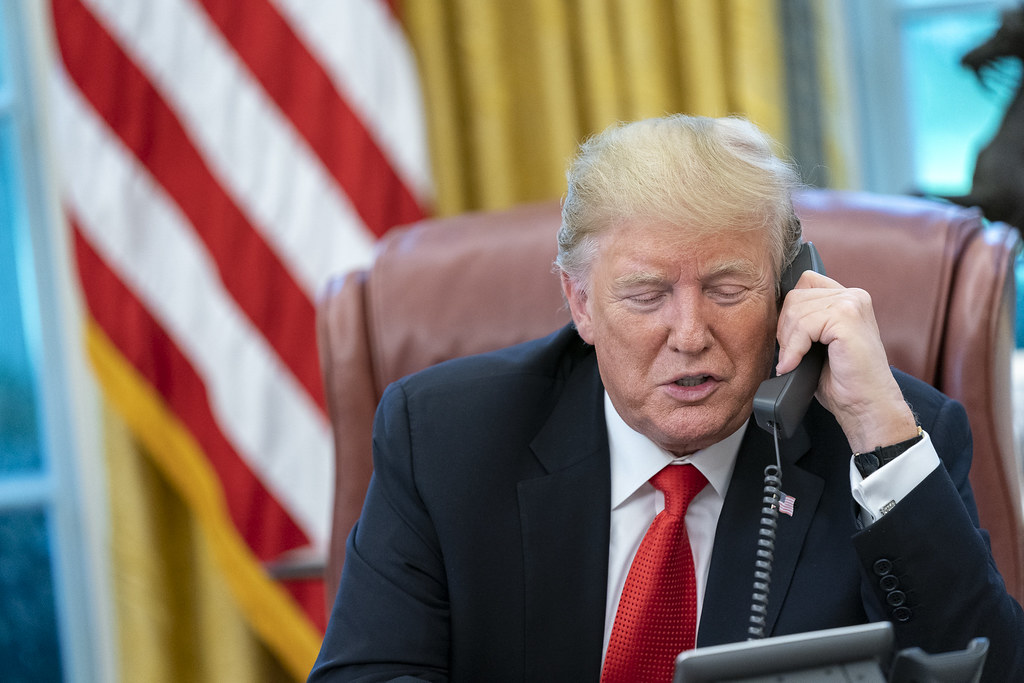

Trump Iran Ceasefire negotiations remain uncertain after the U.S. president said that a potential agreement with Iran is still far from acceptable.
In a lengthy interview discussing the escalating Middle East conflict, President Donald Trump indicated that Iran may be open to discussing a ceasefire. However, he made clear that the conditions currently being discussed do not meet Washington’s expectations. According to the president, any agreement would need to provide stronger guarantees before the United States considers ending the current military confrontation.
The conflict has rapidly intensified in recent weeks following coordinated military operations targeting Iranian facilities. Retaliatory actions across several parts of the Middle East have raised fears of a broader regional crisis. Governments and global markets are watching closely as diplomatic channels attempt to prevent further escalation.
While officials on multiple sides acknowledge that discussions may eventually take place, the Trump Iran Ceasefire question remains unresolved. For now, military operations and strategic calculations continue to dominate the situation.
Trump rejects early ceasefire proposal
President Donald Trump said that Iran has signaled interest in negotiating a ceasefire but emphasized that the United States will not rush into an agreement.
According to the president, the terms currently discussed would not sufficiently address U.S. concerns about Iran’s long-term strategic capabilities. Washington wants stronger commitments related to military activity and nuclear development before it considers halting ongoing operations.
Trump stated that any Trump Iran Ceasefire agreement must be “very solid,” suggesting that the United States will only consider negotiations if the conditions significantly limit Iran’s ability to threaten regional stability.
The remarks come as diplomatic channels remain active behind the scenes. Several countries have quietly attempted to encourage talks between Washington and Tehran, hoping to prevent the situation from turning into a prolonged conflict.
Despite those efforts, the president indicated that he is not ready to accept the proposals currently on the table.
Regional conflict expands across the Middle East
The conflict began when U.S. and Israeli forces carried out coordinated strikes against several Iranian targets. The operation focused on military infrastructure believed to be connected to missile systems and drone manufacturing facilities.
Iran responded with missile and drone attacks across the region, targeting locations linked to American and allied military presence.
Since then, multiple countries in the Middle East have experienced heightened security alerts. Regional governments have increased defense measures while international airlines and shipping companies reassess risk levels.
The growing tensions have also complicated diplomatic relations across the region. Several governments are urging restraint while simultaneously preparing for the possibility of a wider confrontation.
As the situation develops, the Trump Iran Ceasefire question has become central to global diplomatic discussions.
Strategic targets and military objectives
Military operations carried out during the conflict have focused on strategic locations connected to Iran’s military capabilities.
Among the most significant targets was Kharg Island, a key hub for Iran’s oil exports and logistical operations. U.S. officials described the strikes as precision operations aimed at weakening Iran’s ability to support missile and drone activity.
The president said the attacks had significantly damaged Iran’s offensive capabilities. According to his assessment, many missile and drone facilities have already been disrupted.
However, analysts note that Iran has historically relied on decentralized infrastructure, making it difficult to eliminate its military capabilities entirely.
Because of that complexity, the possibility of a Trump Iran Ceasefire agreement remains uncertain.
Oil markets react to rising geopolitical risk
Energy markets reacted quickly as news of the conflict spread across global financial centers.
Oil prices climbed amid fears that supply routes could be disrupted if the conflict continues to escalate. Traders are particularly concerned about shipping activity in the Persian Gulf, which remains one of the most important oil transportation corridors in the world.
Market analysts say geopolitical tensions are often one of the strongest drivers of sudden price movements in energy markets.
Even rumors of potential disruptions can trigger large swings in global oil prices.
The possibility of a Trump Iran Ceasefire agreement could stabilize markets, but uncertainty about the timing of negotiations has kept investors cautious.
Strait of Hormuz security concerns grow
One of the most critical elements of the crisis involves the Strait of Hormuz.
The narrow shipping route connects the Persian Gulf to international waters and is responsible for transporting a significant portion of the world’s oil supply.
Iran has previously warned that it could attempt to disrupt shipping through the strait if military pressure continues.
Because of this risk, several countries have increased naval patrols in the region.
Security experts say maintaining open access to the strait is a top priority for the international community.
The longer the conflict continues without a Trump Iran Ceasefire agreement, the greater the concern about potential disruptions to global energy trade.
Questions surrounding Iran’s leadership
Another unusual aspect of the crisis involves uncertainty surrounding Iran’s political leadership.
Reports indicate that Mojtaba Khamenei, the son of the former supreme leader Ayatollah Ali Khamenei, has taken over the role following recent developments during the conflict.
However, he has not appeared publicly since assuming leadership, issuing only written statements.
The absence of public appearances has fueled speculation about his situation and the stability of Iran’s political structure.
Leadership uncertainty can complicate diplomatic negotiations, especially in a crisis where communication channels are already fragile.
This uncertainty has further complicated discussions surrounding a possible Trump Iran Ceasefire arrangement.
Regional allies respond to the crisis
Countries across the Middle East have been forced to reassess their security strategies as tensions rise.
Some governments have expressed strong support for U.S. military operations, while others have called for immediate diplomatic engagement to prevent further escalation.
Several nations have increased air defense readiness and strengthened surveillance along their borders.
The regional response highlights how quickly the conflict has spread beyond its initial scope.
Diplomatic leaders from multiple countries are encouraging dialogue, arguing that a Trump Iran Ceasefire agreement could reduce the risk of a prolonged confrontation.
Trump Iran Ceasefire negotiations remain uncertain
Despite signs that both sides may eventually explore negotiations, the path toward a Trump Iran Ceasefire agreement remains unclear.
Officials close to the discussions say the main disagreements involve security guarantees and long-term strategic commitments.
The United States wants stronger assurances that Iran will not expand its military capabilities, while Iran has demanded an end to military pressure before entering formal negotiations.
These positions have created a diplomatic standoff.
For now, neither side appears ready to compromise on its core demands.
As a result, the possibility of a Trump Iran Ceasefire agreement continues to depend on whether future negotiations can bridge those differences.
Diplomatic possibilities and global pressure
International leaders are increasingly encouraging diplomatic engagement.
Governments across Europe and Asia have urged both sides to pursue negotiations that could prevent the conflict from expanding further.
Diplomats say that behind-the-scenes conversations are already underway to explore possible frameworks for talks.
These discussions could eventually lay the groundwork for a Trump Iran Ceasefire agreement if both parties decide that continued escalation is not in their strategic interest.
However, such negotiations are often slow and complex, particularly during an active conflict.
What comes next in the escalating conflict
The coming weeks may determine whether the situation moves toward diplomacy or further confrontation.
Military operations continue while diplomatic channels remain open, creating a delicate balance between pressure and negotiation.
Political analysts say the next phase of the crisis could depend on developments on the ground as well as signals from both Washington and Tehran.
If diplomatic momentum builds, the Trump Iran Ceasefire issue could move closer to a formal negotiation process.
Until then, the conflict remains one of the most closely watched geopolitical crises in the world.