


Key Takeaways
• Birds group together to stay safer from predators.
• Large flocks mean more food competition among birds.
• Flocks form by each bird following its nearest neighbors.
• Beyond flocks, birds nest, roost, and even help each other raise chicks.
Why Do Birds Show Social Behavior?
Birds often gather in groups when they feed, rest, or fly. This social behavior helps them survive. Yet it also brings challenges like more competition for food and the spread of disease. By studying birds on beaches, mudflats, and in the sky, scientists have uncovered why birds choose to stick together.
Understanding Bird Social Behavior
Bird social behavior explains why birds flock, nest, and roost in groups. Evolutionary biologists have long asked why an individual bird would risk sharing resources or spreading disease by staying close to others. The key idea is that each bird gains more by being in a group than by staying alone.
Safety in Numbers
When birds feed on a beach, each one is safer in a flock. A lone bird is an easy target for a predator like a hawk. However, when birds group, they can spot a threat sooner. As a result, the flock can scatter or turn together, making it hard for the predator to grab a single bird. For example, common redshanks on British mudflats stay close so sparrowhawks can’t pick off the slowest bird. As a result, each redshank in a tight group avoids becoming the lone target.
Moreover, flocks can offer living shelter. Birds line up so each one hides behind another bird from a predator’s view. This idea, called the selfish herd effect, shows that each bird moves closer to its neighbors to stay safe. Consequently, flocks of shorebirds, fish schools, and herds all use the same tactic to reduce risk.
The Cost of Many Birds
Despite safety benefits, large flocks bring more competition. Each bird fights for the same food on a beach or mudflat. With more birds probing for shrimp and insects, the prey flees faster, and the birds must take more steps to find a meal. Scientists have found that redshanks on predator-free islands form smaller flocks. This way, they can feed with less competition and save energy.
Therefore, birds face a trade-off. They must balance safety in numbers against the cost of sharing resources. When predators roam freely, large flocks win. But where danger is low, smaller groups help birds feed more efficiently.
Flocking Flight Formations
Flying birds like homing pigeons and starlings also use social behavior to avoid threats. Researchers built a robot falcon to chase pigeons fitted with GPS tags. When the robot attacked, the pigeons turned sharply away, matching the moves of their nearest neighbors. As a result, they did not cluster more tightly but used coordinated turns to evade the threat.
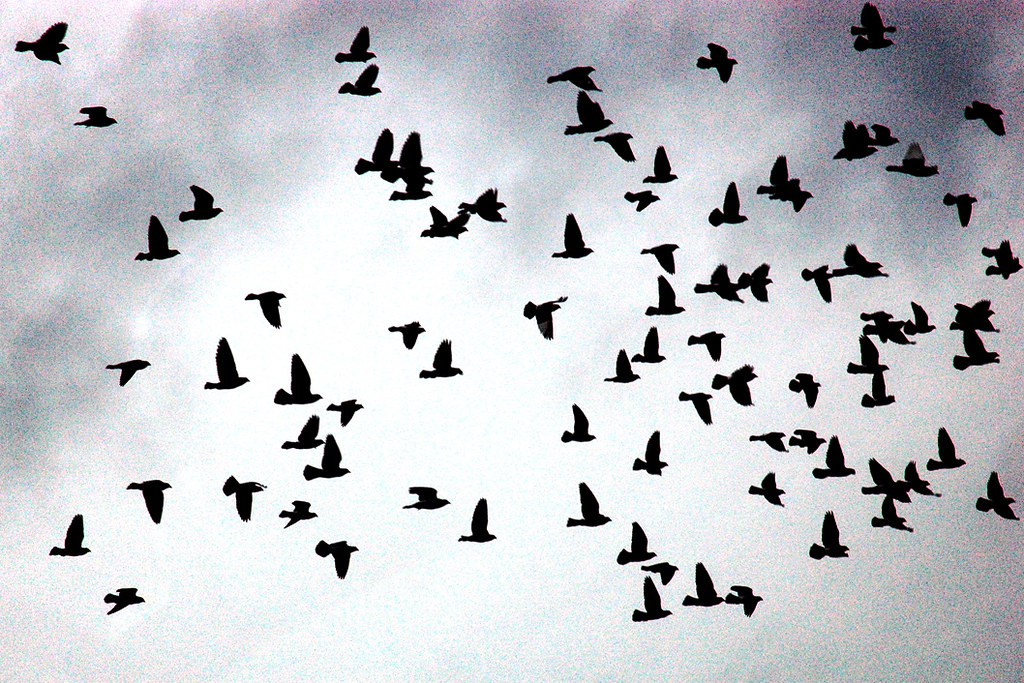
In a spectacular display called a murmuration, thousands of starlings wheel and twist in the sky. Each starling watches only six of its closest neighbors, yet the entire flock moves as one. This simple rule creates complex shapes that confuse predators and delight onlookers. Thus, bird social behavior in flight arises from local interactions, not from a leader guiding the group.
Beyond Flocks: Other Social Lives
Birds share more than protection and flight. Many species sleep together in roosts. Some nest near each other in colonies, such as terns and shearwaters. During mating season, birds like sage grouse gather in groups called leks to perform dances and calls. These displays help males attract a mate.
In addition, some birds help relatives raise chicks. Known as cooperative breeding, this behavior often occurs when young adults wait to inherit a territory. By helping their parents, they gain experience and secure future nesting spots. Thus, bird social behavior extends from flocks to feeding, sleeping, mating, and raising the next generation.
Watching and Wondering
Next time you see birds on a beach or in the sky, look for clues to their social lives. Notice how they space themselves, how they move as a group, and how they react to threats. Understanding bird social behavior adds depth to a simple walk or birdwatching trip. Moreover, this knowledge sparks a stronger connection to nature’s brilliant strategies for survival.
FAQs
What makes birds form flocks on a beach?
Birds flock on beaches to reduce their chance of being caught by predators. More eyes help them spot danger faster.
Do birds in large flocks find less food?
Yes. In big groups, each bird faces more competition. They spend extra time and energy finding enough food.
How do birds coordinate complex flight patterns?
They watch a few nearest neighbors and copy their moves. Simple local rules create large, coordinated shapes.
Can birds show social behavior at night?
Absolutely. Many species roost together in trees or on cliffs. Roosting in groups helps them stay warm and safe.