

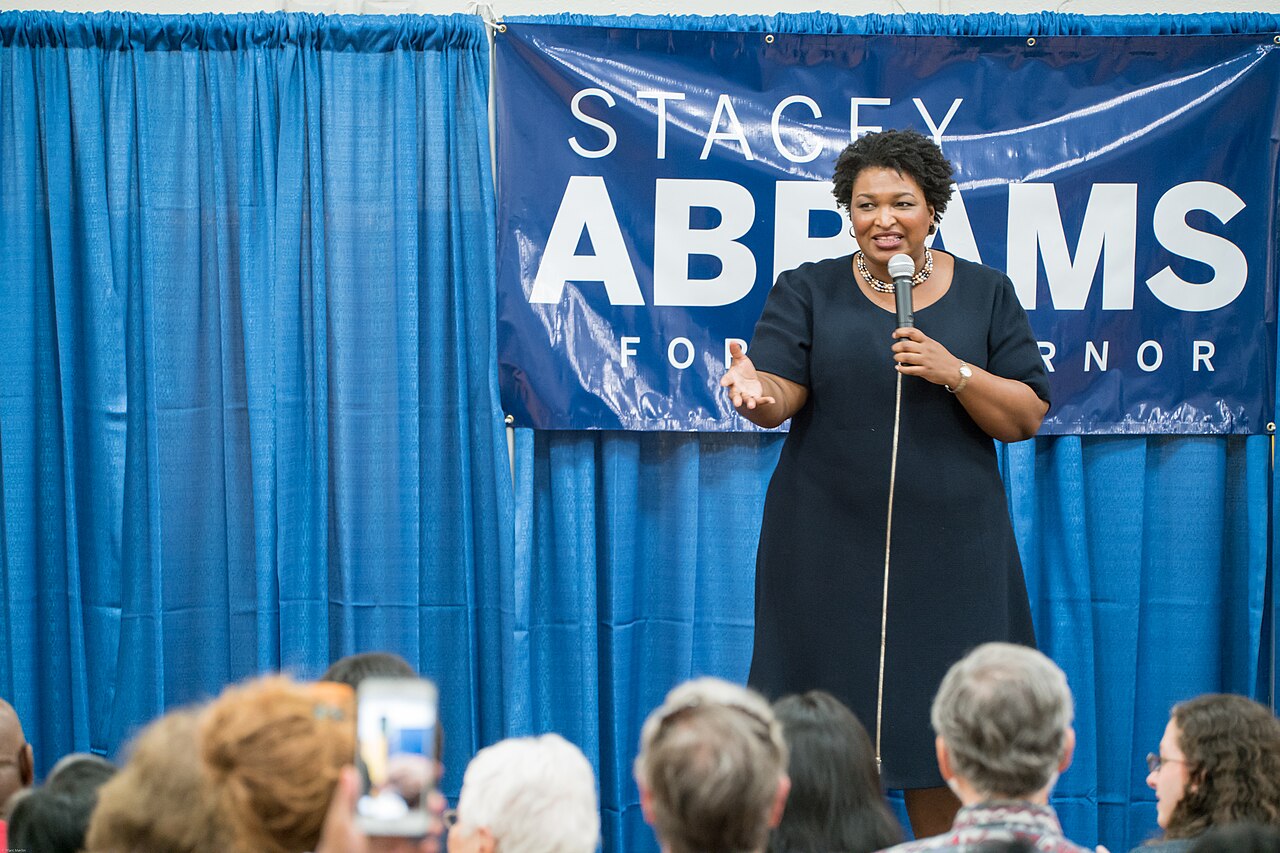

Quick Summary: Stacey Abrams Criticized Prioritizing Loyalty to Trump Over Democracy
- Stacey Abrams criticized Georgia Republicans for prioritizing loyalty to Trump over democracy.
- Georgia’s GOP is embroiled in internal conflicts over election administration and Trump loyalty.
- Brad Raffensperger, Georgia’s Secretary of State, faces backlash for not overturning the 2020 election.
- Georgia Republicans are using Abrams as a political foil despite internal party disputes.
- The outcome of Georgia’s 2026 contests will reflect the GOP’s stance on Trump and democracy.
Source: Read original article
Stacey Abrams is sounding the alarm on a critical issue facing Georgia Republicans: their unwavering allegiance to Donald Trump. Her warning that they are ‘running to be supplicants to Trump, not defenders of democracy’ has ignited a firestorm within the state’s GOP, where election administration and loyalty to Trump are at the forefront.
Georgia’s political landscape is fraught with tension as the Republican Party grapples with its identity. The 2020 election continues to cast a long shadow, with candidates and activists still entrenched in Trump’s false claims. Brad Raffensperger, the incumbent Secretary of State, finds himself caught in the crossfire, defending his refusal to overturn the 2020 results while trying to maintain credibility in a pro-Trump party.
This internal conflict is not just about Trump or Abrams; it’s about the future of democracy in Georgia. Abrams’ pointed critique highlights a broader struggle within the GOP: whether to adhere to state election laws or succumb to Trump’s influence. The stakes are high, with Georgia’s 2026 statewide contests poised to be a battleground for these competing ideologies.
Despite the internal discord, Georgia Republicans continue to use Abrams as a political scapegoat. Her past involvement with the New Georgia Project, which faced a significant ethics fine, is leveraged against her, even as the party’s primary focus remains on Trump’s post-2020 conduct. The question remains whether Georgia Republicans will prioritize institutional integrity or political survival.
The Washington Post reported last week that Raffensperger remains at odds with Vernon Jones, one of the 16 Georgia Republicans who signed on as purported Trump electors in 2020 despite Joe Biden carrying the state. The freshest, most consequential reporting tied to that headline is not a new policy move by Stacey Abrams but the way her warning about Georgia Republicans “running to be supplicants to Trump” has collided with this month’s Georgia Republican fights over election administration, where loyalty to Donald Trump and 2020 election narratives are again dominating statewide politics.
Although not from the past 7 days, AP previously reported that the New Georgia Project, founded by Abrams, paid a $300,000 fine, described as the largest ethics fine in Georgia history, and that state investigators were still probing coordination questions tied to 2018 activity. One of the key figures in that coverage is incumbent Secretary of State Brad Raffensperger, who has tried to reframe himself to Republican voters by stressing that he defended Georgia election law against attacks from “Stacey Abrams, Joe Biden’s Justice Department and the woke world,” even as Trump allies continue to target him for refusing to overturn Biden’s 2020 win in Georgia.
That creates a striking twist in the story: even Republicans who resisted Trump’s 2020 pressure are still campaigning by attacking Abrams, while Abrams is arguing that many of those same Republicans have failed the bigger test by allowing Trump to dictate the party’s terms. The near-term question is whether Georgia Republican voters reward figures associated with Trump’s election grievances or stick with officials like Raffensperger who refused to bend the rules in 2020 while still trying to remain viable in a pro-Trump party.
What happens next is likely to be decided through Georgia’s 2026 statewide contests and the immediate outcome of Republican primaries for election-related offices. Recent reporting says the 2020 election “continues to haunt Georgia” and has become a defining fault line in the GOP contest for the office that oversees voting, with candidates and activists still litigating Trump’s false claims about the state’s results.
Republicans have used that issue aggressively against her, but the current twist is that the state’s loudest election-integrity rhetoric is now colliding with a GOP primary in which the biggest internal divide is still over Trump’s conduct after the 2020 election, not Abrams’ past campaign ecosystem. That detail is central to the conflict because it turns Abrams’ charge into a live argument about whether Georgia Republicans are rewarding officials who resisted Trump or candidates who embraced his effort to undo the election.
The freshest, most consequential reporting tied to that headline is not a new policy move by Stacey Abrams but the way her warning about Georgia Republicans “running to be supplicants to Trump” has collided with this month’s Georgia Republican fights over election administration, where loyalty to Donald Trump and 2020 election narratives are again dominating statewide politics. Although not from the past 7 days, AP previously reported that the New Georgia Project, founded by Abrams, paid a $300,000 fine, described as the largest ethics fine in Georgia history, and that state investigators were still probing coordination questions tied to 2018 activity.
Her past involvement with the New Georgia Project, which faced a significant ethics fine, is leveraged against her, even as the party’s primary focus remains on Trump’s post-2020 conduct. Brad Raffensperger, Georgia’s Secretary of State, faces backlash for not overturning the 2020 election.
Brad Raffensperger, the incumbent Secretary of State, finds himself caught in the crossfire, defending his refusal to overturn the 2020 results while trying to maintain credibility in a pro-Trump party. That creates a striking twist in the story: even Republicans who resisted Trump’s 2020 pressure are still campaigning by attacking Abrams, while Abrams is arguing that many of those same Republicans have failed the bigger test by allowing Trump to dictate the party’s terms.
The near-term question is whether Georgia Republican voters reward figures associated with Trump’s election grievances or stick with officials like Raffensperger who refused to bend the rules in 2020 while still trying to remain viable in a pro-Trump party. The outcome of Georgia’s 2026 contests will reflect the GOP’s stance on Trump and democracy.
Her warning that they are ‘running to be supplicants to Trump, not defenders of democracy’ has ignited a firestorm within the state’s GOP, where election administration and loyalty to Trump are at the forefront. The 2020 election continues to cast a long shadow, with candidates and activists still entrenched in Trump’s false claims.
The scale and speed of this development has caught many observers off guard. Each new update adds another dimension to a story that is still unfolding, and the full picture will only become clear as more verified details emerge from the people and institutions directly involved.
Analysts who have tracked this issue closely say the current moment represents a genuine turning point. The decisions made in the coming weeks are expected to set the direction for months ahead, with ripple effects likely to extend well beyond the immediate actors in the story.
For those directly affected, the practical impact is already visible. People navigating this fast-changing situation are dealing with real consequences while new information continues to reshape what is known and what remains open to interpretation.
Historical parallels offer some context, though experts caution against drawing too close a comparison. Similar situations have played out before, but the specific combination of pressures, personalities, and timing here makes this moment distinct in ways that matter for how it ultimately resolves.
The political and economic dimensions of this story are deeply intertwined. What appears as a single event on the surface is in practice the convergence of multiple pressures that have been building quietly over a longer period than most public reporting has captured.