

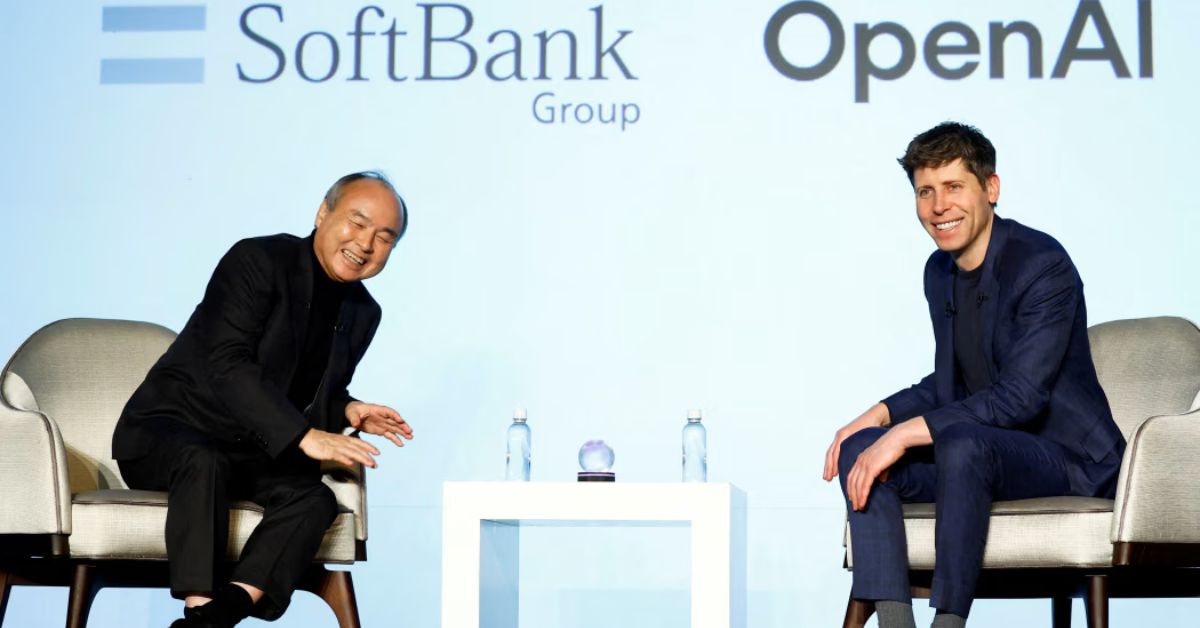

SoftBank’s latest quarterly earnings have placed its artificial intelligence strategy firmly back in the spotlight, following a significant valuation surge tied to one of its most closely watched holdings.
SoftBank OpenAI investment
The Japanese conglomerate reported a $4.2 billion valuation gain linked to its stake in OpenAI during the most recent fiscal quarter, helping return its flagship Vision Fund to profitability and reinforcing its aggressive push into artificial intelligence infrastructure.
SoftBank’s Return to Profitability
SoftBank Group reported a quarterly net profit after periods of volatility that had weighed on investor confidence. The earnings marked a notable reversal compared with prior losses tied to market downturns and declining technology valuations.
At the center of the turnaround was the appreciation of its OpenAI stake. The valuation increase provided a decisive boost to overall performance, offsetting pressure in other segments of its diversified investment portfolio.
For SoftBank, whose Vision Fund has experienced cycles of rapid gains and steep write-downs, the quarter represented more than just improved numbers. It signaled renewed momentum in a strategy increasingly focused on artificial intelligence as the next engine of global growth.
How the SoftBank OpenAI Investment Boosted Earnings
The $4.2 billion valuation uplift tied to the SoftBank OpenAI investment played a critical role in strengthening fiscal results. The Vision Fund recorded multi-billion-dollar gains during the reporting period, with OpenAI emerging as one of its most valuable assets.
SoftBank holds a substantial minority stake in the artificial intelligence developer. As investor interest in generative AI companies continues to rise, the valuation of OpenAI has climbed sharply, reflecting demand for large-scale AI models, enterprise tools, and cloud-based AI infrastructure.
Company executives described the investment as a long-term strategic commitment rather than a short-term trade. During the earnings briefing, leadership emphasized that artificial intelligence remains central to SoftBank’s long-term positioning.
While other portfolio holdings experienced mixed performance, the OpenAI valuation gain helped stabilize overall returns and strengthened the balance sheet.
Vision Fund’s Changing Fortunes
SoftBank’s Vision Fund has experienced dramatic swings since its launch. Early investments in technology startups produced headline-grabbing gains, but market corrections later resulted in significant write-downs.
This quarter’s rebound illustrates how concentrated exposure to high-growth AI assets can reshape performance metrics. The SoftBank OpenAI investment has now become one of the Vision Fund’s defining holdings.
The fund’s earlier struggles were tied to declining valuations across e-commerce, ride-hailing, and fintech startups. In contrast, artificial intelligence companies have attracted sustained capital inflows as enterprises seek automation, productivity tools, and advanced computing capabilities.
SoftBank’s management appears to be recalibrating its portfolio to lean more heavily into AI-centric businesses, signaling a shift from broad technology diversification to targeted sector concentration.
AI Strategy and Capital Reallocation
SoftBank’s leadership has repeatedly expressed confidence that artificial intelligence will define the next phase of technological and economic transformation. The company has repositioned significant portions of its capital to align with this thesis.
Asset sales and strategic divestments have freed liquidity for AI-oriented investments. Over recent quarters, SoftBank reduced exposure in certain telecommunications and semiconductor holdings to focus more intensely on artificial intelligence infrastructure and software platforms.
The SoftBank OpenAI investment reflects this broader capital reallocation strategy. Rather than maintaining a highly diversified technology portfolio, the group is concentrating resources in areas directly tied to AI model development, computing hardware, and supporting ecosystems.
This approach carries risk. Artificial intelligence companies often require substantial funding for research, data processing, and infrastructure expansion. However, SoftBank’s management believes the long-term upside outweighs short-term volatility.
Competitive Landscape in Generative AI
OpenAI operates in an increasingly competitive global environment. Technology giants and emerging AI startups are investing heavily in generative AI models capable of producing text, code, images, and advanced analytics.
Major competitors are expanding enterprise offerings, building proprietary large language models, and strengthening cloud partnerships. The race for dominance in AI platforms is accelerating, driven by corporate adoption and consumer demand.
Despite growing competition, OpenAI has continued to expand its enterprise integrations and developer ecosystem. Its AI tools are being deployed across industries ranging from finance and healthcare to software development and education.
For SoftBank, the strength of OpenAI’s market position is central to the long-term value of its stake. Sustained adoption and technological leadership will determine whether valuation gains translate into durable financial returns.
Semiconductor and Infrastructure Expansion
SoftBank’s AI ambitions extend beyond software investments. The company has increased its focus on semiconductor design and advanced computing infrastructure — critical components for powering AI workloads.
AI systems require vast processing power for model training and deployment. Recognizing this, SoftBank has invested in chip design and computing hardware companies that form the backbone of AI infrastructure.
By integrating hardware exposure with AI software investments, SoftBank aims to create a vertically aligned ecosystem capable of capturing value across multiple layers of the AI stack.
The SoftBank OpenAI investment fits within this broader strategy, representing the software and application layer, while semiconductor holdings support underlying computational capacity.
Market Reaction and Investor Sentiment
Following the earnings announcement, SoftBank shares experienced upward momentum, reflecting improved investor confidence. The return to profitability and the sizable valuation gain were seen as positive indicators of strategic direction.
However, analysts remain cautious. Some have noted that heavy reliance on a small number of AI holdings could amplify volatility if valuations shift.
Investor sentiment toward artificial intelligence remains broadly optimistic, but market conditions can change rapidly. Regulatory developments, competitive pressures, or slower-than-expected enterprise adoption could affect valuations.
SoftBank’s management has acknowledged these risks while reiterating confidence in the transformative potential of artificial intelligence technologies.
Regulatory Risks and Profitability Concerns
Artificial intelligence regulation is evolving globally. Governments are drafting frameworks to address data privacy, model transparency, and ethical considerations.
OpenAI, like many AI developers, operates in a space subject to increasing scrutiny. New compliance requirements could impact operational costs or deployment timelines.
Additionally, profitability remains a critical question. Many AI firms continue to invest heavily in research and infrastructure, prioritizing growth over short-term earnings.
While the SoftBank OpenAI investment has generated substantial valuation gains, long-term returns will depend on OpenAI’s ability to translate user growth into sustainable revenue streams.
SoftBank must balance optimism with disciplined financial oversight, particularly as AI investments demand significant capital.
Long-Term Strategic Outlook
SoftBank founder Masayoshi Son has frequently described artificial intelligence as a defining force for the coming decades. He has spoken about the potential for advanced AI systems to reshape industries and drive economic expansion.
A growing portion of SoftBank’s assets is now classified internally as AI-oriented investments. This signals a strategic pivot from diversified technology investing toward concentrated AI leadership.
The SoftBank OpenAI investment exemplifies that pivot. It represents both a financial stake in a high-growth company and a symbolic commitment to the AI revolution.
If OpenAI continues to expand enterprise partnerships, strengthen its product offerings, and navigate regulatory challenges effectively, the long-term upside could be significant.
Conversely, intensifying competition or shifting market conditions could moderate future valuation gains. SoftBank’s concentrated exposure makes the trajectory of OpenAI particularly consequential.
Broader Implications for the AI Economy
The quarter’s results underscore a broader trend: artificial intelligence is reshaping capital allocation patterns across global markets.
Institutional investors are directing significant funds toward AI-focused ventures. Infrastructure providers, chip manufacturers, cloud computing firms, and AI application developers are experiencing heightened demand.
SoftBank’s renewed profitability illustrates how early positioning in AI platforms can yield material financial benefits. The valuation surge tied to OpenAI reflects investor confidence in generative AI’s long-term commercial viability.
As enterprises integrate AI into core workflows, demand for advanced models and computational resources is expected to rise. This creates opportunities for investors positioned across the AI ecosystem.
Conclusion
The $4.2 billion valuation gain linked to the SoftBank OpenAI investment has strengthened SoftBank’s financial performance and reinforced its long-term AI strategy.
By doubling down on artificial intelligence infrastructure and software platforms, SoftBank is positioning itself at the center of a rapidly expanding technological transformation.
While risks remain — including regulatory oversight, competitive pressures, and profitability challenges — the latest results highlight the financial impact of concentrated AI exposure.
As global markets continue to evaluate the economic implications of generative AI, SoftBank’s strategy places it among the most prominent financial backers of this technological shift.