

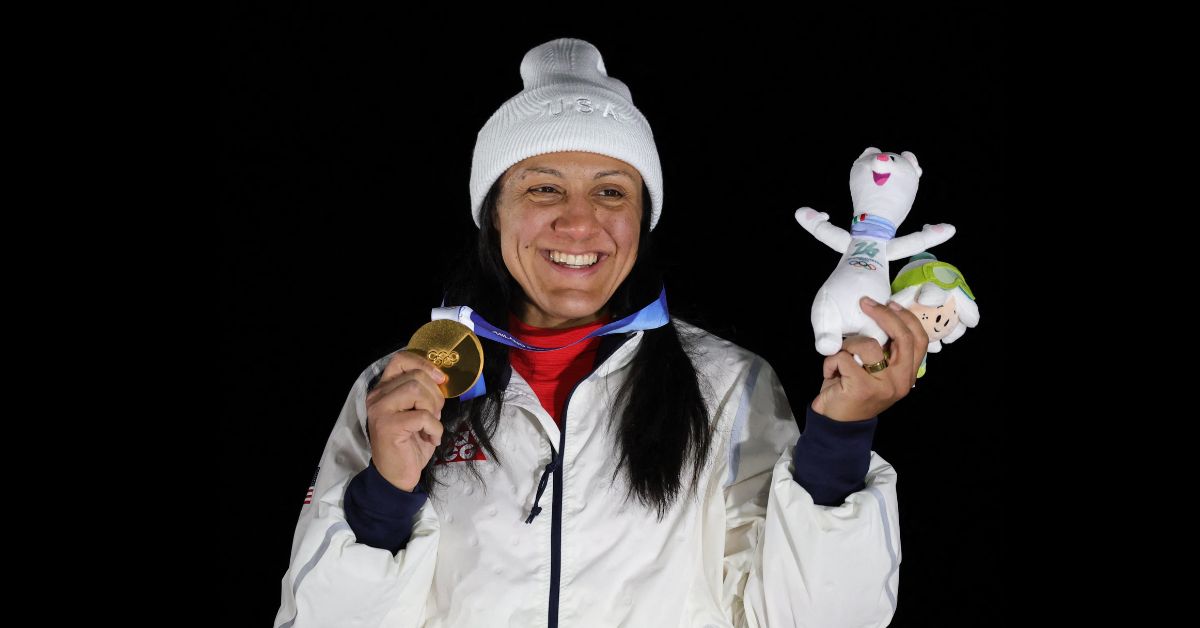

Elana Meyers Taylor delivered the performance of her career at the Milano Cortina Winter Games, capturing the Olympic gold medal in women’s monobob at age 41 and completing one of the most enduring pursuits in modern winter sports.
For more than a decade, Elana Meyers Taylor had stood among the most consistent medal contenders in Olympic bobsleigh. Silver and bronze medals filled her résumé, along with world championships and World Cup titles. Yet one achievement remained just out of reach. On a cold evening in Italy, that pursuit finally ended when Elana Meyers Taylor crossed the finish line with a combined time that none of her rivals could match.
The victory instantly elevated Elana Meyers Taylor into rare territory in U.S. Olympic history. At 41, she became the oldest American woman to win a Winter Olympic gold medal, a milestone that carries weight beyond the sliding track. The moment was not defined by surprise dominance but by patient, methodical execution built over five Olympic cycles.
A Long Journey to the Top of the Podium
The road to Olympic gold for Elana Meyers Taylor began in Vancouver in 2010. She entered that Games as a promising competitor and left with a silver medal. Sochi 2014 brought another silver. PyeongChang 2018 and Beijing 2022 added bronze and silver to her collection. Each Games added to her reputation for resilience, but each also reinforced the narrative that gold had eluded her.
That narrative followed Elana Meyers Taylor into Milano Cortina. Analysts questioned whether age might limit her explosive start times. Younger athletes were entering the discipline with refined training programs and fresh legs. Yet those who understood the sport knew that monobob rewards more than raw power. It demands track awareness, steering precision, and composure in corners where milliseconds decide medals.
From the first run, Elana Meyers Taylor appeared locked into rhythm. Her push off the start line was controlled and powerful, and her steering lines through the midsection curves were notably clean. Observers pointed out that she minimized small steering corrections that often cost precious time. By the third run, she had built a margin that placed pressure squarely on her closest competitors.
Mastering the Monobob Discipline
The women’s monobob event places athletes alone in the sled, eliminating the coordinated push of a two-person team. Every responsibility — the sprint start, sled load, steering, and weight balance — rests with a single athlete. That format has transformed the sport into a test of individual control.
For Elana Meyers Taylor, monobob provided a setting where experience carried measurable value. Years of sliding at world championships had sharpened her ability to anticipate track transitions and maintain speed through high-pressure turns. While younger competitors attacked the course aggressively, Elana Meyers Taylor relied on strategic smoothness.
Her combined time over four runs reflected not a single dominant heat but consistent excellence. She never recorded the absolute fastest split in every section, yet she avoided the small errors that accumulate across a competition. In monobob, that steadiness can outweigh momentary bursts of speed.
Age and Athletic Longevity
The gold medal win by Elana Meyers Taylor has fueled renewed conversation about longevity in elite sport. Winter disciplines impose extraordinary physical demands, from explosive starts to the G-forces sustained in tight curves. Historically, athletes in sliding sports peaked in their late twenties or early thirties.
Advances in strength training, injury recovery, and performance analytics have gradually shifted that timeline. Elana Meyers Taylor has credited disciplined preparation and recovery protocols for extending her competitive window. Coaches noted that her sprint metrics remained competitive with athletes nearly a decade younger.
Still, the accomplishment cannot be reduced to sports science alone. The discipline required to maintain Olympic-level conditioning over five Games is rare. Elana Meyers Taylor approached each Olympic cycle with renewed focus, adapting training blocks and refining technique rather than relying solely on physical dominance.
A Career Defined by Resilience
Before this gold medal, Elana Meyers Taylor had already established herself as one of the most decorated athletes in American Winter Olympic history. Her medal count placed her alongside some of the sport’s most celebrated names. Yet gold remained the missing piece of her Olympic story.
The pressure of chasing that milestone intensified with each Games. In Beijing, she narrowly missed the top podium position in monobob, finishing with silver. That result could have signaled the closing chapter of her Olympic journey. Instead, it became fuel.
In Milano Cortina, Elana Meyers Taylor entered competition with a calmer perspective. Rather than framing the race as a final chance, she described it as an opportunity to execute four clean runs. That mental shift proved decisive. Teammates later observed that Elana Meyers Taylor appeared unusually relaxed in the start house, focused only on process.
Technical Breakdown of the Winning Runs
Competition in monobob unfolds over four heats, with cumulative time determining the champion. The margin separating first and second place often measures in hundredths of a second. Precision matters at every stage.
During the third run, Elana Meyers Taylor produced her most significant advantage. Her start time ranked among the best in the field, and she navigated a notoriously difficult transition curve with minimal drift. Data analysts later noted that she gained critical momentum exiting the lower straight, maintaining speed where others lost fractions.
Her final run was not the fastest of the night, but it was steady. Knowing her earlier margin provided a buffer, Elana Meyers Taylor chose clean steering lines over high-risk aggression. That discipline secured her place atop the standings.
Impact on U.S. Bobsleigh
The victory by Elana Meyers Taylor strengthens the profile of American bobsleigh on the global stage. Germany has traditionally dominated sliding sports, while Canada and other European nations have frequently controlled podium positions. An Olympic gold from Elana Meyers Taylor reaffirms the United States as a force in the discipline.
Younger American athletes have pointed to Elana Meyers Taylor as a model of sustained excellence. Her presence in training camps and world championships has shaped team culture. Coaches describe her as both competitor and mentor, balancing personal ambition with collective growth.
The ripple effect of this win could influence recruitment and funding in the sport. Visibility matters, and the image of Elana Meyers Taylor standing on the podium at 41 challenges conventional narratives about the limits of athletic careers.
Representation and Broader Significance
Beyond statistics, Elana Meyers Taylor has carried symbolic importance in winter sport. As one of the most decorated Black athletes in Winter Olympic history, she has helped broaden representation in disciplines historically lacking diversity.
Her gold medal adds another layer to that legacy. For young athletes watching from communities where winter sports are less accessible, Elana Meyers Taylor represents possibility. The visibility of her achievement may inspire broader participation in sliding events.
Her journey underscores that pathways into winter sport need not follow a single trajectory. Elana Meyers Taylor began her athletic career in softball before transitioning to bobsleigh, demonstrating that skill transfer and adaptability can open unexpected doors.
Rivalries and the Competitive Landscape
The Milano Cortina final unfolded against a backdrop of intense international rivalry. German and Canadian competitors entered as favorites, carrying recent World Cup victories into the Olympic arena. Each heat tightened the standings.
By the fourth run, all eyes turned to whether Elana Meyers Taylor could hold her lead. As her final time posted atop the leaderboard, anticipation shifted to her closest rival’s descent. When that challenger crossed the line just short, the realization settled in: Elana Meyers Taylor had secured gold.
The exchange of congratulations in the finish area reflected mutual respect. Rival athletes acknowledged the significance of the moment, recognizing that Elana Meyers Taylor had earned her title through cumulative mastery rather than a single dramatic run.
Completing the Medal Set
For years, commentators framed the Olympic career of Elana Meyers Taylor as unfinished without gold. That framing added pressure but also sharpened purpose. With six Olympic medals now in her collection, including this gold, Elana Meyers Taylor has achieved a complete set.
The completion of that arc resonates emotionally. It transforms her Olympic narrative from near-misses to fulfillment. Observers described visible relief in her expression during the medal ceremony, as if years of pursuit had lifted in a single moment.
Standing atop the podium, Elana Meyers Taylor embodied both triumph and closure. The medal around her neck represented not just victory in one race but validation of perseverance across sixteen years.
What Comes Next
Whether this marks the final Olympic appearance for Elana Meyers Taylor remains uncertain. Retirement questions inevitably follow athletes beyond 40, particularly in physically demanding sports. Yet those who know her caution against assuming immediate departure.
If this gold medal signals the closing chapter, it is a fitting conclusion. If not, Elana Meyers Taylor has already proven that timelines in elite sport are evolving. Either path leaves her legacy intact.
A Legacy Secured
The story of Elana Meyers Taylor at the Milano Cortina Winter Games will endure as one of perseverance and calculated excellence. It reflects the maturation of an athlete who refined technique year after year, adapted to changing competition, and ultimately achieved the sport’s highest honor.
In a Games filled with emerging stars, the victory by Elana Meyers Taylor stands apart because of its patience. It reminds the sporting world that progress is not always linear and that excellence can deepen with experience.
As the Olympic flame dims in Italy, one image lingers: Elana Meyers Taylor holding her gold medal, the culmination of years spent chasing a moment that finally arrived.
Her name will now be permanently etched into Winter Olympic history not only as a consistent contender, but as a champion whose persistence redefined what is possible in elite competition.