

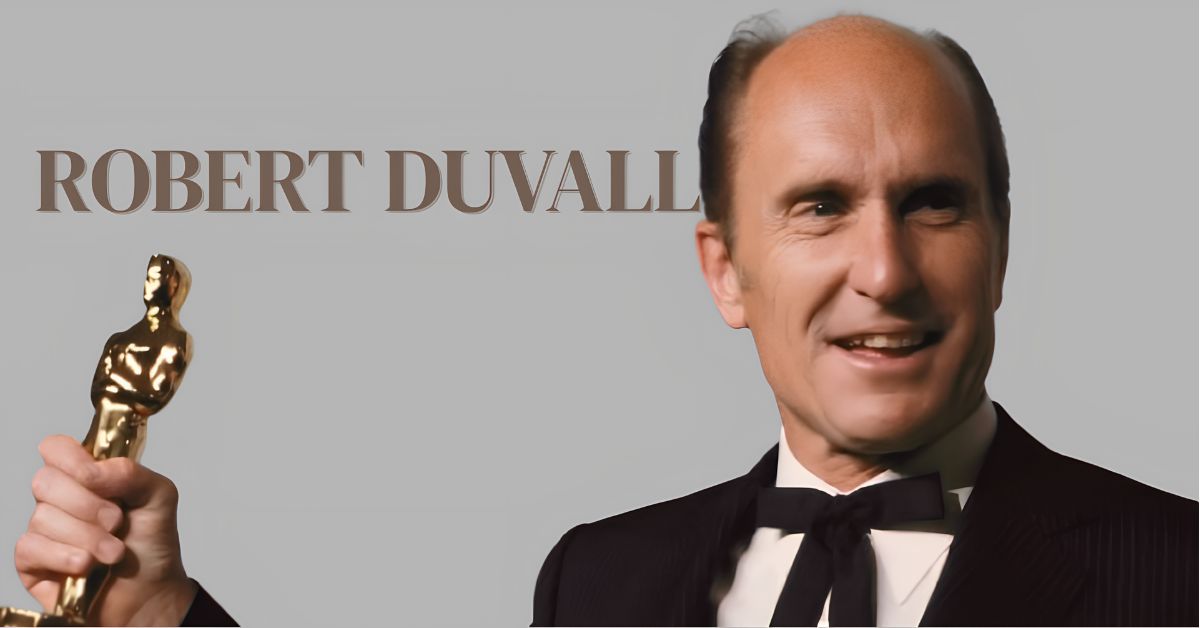

Robert Duvall has died at the age of 95, closing the chapter on one of the most disciplined and respected careers in American cinema. The Academy Award–winning actor passed away peacefully at his Virginia home, according to a statement from his family. His death marks the end of more than sixty years of performances that reshaped modern character acting.
The passing of Robert Duvall represents more than the loss of a celebrated performer. It signals the departure of a generation of actors who valued authenticity over spectacle. Throughout his career, he built authority not through flamboyance, but through restraint and emotional precision.
Early Life and Military Foundations of Robert Duvall
Born on January 5, 1931, in San Diego, California, Robert Duvall grew up in a military household. His father served as a Navy admiral, and the family relocated frequently during his childhood. That structured upbringing later influenced many of the disciplined figures he portrayed on screen.
After completing his education at Principia College, he served in the United States Army during the Korean War era. Although he did not see combat, the discipline of military service left a lasting imprint on his demeanor and work ethic.
Following his service, he moved to New York City to pursue acting. He studied at the Neighborhood Playhouse under Sanford Meisner, training alongside future stars such as Dustin Hoffman and Gene Hackman. Those early years shaped his lifelong commitment to realism in performance.
Breakthrough in The Godfather
The turning point came in 1972 with his portrayal of Tom Hagen in The Godfather. The role brought Robert Duvall into the mainstream and earned him an Academy Award nomination. His performance stood out for its calm intensity, offering balance amid the film’s volatile characters.
He reprised the role in The Godfather Part II, further solidifying his place within one of cinema’s most influential franchises. The character became synonymous with quiet authority and measured judgment.
Film historians frequently cite his performance in the series as an example of understated power in acting.
A Defining Role in Apocalypse Now
In 1979, he collaborated again with director Francis Ford Coppola in Apocalypse Now. His portrayal of Lt. Col. Bill Kilgore produced one of the most memorable lines in film history.
The performance combined charisma with unsettling bravado. Though not the film’s central figure, he dominated his scenes through composure and presence rather than excess.
That role demonstrated how Robert Duvall could embody authority while revealing subtle psychological complexity.
Oscar Glory in Tender Mercies
The early 1980s brought a career milestone with Tender Mercies. In the film, Robert Duvall portrayed a troubled country singer seeking redemption. The performance earned him the Academy Award for Best Actor in 1984.
Unlike his earlier roles rooted in authority, this portrayal emphasized vulnerability. He performed his own songs, adding authenticity and emotional weight to the story.
Critics praised the restraint of the performance, noting that transformation unfolded through quiet gestures rather than dramatic speeches.
Versatility Across Decades
Throughout the 1980s and 1990s, he appeared in films such as The Great Santini, The Natural, and A Civil Action. Each role reinforced his range and credibility.
He also directed and starred in The Apostle, a personal project exploring faith and morality. The film received critical acclaim and further demonstrated his depth as a storyteller.
Even in later years, his craft remained formidable. A supporting role in The Judge earned another Academy Award nomination, underscoring his enduring relevance.
Influence on Modern Acting
The influence of Robert Duvall extended beyond awards and accolades. He became known for meticulous preparation and disciplined focus on set.
Directors valued his steadiness during complex productions. Younger actors often cited him as an example of longevity achieved through craft rather than publicity.
Film scholars point to his work as central to the shift toward realism in 1970s American cinema. His performances aligned with an era that favored psychological depth over theatrical excess.
Industry Reaction to His Death
Following confirmation that Robert Duvall had died, tributes emerged from across the film community. Colleagues described him as professional, humble, and unwavering in his standards.
Many highlighted his ability to elevate scenes without dominating them unnecessarily. That balance became a hallmark of his performances.
Organizations across Hollywood acknowledged the cultural significance of his body of work.
A Private Life Away From Spotlight
Despite global recognition, he preferred a quieter existence in Virginia. Married to Luciana Pedraza since 2005, he maintained distance from Hollywood’s constant glare.
Friends often remarked that he valued privacy over publicity. That approach reflected the same restraint visible in his acting style.
The Enduring Legacy
The phrase announcing that Robert Duvall has died at 95 carries historical weight. It marks the end of an era defined by disciplined storytelling and character-driven narratives.
With seven Academy Award nominations, multiple Golden Globe honors, and more than sixty years of contributions to cinema, his legacy remains secure.
Audiences continue to revisit his performances in The Godfather, Apocalypse Now, and Tender Mercies, ensuring that his influence endures.
The death of Robert Duvall closes a remarkable chapter in American film history. Yet the authenticity he brought to every role ensures that his work will continue to resonate for generations.