

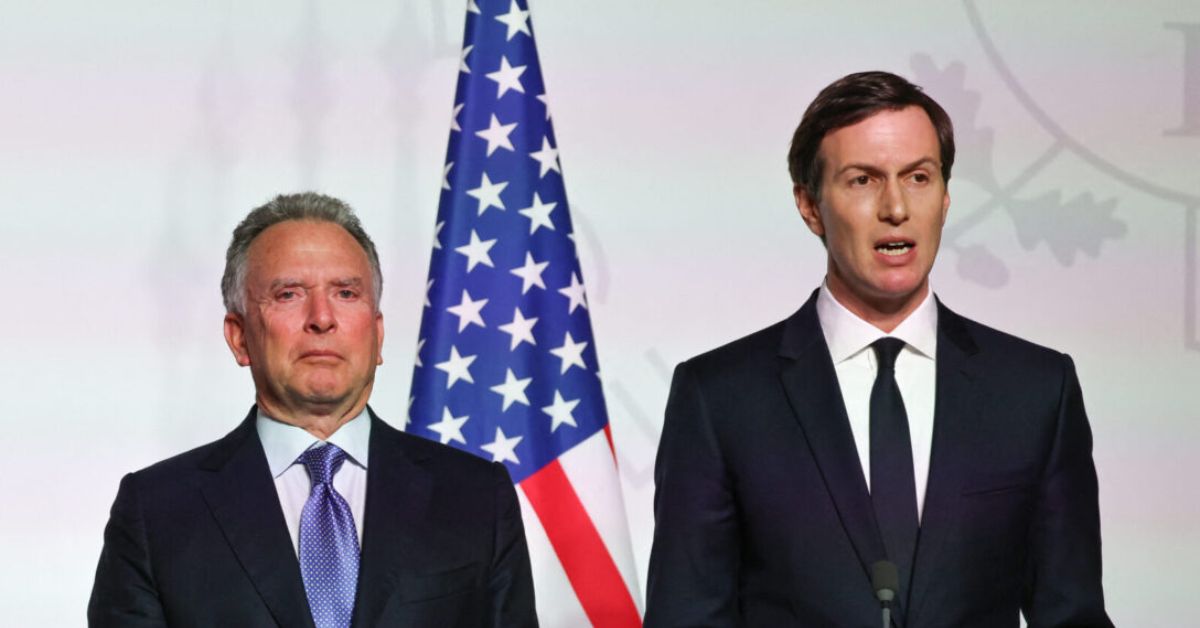

Witkoff and Kushner have moved into one of the most sensitive diplomatic landscapes of 2026, navigating parallel negotiations that span Gaza, Ukraine and Iran. Their involvement signals a renewed effort by Washington to test whether unconventional channels can deliver progress where traditional diplomacy has stalled.
Global markets, military planners and humanitarian agencies are watching closely. The stakes are high, not only for the regions involved but for broader geopolitical stability.
Witkoff and Kushner now find themselves operating across three flashpoints simultaneously, an unusually wide portfolio for any diplomatic team. The scale of the effort reflects both urgency and political calculation.
Witkoff and Kushner at Center of Three Conflicts
Witkoff and Kushner are at the center of a high-pressure diplomatic cycle that stretches from the Middle East to Eastern Europe. Unlike career diplomats who move through established bureaucratic structures, their engagement reflects a more direct line to executive authority.
Supporters argue that this proximity allows for rapid decision-making. Critics caution that speed can complicate delicate negotiations built on incremental trust.
In private meetings and back-channel discussions, Witkoff and Kushner have reportedly focused on identifying narrow areas of overlap among adversaries. The objective is not sweeping peace accords in the immediate term but measurable stabilization.
The complexity of juggling three conflicts at once cannot be overstated. Each arena carries distinct political histories, security calculations and domestic pressures. Yet the shared thread is escalation risk.
Gaza: Managing a Fragile Pause
In Gaza, ceasefire arrangements remain precarious. Hostilities have paused in cycles before, only to resume amid mistrust and competing narratives.
Witkoff and Kushner have been associated with efforts to maintain communication between regional stakeholders and international mediators. The immediate focus has centered on humanitarian corridors, detainee exchanges and preventing localized flare-ups from widening.
The deeper issue remains governance and security architecture. Gaza’s political landscape is shaped by longstanding tensions that extend beyond a single ceasefire framework.
While short-term de-escalation has reduced immediate casualties, sustainable calm depends on enforceable guarantees. Analysts note that any stabilization plan must address reconstruction, monitoring mechanisms and broader regional buy-in.
In this environment, Witkoff and Kushner are attempting to balance urgency with caution. A miscalculation could collapse the fragile pause. A breakthrough, even incremental, could shift regional momentum.
Ukraine: Dialogue in the Shadow of War
The war in Ukraine continues to define European security. Battlefield developments and diplomatic signaling often move in parallel, creating an environment where negotiation carries strategic implications.
Witkoff and Kushner have reportedly explored indirect dialogue channels aimed at lowering escalation risks. The challenge lies in reconciling sharply opposing objectives. Moscow maintains security-driven territorial arguments, while Kyiv emphasizes sovereignty and territorial integrity.
Diplomatic engagement in wartime is inherently delicate. Any perception of imbalance can influence both domestic politics and frontline morale.
Observers say that Witkoff and Kushner are working to identify confidence-building measures rather than sweeping concessions. These could include localized humanitarian pauses or limited agreements tied to infrastructure security.
Yet skepticism remains strong. Past efforts to negotiate during active conflict have often faltered under shifting battlefield realities.
Even so, incremental dialogue can create openings. The question is whether sustained communication can translate into structural compromise.
Iran: Nuclear Diplomacy Revisited
Iran represents a different dimension of geopolitical tension. Nuclear oversight, sanctions frameworks and regional alliances converge in a policy arena shaped by years of mistrust.
Witkoff and Kushner have engaged in exploratory discussions focused on transparency and verification concepts. While formal frameworks remain complex, even limited progress could reduce escalation risks.
The Iranian leadership has signaled conditional openness to renewed dialogue. However, domestic political dynamics in both Tehran and Washington complicate long-term commitments.
The delicate balance involves pressure and incentive. Excessive rigidity may close doors. Premature compromise may face domestic backlash.
In this environment, Witkoff and Kushner are navigating a narrow path between deterrence and engagement. The diplomatic calculus is as much about preventing miscalculation as it is about achieving headline agreements.
Strategic Risks and Political Calculations
Operating across three conflicts simultaneously introduces substantial risk. Diplomatic resources are finite. Political attention is divided.
Witkoff and Kushner must assess how developments in one region affect negotiations in another. Escalation in Gaza, for example, could influence broader Middle East calculations tied to Iran.
Critics question whether a business-style negotiation approach can address deeply rooted geopolitical grievances. Supporters argue that unconventional frameworks may bypass institutional inertia.
The reality likely lies somewhere in between. Peace processes rarely move in straight lines.
For Witkoff and Kushner, credibility will depend on measurable outcomes rather than rhetoric. Even incremental agreements could alter diplomatic trajectories.
Domestic Implications in Washington
Foreign policy rarely unfolds in isolation from domestic politics. Public perception of diplomatic success or failure can shape broader narratives.
Witkoff and Kushner operate within a political environment that values tangible results. Statements from leadership emphasize negotiation as a cornerstone of strategy.
However, foreign conflicts are influenced primarily by regional dynamics rather than election cycles. Timelines often stretch beyond political expectations.
As a result, Witkoff and Kushner face dual pressures: demonstrating progress while managing unpredictable developments abroad.
Broader Geopolitical Impact
Each of the three regions involved carries distinct global consequences. Gaza affects Middle East stability and humanitarian conditions. Ukraine shapes European security architecture. Iran influences nuclear non-proliferation and regional balance.
Witkoff and Kushner are attempting to maintain simultaneous engagement across these arenas without allowing setbacks in one to derail talks in another.
This balancing act requires coordination with allied governments, intelligence assessments and economic stakeholders.
Financial markets, in particular, respond quickly to diplomatic signals. A credible breakthrough can calm volatility. Renewed escalation can trigger rapid shifts.
The role of Witkoff and Kushner, therefore, extends beyond negotiation rooms. Their engagement intersects with global trade, energy flows and defense planning.
Long-Term Global Outlook
Peace efforts often unfold gradually. Initial agreements may focus on humanitarian stabilization before addressing structural grievances.
Witkoff and Kushner appear to be prioritizing dialogue continuity over dramatic announcements. Maintaining communication lines can prevent crises from spiraling.
Yet durability depends on regional actors’ willingness to compromise. External facilitation cannot substitute for internal political consensus.
In the coming months, observers will assess whether incremental steps evolve into broader frameworks. Success may not resemble a single grand accord but a series of layered understandings.
Witkoff and Kushner face an environment defined by uncertainty, competing narratives and fragile trust.
If stabilization efforts hold, their involvement may be viewed as a turning point in 2026 diplomacy. If negotiations falter, critics will question whether the strategy overreached.
For now, Witkoff and Kushner remain central figures in a diplomatic experiment unfolding across three volatile regions.
The outcome will depend not only on negotiation tactics but on the willingness of adversaries to envision a less confrontational future.
In a world where geopolitical tensions increasingly intersect, the efforts of Witkoff and Kushner represent both opportunity and risk a critical test of whether dialogue can outpace escalation in 2026.