

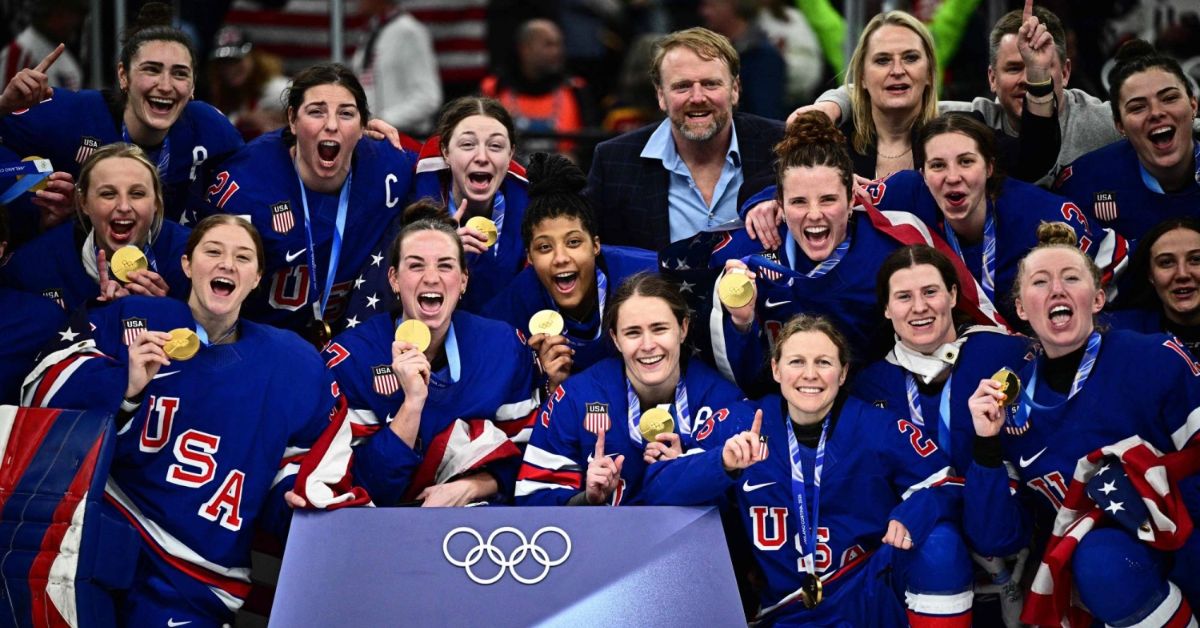

The gold medal game at the Milan Cortina Winter Games delivered a finish that will be remembered for generations. In a rivalry built on intensity and precision, US women’s hockey rose again on the Olympic stage, defeating Canada in overtime and reclaiming its place at the top of international competition.
US women’s hockey stood at the center of global attention as the puck dropped in one of the most anticipated finals of the 2026 Winter Games.
A Rivalry That Defines Olympic Ice Hockey
For nearly three decades, olympic women’s hockey has revolved around two nations. Every tournament begins with contenders from across Europe, Asia and North America, yet the championship conversation consistently returns to the same matchup. The United States and Canada have built a rivalry grounded in speed, structure and emotional resilience.
The 2026 final was no exception. US women’s hockey entered the game unbeaten in tournament play, while Canada arrived with its own record of disciplined defensive performances. The margin between these programs has always been narrow. Championships are decided by small details: a defensive gap closed at the right moment, a shot redirected at the crease, or a turnover capitalized on in transition.
What distinguishes this rivalry is its consistency at the highest level. From Nagano to Beijing, Olympic finals have often featured these two flags raised above the rink. Each generation inherits the responsibility of maintaining standards established by those who came before. In Milan Cortina, US women’s hockey carried that legacy forward under immense pressure.
The buildup to the game reflected the magnitude of the occasion. Tickets sold out quickly. Television audiences surged across North America. Analysts debated line combinations, special teams efficiency and goaltending matchups. Yet once the puck hit the ice, the narrative narrowed to execution.
How US Women’s Hockey Reached the Final
The path to gold rarely unfolds smoothly, even for dominant programs. Throughout the preliminary round, US women’s hockey displayed a blend of offensive creativity and defensive stability that separated it from much of the field.
In group play, the team controlled possession for extended stretches. Breakouts were clean. Neutral-zone transitions were efficient. The forward lines generated layered pressure, forcing opponents into hurried clears and blocked shooting lanes. Several games ended in multi-goal victories, reinforcing the perception that US women’s hockey had arrived in Italy with championship intent.
Still, the semifinal round posed a critical test. Facing a determined opponent eager to disrupt structure, the United States relied on patience rather than risk. Defensive pairings maintained disciplined spacing. The goaltender delivered timely saves to preserve momentum. A late third-period goal secured passage to the final, sending US women’s hockey back to a familiar stage.
What stood out most during the tournament run was composure. Players spoke about focusing on systems rather than headlines. Coaches emphasized recovery, video analysis and repetition in practice sessions. By the time the championship game arrived, the roster appeared prepared for every possible scenario.
Championship Game: Tension, Tactics and Turning Points
The gold medal contest opened cautiously. Both teams respected each other’s speed through the neutral zone, reducing space and limiting high-risk plays. The first period featured structured forechecking and deliberate puck movement along the boards.
Canada struck first in the second period, capitalizing on a brief defensive lapse. For the first time in the tournament, US women’s hockey found itself trailing in a meaningful moment. The bench response was measured rather than frantic. Players leaned on communication and line adjustments rather than emotion.
Throughout the middle frame, US women’s hockey increased shot volume. Screens in front of the net became more aggressive. Defensemen stepped deeper into the offensive zone to extend cycles. Canada’s goaltender absorbed repeated attempts, preserving the lead and heightening tension.
The third period delivered the emotional shift. As minutes ticked away, urgency intensified. With under two minutes remaining, US women’s hockey pulled its goalie for an extra attacker. The offensive zone filled with bodies. A low shot from the blue line deflected through traffic and into the net, tying the game and forcing overtime.
The equalizer was not a product of chance. It reflected sustained pressure, layered positioning and trust in preparation. The arena erupted. Momentum swung.
Overtime and the Defining Moment
Three-on-three overtime introduced open ice and opportunity. Both teams traded rushes during the opening shifts. Each possession carried the weight of history.
US women’s hockey maintained control along the half boards before cycling back to the point. A precise pass found a defender stepping into space. The shot was clean, direct and decisive. The puck crossed the line, ending the contest instantly.
Helmets flew into the air. Sticks scattered across the ice. The bench emptied in celebration as US women’s hockey secured Olympic gold in dramatic fashion.
The final score captured the margin. The celebration captured the emotion. For veterans playing their final Olympic tournament, the moment symbolized closure and accomplishment. For younger athletes, it marked the beginning of their own chapter within the program.
Leadership, Experience and Locker Room Culture
Championships are rarely defined solely by goals. They are shaped in training camps, film sessions and quiet conversations between shifts.
Veteran leaders within US women’s hockey guided the group through moments of doubt and fatigue. They spoke about maintaining rhythm, staying connected and trusting the system. Coaches credited communication on the bench as a decisive factor in the comeback.
Beyond strategy, culture distinguished the roster. Players described an environment rooted in accountability and respect. Each line understood its responsibility. Each defensive pairing recognized the importance of spacing and support.
During intermissions, messages focused on clarity rather than urgency. Adjustments were subtle: shift timing, forecheck pressure, and neutral-zone coverage tweaks. Those refinements accumulated into the third-period surge that changed the game’s trajectory.
US women’s hockey has built a reputation for resilience in Olympic settings. That resilience surfaced again in Milan Cortina, transforming a one-goal deficit into an unforgettable victory.
What This Means for the Future of US Women’s Hockey
Olympic cycles operate in four-year arcs, yet their influence stretches further. With the 2026 title secured, attention inevitably shifts to the next generation.
Several veterans are expected to step away from international competition. Their departure opens opportunities for emerging players from collegiate and developmental programs. The pipeline supporting US women’s hockey has expanded in recent years, producing deeper rosters and heightened competition for roster spots.
The 2026 triumph reinforces belief within youth programs across the country. Participation rates have risen steadily, and the visibility of Olympic success accelerates that growth. Young athletes watched the overtime winner and saw possibility.
Administrators within US women’s hockey emphasize long-term investment in coaching, facilities and grassroots development. The goal extends beyond repeating championships. It centers on sustaining excellence across decades.
The 2026 gold medal offers both validation and motivation. It validates the current structure. It motivates the next generation to maintain the standard.
The Global Impact of the 2026 Victory
While the championship centered on North America’s most storied rivalry, the broader tournament reflected international growth. European programs narrowed scoring margins in early rounds. Asian federations introduced younger, faster lineups. Competitive balance improved measurably.
Yet in the final, US women’s hockey and Canada once again defined the benchmark.
Global viewership numbers underscored the sport’s expanding appeal. Broadcasters reported strong ratings across multiple time zones. Social media engagement surged in the hours following the overtime goal. The spectacle of US women’s hockey reclaiming gold resonated well beyond the rink.
International observers note that repeated high-quality finals between these programs elevate standards worldwide. Teams study their systems, conditioning programs and development models. The ripple effect extends to domestic leagues and youth academies.
In that sense, the 2026 championship transcends a single result. It influences how the sport evolves globally.
The Emotional Weight of the Moment
Athletes often describe Olympic victories as surreal. The journey spans years of preparation, sacrifice and uncertainty.
For members of US women’s hockey, Milan Cortina represented both culmination and redemption. After falling short in the previous Olympic cycle, the desire to return to the podium intensified. Training blocks were longer. Recovery protocols were refined. Every decision pointed toward this stage.
The final buzzer confirmed that effort.
Players embraced at center ice. Some skated quietly toward the boards, absorbing the crowd’s reaction. Others lifted their sticks toward family members in the stands. The American flag draped across shoulders during the medal ceremony carried symbolic weight.
Moments later, US women’s hockey stood atop the podium, gold medals resting against jerseys damp from overtime exertion. The anthem echoed through the arena. For many, it marked the fulfillment of childhood aspirations.
A Lasting Legacy Beyond the Scoreboard
History often compresses games into statistics. A 2-1 overtime victory. A championship reclaimed. Yet behind those numbers lies a deeper narrative.
US women’s hockey demonstrated that preparation, structure and composure can withstand pressure at the highest level. The 2026 gold medal adds another chapter to a legacy defined by consistency and courage.
Future tournaments will introduce new faces, new systems and new rivalries. But the image of US women’s hockey celebrating under the lights of Milan Cortina will endure.
As the Winter Games concluded, the conversation shifted from what might happen to what had already occurred. US women’s hockey had delivered one of the defining performances of the 2026 Olympics.
The story will be retold in locker rooms, youth practices and living rooms across the country. It will inspire the next generation to lace skates and imagine their own Olympic moment.
And long after the medals are stored and the ice resurfaced, the memory of US women’s hockey claiming gold in overtime will remain etched in Olympic history.