

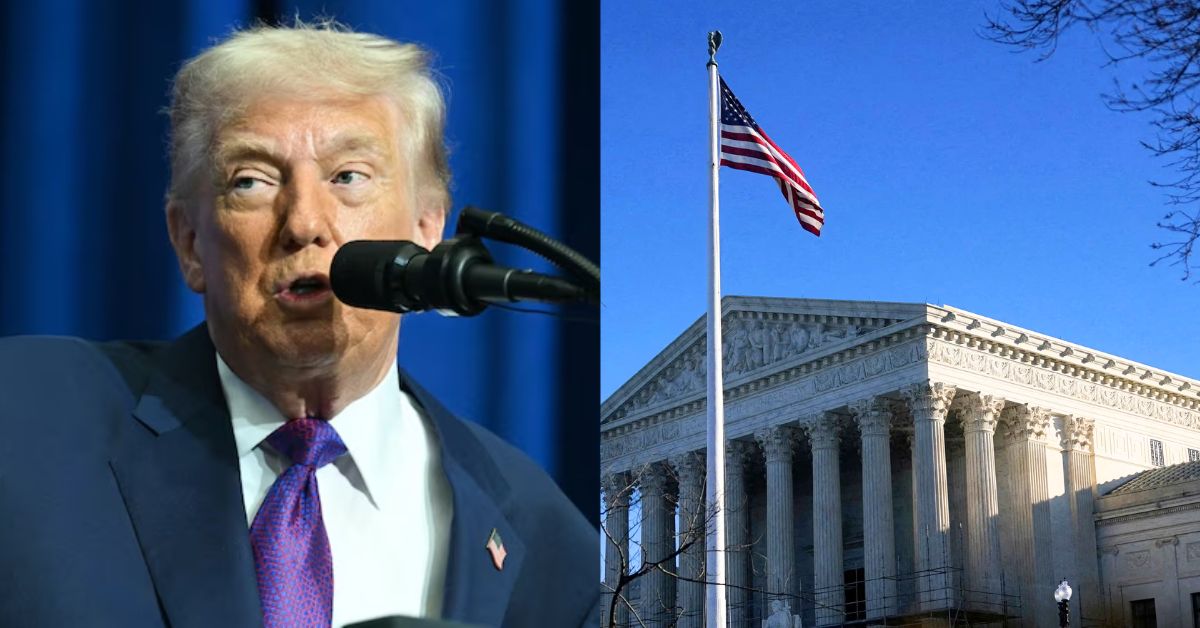

The Trump Supreme Court tariffs ruling has sent shockwaves through Washington and global financial markets after a decisive 6-3 decision sharply limited the use of emergency powers to impose sweeping trade tariffs.
In a landmark opinion released Tuesday morning, the United States Supreme Court concluded that a decades-old emergency statute does not authorize broad, worldwide tariffs without explicit congressional approval. The ruling reshapes the legal boundaries of executive authority and reopens a fundamental constitutional debate about who controls America’s trade policy.
The Trump Supreme Court tariffs ruling immediately reverberated across Capitol Hill, the White House, and international trade capitals, marking one of the most consequential judicial interventions in economic policy in decades.
Background of the Dispute
The origins of the Trump Supreme Court tariffs ruling trace back to a legal challenge over the use of emergency powers under a 1977 federal statute. That law, originally designed to address national security and international crises, grants presidents limited authority to respond quickly during declared emergencies.
In recent years, tariffs became a central tool of trade strategy. The administration argued that persistent trade deficits and strategic vulnerabilities constituted a national emergency under the statute. Critics countered that imposing sweeping global tariffs amounted to taxation — a power reserved for Congress under Article I of the Constitution.
Lower courts offered conflicting interpretations, setting the stage for the Supreme Court to intervene. By agreeing to hear the case, the justices signaled that the dispute had significant constitutional implications beyond trade.
The Trump Supreme Court tariffs ruling ultimately focused on statutory interpretation and separation of powers rather than partisan politics, though its political ramifications are undeniable.
Legal Foundations Behind the Trump Supreme Court Tariffs Ruling
At the heart of the Trump Supreme Court tariffs ruling lies a core constitutional principle: Congress holds primary authority over taxation and regulation of commerce with foreign nations.
While Congress has delegated certain trade authorities to the executive branch, the Court examined whether the 1977 emergency statute clearly authorized sweeping, across-the-board tariffs. The majority concluded that it did not.
The opinion emphasized that emergency powers must be narrowly interpreted when they intersect with Congress’s core constitutional responsibilities. The Trump Supreme Court tariffs ruling therefore restricts future administrations from relying on vague emergency declarations to enact broad economic measures without legislative backing.
The 6-3 Majority Opinion Explained
In a 6-3 decision, the Court ruled that the statute’s language was not intended to grant blanket authority for global tariff programs.
Writing for the majority, the chief justice stated that while presidents must retain flexibility to respond to crises, such flexibility does not extend to unilateral restructuring of national trade policy. The Trump Supreme Court tariffs ruling draws a sharp distinction between targeted emergency responses and sweeping economic policy shifts.
The majority opinion stressed that Congress must explicitly authorize large-scale tariff regimes. Without clear legislative language, executive action cannot override constitutional limits.
The Trump Supreme Court tariffs ruling therefore reinforces the separation of powers framework that underpins American governance.
The Dissenting Argument
The three dissenting justices took a different view. They argued that economic threats can evolve rapidly and that the executive branch requires agility to respond effectively.
According to the dissent, courts should defer to presidential determinations during declared national emergencies unless Congress explicitly restricts such action. They warned that the Trump Supreme Court tariffs ruling could weaken the government’s ability to act swiftly in future crises.
The dissenting opinion emphasized historical precedent, noting that presidents from both parties have exercised broad trade authority during periods of economic tension.
Despite these arguments, the majority prevailed, establishing a new legal benchmark for trade authority.
Immediate Political Reaction
The political response to the Trump Supreme Court tariffs ruling was swift and divided.
Supporters of the decision praised it as a victory for constitutional order. Lawmakers who had challenged the tariff measures described the ruling as a reaffirmation of congressional authority.
Critics, however, argued that the decision hampers the executive branch’s ability to protect domestic industries. Within hours of the ruling, officials signaled they would explore alternative legal pathways to pursue trade objectives.
The Trump Supreme Court tariffs ruling thus intensified an already heated debate over economic sovereignty and presidential power.
Economic and Market Impact
Financial markets reacted cautiously to the Trump Supreme Court tariffs ruling.
Equity indices experienced early volatility as investors assessed potential changes to trade strategy. Currency markets reflected uncertainty about future tariff stability. Manufacturing and export sectors monitored developments closely.
Economists note that tariffs can affect consumer prices, supply chains, and corporate investment decisions. The Trump Supreme Court tariffs ruling introduces new uncertainty regarding how future tariff programs will be structured and authorized.
While some analysts predict greater legislative involvement may bring stability, others caution that congressional negotiations could slow policy responses.
Constitutional Implications
Beyond economics, the Trump Supreme Court tariffs ruling carries deep constitutional significance.
The ruling reinforces that emergency powers are not unlimited. Courts retain authority to review executive interpretations of statutes that intersect with congressional powers.
Legal scholars say the decision may influence how future presidents invoke emergency authority in areas beyond trade. By narrowing statutory interpretation, the Court has signaled heightened scrutiny of expansive executive claims.
The Trump Supreme Court tariffs ruling thus joins a series of cases in which the judiciary has recalibrated the balance between branches of government.
Trade Policy Moving Forward
The practical impact of the Trump Supreme Court tariffs ruling depends on how policymakers respond.
Congress may consider clarifying trade statutes to define emergency powers more explicitly. Lawmakers could either expand delegation to the executive branch or tighten restrictions.
Meanwhile, alternative trade tools remain available under existing statutes that specifically authorize targeted tariffs based on national security or unfair trade practices.
The Trump Supreme Court tariffs ruling does not eliminate tariff authority entirely. Rather, it limits reliance on broad emergency declarations without congressional approval.
International Response
Trading partners reacted carefully to the Trump Supreme Court tariffs ruling.
Some governments welcomed the decision as evidence of institutional checks and balances. Others expressed concern about continued uncertainty as new legal strategies are explored.
Diplomatic observers note that trade negotiations may now require deeper congressional involvement. The Trump Supreme Court tariffs ruling could therefore reshape how international trade agreements are structured and approved.
Multinational companies are evaluating supply chain adjustments in light of potential policy shifts.
Long-Term Consequences
The long-term implications of the Trump Supreme Court tariffs ruling extend beyond a single administration.
Future presidents may exercise greater caution when invoking emergency statutes. Congress may seek to reassert its authority more clearly in trade matters. Courts may apply stricter scrutiny to executive economic decisions.
Political analysts suggest the ruling could become a defining legal moment in modern economic governance.
The Trump Supreme Court tariffs ruling underscores the enduring tension between speed and accountability in policymaking.
Why This Moment Matters
The Trump Supreme Court tariffs ruling represents more than a legal setback or victory. It signals a recalibration of constitutional boundaries at a time when executive authority has expanded across multiple policy areas.
By clarifying the limits of emergency-based tariff programs, the Court has reshaped the legal framework governing American trade.
As policymakers navigate the path forward, the Trump Supreme Court tariffs ruling will remain central to debates about economic strategy, institutional power, and constitutional balance.
Conclusion
The Trump Supreme Court tariffs ruling marks a pivotal moment in 2026.
With a 6-3 decision, the Supreme Court limited the executive branch’s ability to impose sweeping tariffs under emergency powers. The ruling reinforces Congress’s primary authority over taxation and trade while preserving more targeted tools for future administrations.
Markets, lawmakers, and international partners now face a new trade landscape shaped by judicial interpretation.
The Trump Supreme Court tariffs ruling will likely influence economic governance and constitutional law for years to come.