

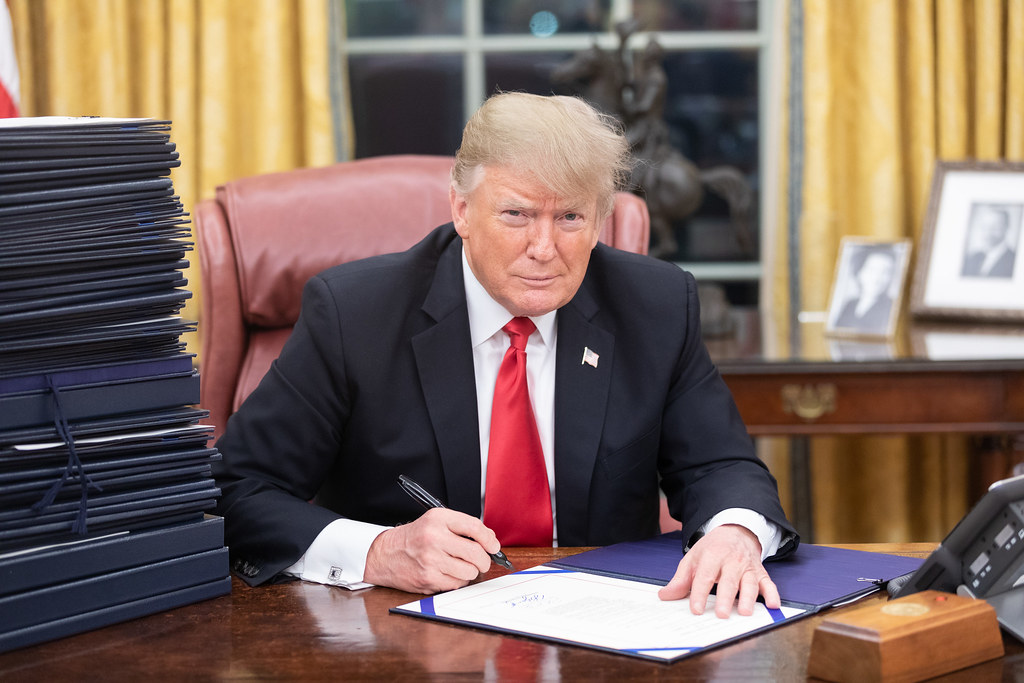

The Trump Tariff Policy has entered a volatile new chapter after the administration confirmed a sweeping 15% global import duty in the wake of a Supreme Court ruling that curtailed the use of emergency economic authority. The move underscores the central role trade measures continue to play in the White House’s broader economic agenda and signals that the administration is prepared to defend its approach through alternative legal channels.
Trump Tariff Policy.
The phrase now dominates political debate, financial market discussions, and international diplomatic exchanges. What began as an aggressive assertion of executive power over trade has evolved into one of the most closely watched economic confrontations in recent years.
How the Trump Tariff Policy Reached This Moment
The Trump Tariff Policy did not emerge overnight. Its roots lie in a long-running argument that the United States has tolerated trade imbalances and unfair practices for decades. The administration has repeatedly framed tariffs as corrective tools designed to strengthen domestic manufacturing, protect strategic industries, and restore leverage in international negotiations.
From its earliest stages, the approach relied heavily on executive authority, particularly statutes granting the president discretion during national emergencies. Critics argue the Trump Tariff Policy stretches those authorities beyond their intended scope, while supporters insist the global economy demands swift and decisive action.
As trade tensions intensified, legal challenges mounted. Business groups, importers, and industry coalitions questioned whether broad global duties could be justified under emergency provisions designed for targeted threats. Those challenges culminated in a landmark Supreme Court decision that reshaped the legal framework underpinning the administration’s trade strategy.
Supreme Court Ruling and Its Impact on the Trump Tariff Policy
In a closely divided decision, the Supreme Court narrowed the administration’s reliance on emergency powers to impose sweeping import duties. The ruling emphasized constitutional separation of powers, reaffirming that Congress holds primary authority over taxation and trade regulation.
In its opinion, the Court narrowed the legal path available to the Trump Tariff Policy. While the justices did not declare tariffs unconstitutional, they made clear that emergency statutes cannot serve as open-ended mechanisms for permanent global trade measures. The judgment effectively redirected the administration toward other statutory tools if it wished to continue imposing broad import duties.
The ruling introduced immediate uncertainty into financial markets. Investors weighed the possibility of a rapid rollback against the likelihood that the administration would pivot to alternative legal grounds. Within hours, officials confirmed that a recalibrated strategy was already underway.
White House Recalibrates the Trump Tariff Policy at 15%
Rather than retreat, the administration announced that the Trump Tariff Policy would move forward under a revised framework centered on a 15% global import duty. Officials argued that longstanding trade statutes provide sufficient authority when specific economic criteria are satisfied.
Under this recalibrated structure, the Trump Tariff Policy would apply broadly across multiple sectors, affecting consumer goods, industrial inputs, and technology components. Administration representatives described the shift as a legal adjustment rather than a strategic reversal.
Supporters of the Trump Tariff Policy contend that a uniform rate simplifies enforcement and signals resolve to trading partners. They argue that the revised structure reflects careful legal vetting and demonstrates the administration’s commitment to preserving trade leverage despite judicial constraints.
Critics, however, question whether the pivot will withstand further legal scrutiny. They warn that prolonged litigation could create sustained uncertainty for businesses already navigating inflationary pressures and supply chain disruptions.
Economic Ripple Effects of the Trump Tariff Policy
Analysts say the Trump Tariff Policy could lift import costs across several major sectors. Tariffs operate as taxes on imported goods, and while they are technically imposed at the border, the financial burden often travels through supply chains to wholesalers, retailers, and ultimately consumers.
As the Trump Tariff Policy takes effect, companies that rely heavily on foreign components may face higher production expenses. Manufacturers in industries such as automotive, electronics, machinery, and apparel are assessing how a 15% duty could alter cost structures and pricing strategies.
Retailers, many of whom operate on narrow margins, are evaluating whether to absorb part of the increase or pass costs to customers. In prior tariff cycles, businesses adopted mixed approaches, sometimes renegotiating supplier contracts or shifting sourcing to mitigate exposure.
Economists remain divided on the broader macroeconomic impact. Some argue that sustained tariffs can encourage domestic production and reduce trade deficits. Others caution that higher input costs may dampen growth, reduce purchasing power, and introduce inefficiencies into global commerce.
Financial markets reacted cautiously following the announcement. Currency fluctuations and commodity price movements reflected investor concerns about retaliatory measures from trading partners. Volatility may persist as companies and governments digest the implications of the revised trade regime.
Global Response to the Trump Tariff Policy
Trading partners are studying the Trump Tariff Policy closely. Governments in Europe, Asia, and North America are assessing whether the 15% duty violates trade agreements or warrants reciprocal action.
If retaliation follows, the Trump Tariff Policy may face an escalation cycle reminiscent of earlier trade disputes. Reciprocal tariffs could target agricultural exports, manufactured goods, or technology services, potentially widening the economic impact beyond U.S. borders.
Diplomatic channels remain active. Officials have indicated that dialogue with key trading partners continues, suggesting that negotiation remains an option even amid firm public messaging. Historically, tariff announcements often coincide with behind-the-scenes bargaining aimed at extracting concessions or revising trade terms.
International businesses are also adapting. Multinational corporations with diversified supply chains may reallocate production to minimize exposure. Smaller exporters, however, may struggle to absorb additional costs or navigate shifting customs regulations.
The global response will likely determine whether the current trade posture stabilizes or evolves into a broader confrontation affecting multiple sectors.
Political Debate Surrounding the Trump Tariff Policy
On Capitol Hill, lawmakers split over the Trump Tariff Policy. Supporters argue that decisive trade action strengthens national security and reduces dependence on foreign suppliers in strategic industries such as semiconductors and energy.
Opponents counter that broad tariffs function as indirect taxes on American consumers and businesses. They emphasize that Congress, not the executive branch, holds constitutional authority over trade levies and caution against expanding presidential discretion.
The political divide reflects deeper ideological differences about globalization. Proponents of open trade warn that protectionist policies risk isolating the United States from global markets. Advocates of stricter trade enforcement insist that prior frameworks left domestic industries vulnerable.
The Supreme Court ruling added fuel to the debate, with some lawmakers proposing legislative clarification of executive trade authority. Others argue that the administration’s pivot demonstrates resilience and adaptability within the existing legal system.
Public opinion remains mixed. Surveys suggest that voters support protecting domestic industries but express concern about potential price increases. The balance between economic nationalism and consumer affordability continues to shape the national conversation.
Industry Perspectives and Corporate Strategy
Corporate leaders are approaching the Trump Tariff Policy with a mix of caution and contingency planning. Supply chain managers are modeling various scenarios, including partial cost absorption, strategic stockpiling, and long-term sourcing shifts.
In manufacturing sectors, executives note that domestic capacity expansion requires significant capital investment and time. While tariffs may create incentives to reshore production, infrastructure constraints and labor availability present practical challenges.
Technology companies face particular complexity. Modern electronics rely on globally integrated supply chains, and component substitution is not always straightforward. Firms may explore diversification across multiple regions to mitigate concentration risk.
Agricultural exporters are watching developments carefully. If trading partners respond with retaliatory duties, farm producers could encounter reduced demand in key markets. Industry groups have urged policymakers to consider safeguards to prevent disproportionate impacts on rural economies.
Across industries, uncertainty remains a central concern. Businesses emphasize the need for clarity and predictability to guide investment decisions and long-term planning.
Legal Outlook and Future Challenges
Legal experts anticipate further courtroom battles as stakeholders examine the statutory basis for the revised framework. The administration’s decision to proceed under alternative authority may prompt new lawsuits challenging procedural compliance or scope.
Ultimately, the Trump Tariff Policy will be judged not only on economic outcomes but also on its durability under judicial review. Courts may evaluate whether the criteria invoked to justify the 15% duty meet statutory requirements and align with congressional intent.
The possibility of prolonged litigation introduces another layer of complexity. Companies facing increased costs must weigh short-term adaptation against the chance that future rulings could alter or suspend the tariff regime.
Broader Economic Strategy and Long-Term Implications
Beyond immediate legal and market reactions, the Trump Tariff Policy reflects a broader economic philosophy centered on national resilience and leverage. The administration has repeatedly framed tariffs as tools to strengthen bargaining power in trade negotiations and incentivize domestic production.
Supporters argue that short-term disruptions may yield long-term gains in strategic autonomy. They cite concerns about supply chain vulnerabilities exposed by global crises and advocate for greater domestic capacity in critical sectors.
Critics question whether uniform tariffs effectively target unfair practices or instead impose blanket costs that ripple through the economy. They suggest that targeted enforcement mechanisms and multilateral engagement may achieve similar goals with fewer unintended consequences.
Economic historians note that tariff policy has long been intertwined with political identity and national priorities. Debates over trade barriers have shaped U.S. policy for more than a century, often resurfacing during periods of economic transition.
Whether the current approach produces measurable shifts in trade balances or industrial output remains to be seen. Much depends on global responses, domestic investment trends, and judicial interpretations of executive authority.
What Comes Next
Whether the Trump Tariff Policy succeeds will depend on a convergence of legal validation, market adaptation, and diplomatic negotiation. Several scenarios are possible.
A stabilization scenario would involve trading partners adjusting without aggressive retaliation, allowing businesses to recalibrate gradually. An escalation scenario could trigger reciprocal measures and renewed trade disputes. A judicial intervention scenario might narrow or suspend the revised duties, reshaping the policy landscape once again.
For now, the announcement of a 15% global import duty marks a defining moment. The administration’s rapid recalibration after the Supreme Court ruling demonstrates its determination to sustain trade leverage even under constitutional constraints.
As policymakers, businesses, and global partners respond, the unfolding developments will continue to test the boundaries of executive authority and the resilience of modern supply chains.
The coming months will reveal whether the recalibrated trade posture consolidates domestic support, triggers international pushback, or evolves into a more negotiated framework. What remains clear is that the Trump Tariff Policy stands at the center of a consequential debate over economic sovereignty, constitutional balance, and the future of global commerce.