


El Mencho killed in a high-risk military operation in western Mexico has become one of the most consequential security developments of 2026. Authorities confirmed that the longtime alleged leader of the Jalisco New Generation Cartel was fatally wounded during an intense confrontation with federal forces in the state of Jalisco.
The confirmation that El Mencho was killed has sent shockwaves across Mexico’s political establishment, law enforcement agencies and international partners monitoring organized crime networks.
A Defining Security Operation in Jalisco
Mexican defense officials described the raid that led to El Mencho killed as the result of months of coordinated intelligence work. According to federal sources, surveillance operations intensified in early 2026 after authorities narrowed possible movements of high-ranking cartel figures in rural areas near Tapalpa, Jalisco.
Security forces deployed specialized army units supported by aerial reconnaissance. The operation unfolded at dawn, when federal troops encountered heavily armed resistance. An exchange of gunfire followed, lasting several minutes before security personnel secured the site.
Officials later confirmed that El Mencho killed during the confrontation was transported under heavy guard for emergency treatment but succumbed to his injuries before reaching a military hospital. The Defense Ministry characterized the operation as lawful, targeted and conducted under established protocols.
The announcement that El Mencho was killed marks a turning point in a conflict that has shaped Mexico’s internal security policy for nearly two decades.
Who Was El Mencho
Before El Mencho killed became global headlines, Nemesio Rubén Oseguera Cervantes had long been one of the most wanted figures in Mexico and the United States. Rising from regional criminal networks in western Mexico, he helped establish the Jalisco New Generation Cartel, commonly known as CJNG, in the early 2010s.
Under his leadership, CJNG expanded rapidly. The organization became known for its aggressive territorial strategies and its ability to challenge rival groups directly. Analysts frequently described it as one of the most heavily armed criminal organizations in the country.
For years, El Mencho was believed to have evaded capture through a sophisticated security apparatus. His operational style combined secrecy with calculated displays of force intended to intimidate competitors and authorities alike.
The confirmation that El Mencho killed in a military raid represents the end of a chapter that defined organized crime dynamics across multiple Mexican states.
How El Mencho Built CJNG Into a Powerhouse
The rise of CJNG under El Mencho reflected shifts in Mexico’s criminal landscape. As older cartels fractured, new groups competed for influence over trafficking corridors and local markets.
CJNG distinguished itself by focusing on rapid territorial expansion. It invested in advanced weaponry and developed decentralized regional cells capable of independent operations. This structure allowed flexibility and resilience even when specific leaders faced legal pressure.
Investigators have long associated the group with synthetic drug production and international distribution channels. Security experts argue that El Mencho leveraged alliances, intimidation and strategic violence to consolidate control.
The fact that El Mencho killed during a targeted operation underscores how deeply embedded the organization became in western Mexico’s criminal ecosystem.
The Military Raid That Led to El Mencho Killed
Federal authorities indicated that the raid was triggered by actionable intelligence suggesting a temporary gathering of senior CJNG members. Troops advanced through rugged terrain to reach a rural compound believed to be a safe house.
Witness accounts described helicopters circling overhead before gunfire erupted. Residents in nearby communities reported hearing sustained exchanges lasting several minutes.
After the firefight ended, security forces detained several individuals and seized weapons. Among the wounded was Oseguera Cervantes. Officials later confirmed that El Mencho killed in the confrontation had suffered critical injuries.
Government representatives emphasized that the operation was not indiscriminate but focused on a specific objective. They stated that precautions were taken to minimize civilian harm.
The declaration that El Mencho was killed became official after forensic identification procedures were completed later that day.
Immediate Security Fallout Across Western Mexico
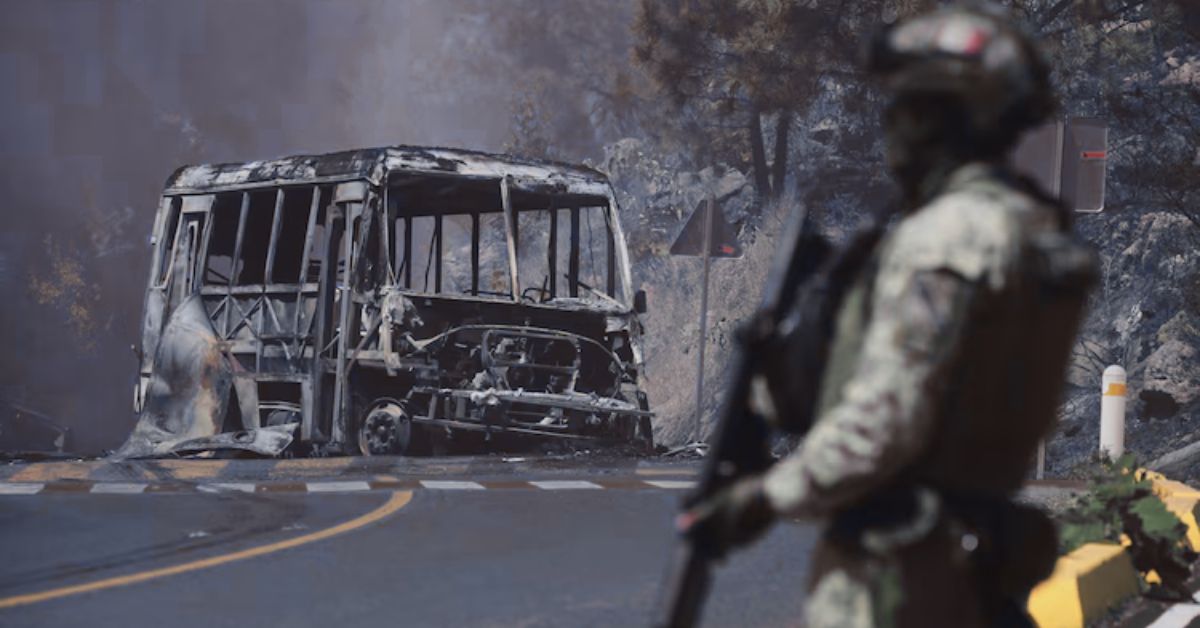
Within hours of reports that El Mencho killed during the military operation, tensions rose in parts of Jalisco and neighboring states. Authorities reported isolated incidents of vehicles set ablaze and temporary road blockades.
Security forces increased patrols in Guadalajara and other urban centers. Local governments issued public advisories urging residents to remain calm and rely on official updates.
Schools in some districts adjusted schedules as a precaution. Commercial activity slowed briefly in certain municipalities before returning to normal.
Analysts note that similar retaliatory patterns have occurred following high-profile cartel actions. The announcement that El Mencho killed carried symbolic weight likely to provoke reactions from loyalists seeking to demonstrate strength.
However, officials indicated that federal presence prevented escalation beyond localized disturbances.
Political Reaction After El Mencho Killed
Mexico’s federal government described the outcome as a major achievement in its ongoing security strategy. In a televised statement, senior officials characterized El Mencho killed as evidence of institutional coordination and perseverance.
Opposition lawmakers called for transparency regarding operational details. They requested a comprehensive review to ensure accountability and adherence to legal standards.
Civil society organizations emphasized the importance of safeguarding human rights during high-intensity security missions. Observers urged authorities to prioritize stability in affected communities.
The political debate surrounding El Mencho killed reflects broader national discussions about how to confront organized crime effectively while preserving democratic oversight.
Impact on Drug Trafficking Networks
Security experts are now assessing how El Mencho killed could influence trafficking routes and supply chains. CJNG’s role in synthetic drug production has drawn international scrutiny in recent years.
Some analysts predict short-term instability within distribution networks. Others caution that established systems may adapt quickly to leadership changes.
Historical precedent suggests that removing a single leader does not automatically dismantle operational infrastructure. Nonetheless, the confirmation that El Mencho killed may disrupt coordination temporarily.
Law enforcement agencies across North America are monitoring developments closely. They aim to identify potential shifts in alliances or supply patterns following the event.
Succession Risks and Cartel Fragmentation
One key question after El Mencho killed is who will assume command within CJNG. Criminal organizations often experience internal tensions during leadership transitions.
Security analysts outline three possible scenarios: rapid consolidation under a designated successor, internal fragmentation into competing factions, or intensified pressure from the state during a period of vulnerability.
Fragmentation can produce unpredictable violence as regional commanders seek dominance. Conversely, swift succession could preserve continuity within the organization.
Authorities have increased intelligence operations to detect signs of emerging leadership figures. The weeks following El Mencho killed will likely determine the trajectory of the group’s internal dynamics.
Mexico’s Security Strategy in Focus
The fact that El Mencho killed in a direct military engagement highlights Mexico’s reliance on federal forces in combating organized crime.
Since the mid-2000s, successive administrations have deployed troops in public security roles. Supporters argue that targeted operations against high-value individuals weaken criminal hierarchies.
Critics contend that structural reforms in policing, judicial capacity and economic development are equally necessary to address root causes.
The confirmation that El Mencho killed reignites this debate. Some policymakers view the operation as validation of intelligence-driven enforcement. Others question whether sustainable peace requires broader institutional investment.
International and Economic Implications
International observers responded swiftly to the news that El Mencho killed during a military raid. Governments across the region acknowledged the significance of the development.
Economic analysts are also evaluating potential ripple effects. Short-term disruptions in transportation corridors and tourism flows were reported in western Mexico immediately after the announcement.
However, experts emphasize that sustained economic stability depends on preventing prolonged violence. Confidence among investors and travelers hinges on perceptions of safety.
Diplomatic channels continue to stress cooperative frameworks in addressing transnational crime challenges.
Community Impact in Jalisco
For residents in Jalisco, the confirmation that El Mencho killed carries both relief and uncertainty. Some community leaders expressed hope that the event might reduce immediate threats.
Others worry about potential retaliatory violence or instability linked to succession disputes.
Local authorities have prioritized outreach efforts to reassure citizens. Additional patrols and emergency response teams remain active in key municipalities.
Public sentiment appears cautious but measured. Many residents have lived through cycles of confrontation between criminal groups and security forces.
The long-term effect of El Mencho killed on daily life in affected communities remains to be seen.
Historical Context of High-Profile Cartel Operations
Mexico has previously witnessed the capture or death of major criminal figures. Outcomes have varied widely.
In some cases, organizations weakened significantly. In others, rival groups filled the vacuum quickly, leading to renewed violence.
The announcement that El Mencho killed invites comparison with those earlier episodes. Analysts will monitor whether similar patterns emerge.
Data on homicide rates, territorial disputes and trafficking flows over the coming months will offer insight into measurable impacts.
Media Coverage and Public Perception
The news that El Mencho killed spread rapidly through national and international media outlets. Social media platforms amplified images and unofficial claims before authorities confirmed details.
Government agencies responded by issuing verified statements and clarifying timelines. Transparent communication proved essential in maintaining credibility.
Public perception often shapes political momentum in security policy debates. The symbolism of El Mencho killed resonates beyond operational metrics.
For many citizens, the development represents a moment of reckoning in a prolonged struggle against organized crime.
Legal and Institutional Considerations
Even though El Mencho killed during the raid, ongoing investigations into CJNG’s financial and logistical networks continue. Authorities have emphasized asset tracing, financial monitoring and international cooperation.
Legal experts note that dismantling infrastructure is as important as neutralizing leadership figures. Sustained prosecutions and institutional reforms will determine whether the organization’s capacity diminishes.
The broader legal framework surrounding anti-cartel operations may undergo review in light of the event.
Long-Term Security Outlook After El Mencho Killed
Security analysts caution that while El Mencho killed marks a dramatic milestone, long-term transformation depends on comprehensive policy measures.
Strengthening local police institutions, enhancing judicial efficiency and expanding economic opportunity in vulnerable regions remain critical objectives.
Without parallel reforms, leadership changes alone may not resolve structural challenges.
Nonetheless, authorities describe the outcome as a decisive step forward. The removal of a high-profile figure sends a message regarding state capability.
What El Mencho Killed Means for Mexico’s Future
The confirmation that El Mencho killed during a coordinated military operation represents a pivotal moment in Mexico’s confrontation with organized crime.
It closes the chapter of one of the country’s most elusive cartel leaders. At the same time, it opens a period of uncertainty regarding succession, stability and policy direction.
Whether El Mencho killed ultimately contributes to sustained reductions in violence will depend on institutional follow-through and strategic clarity.
For now, the nation watches closely as security forces maintain heightened vigilance and policymakers debate next steps.
The legacy of El Mencho killed will not be defined solely by the raid itself but by what follows in the months and years ahead.