

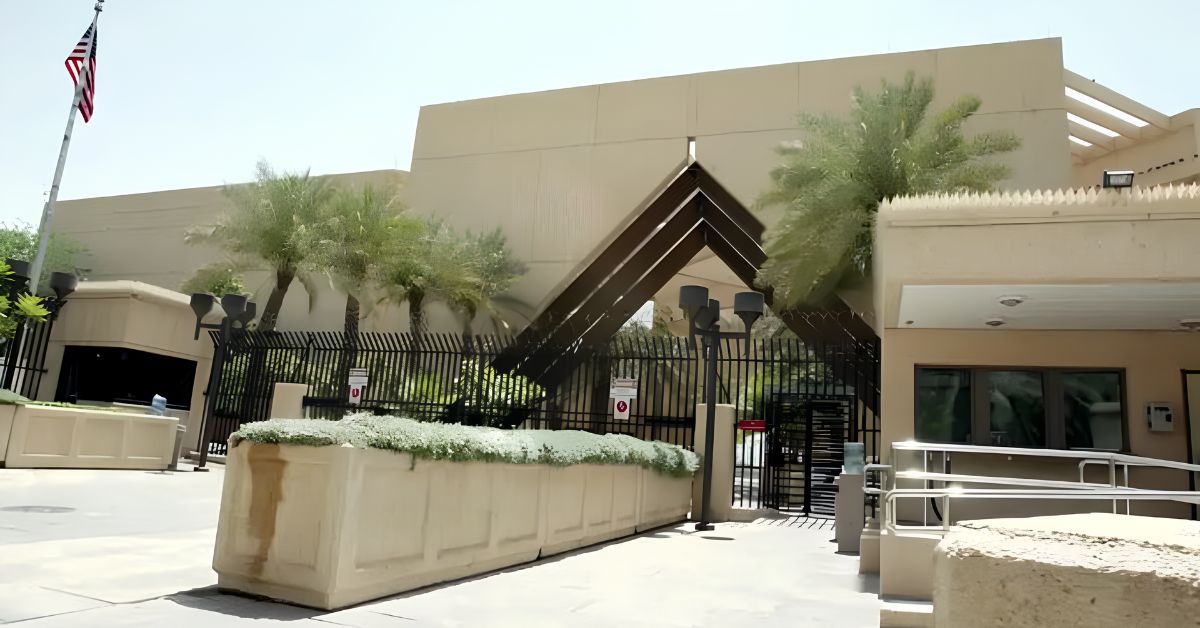

The US Embassy in Riyadh became the focal point of heightened diplomatic concern after two drones struck the American diplomatic compound in the Saudi capital’s Diplomatic Quarter early Tuesday morning. Saudi authorities confirmed the incident, describing the damage as limited and reporting no injuries.
While the structural impact appears minor, the symbolism of an attack on a diplomatic mission carries weight far beyond the physical damage. The incident has reignited concerns over regional security and the growing use of drone technology in geopolitical confrontations.
The early morning strike on the US Embassy occurred at a time of escalating tensions across the Middle East. Regional alliances, military operations, and retaliatory measures have created a fragile security environment in which diplomatic facilities often become symbolic targets.
Immediate Details of the Incident
According to Saudi defense officials, two drones entered restricted airspace shortly before dawn and impacted the diplomatic compound housing the US Embassy. Witnesses in nearby residential areas reported hearing an explosion followed by visible flames rising above the embassy perimeter.
Emergency services responded within minutes. Fire crews contained a small blaze that broke out within part of the compound. Authorities later confirmed that no American or Saudi personnel were injured.
Security officials indicated that parts of the US Embassy were not fully occupied at the time due to routine early morning staffing levels. This timing likely minimized the risk of casualties.
Investigators are now analyzing debris from the drones to determine their origin and technical configuration. Officials have not yet publicly attributed responsibility.
Security Response at the Diplomatic Quarter
The Diplomatic Quarter in Riyadh is considered one of the most secure areas in the city. It hosts numerous foreign missions, diplomatic residences, and international organizations. Following the incident, Saudi security forces sealed off access roads and expanded patrols throughout the zone.
The perimeter surrounding the US Embassy was reinforced with additional checkpoints and surveillance monitoring. Officials stated that airspace monitoring systems are under review to assess how the drones managed to penetrate restricted zones.
Although physical damage was described as limited, authorities are conducting a comprehensive structural assessment inside the compound. The US Embassy continues to operate, though certain services may experience temporary procedural adjustments during the review.
The Strategic Importance of the US Embassy in Riyadh
The US Embassy in Riyadh represents more than a diplomatic office. It is a central hub for bilateral coordination between Washington and Riyadh on matters ranging from defense cooperation to economic investment and regional security.
Saudi Arabia remains a key strategic partner of the United States in the Gulf. The embassy facilitates military coordination, intelligence sharing, and energy market discussions. For this reason, any incident involving the US Embassy carries symbolic geopolitical significance.
Diplomatic observers emphasize that embassies function as extensions of sovereign territory. Under international law, they are entitled to protection by host governments. An attack on such a facility can therefore trigger diplomatic consultations and security reassessments at the highest levels.
Drone Warfare and Changing Conflict Dynamics
The incident highlights the evolving nature of modern conflict. Drones have transformed regional security calculations. Their relative affordability and mobility allow actors to carry out targeted strikes without deploying traditional military forces.
The targeting of a US Embassy illustrates how unmanned systems are increasingly used to send strategic signals. While the damage in Riyadh appears limited, the psychological and diplomatic impact is substantial.
Defense analysts note that drone technology continues to advance in precision, range, and stealth capability. As a result, diplomatic facilities worldwide are reassessing security protocols.
Diplomatic Implications
An attack on a US Embassy often reverberates across international diplomatic channels. Even when injuries are avoided, the act itself can influence negotiations, defense posture, and intelligence operations.
Washington is expected to coordinate closely with Saudi authorities regarding the investigation. Additional security measures may be implemented not only at the Riyadh compound but also at other American diplomatic sites in the region.
Historically, incidents involving a US Embassy have prompted broader reviews of regional policy. However, officials have emphasized restraint while investigations continue.
Impact on American Citizens in Saudi Arabia
Following the incident, advisory notices were issued to American citizens residing in Saudi Arabia. While daily life in Riyadh continues without disruption, the US Embassy urged citizens to remain vigilant and monitor official communications.
Consular operations remain active. However, precautionary adjustments may be implemented as security evaluations proceed. The embassy reiterated that no injuries were reported and that local authorities responded swiftly.
American residents in Jeddah and Dhahran were also advised to stay informed. The US Embassy emphasized coordination with Saudi security services to ensure continued safety.
Saudi Arabia’s Security Posture
Saudi Arabia has invested heavily in air defense systems, particularly in response to prior drone and missile attacks targeting infrastructure. The latest strike near the US Embassy raises questions about how emerging technologies can bypass traditional defensive layers.
Security officials are reviewing radar coverage, interception readiness, and response timing. Analysts suggest that even sophisticated defense networks face challenges when confronting small, low-altitude unmanned aerial vehicles.
The Saudi government reaffirmed its commitment to protecting diplomatic missions within its borders. Safeguarding the US Embassy and other foreign compounds remains a priority.
Regional Context and Escalating Tensions
The attack unfolded amid rising tensions between regional powers. Recent military actions and retaliatory measures have contributed to a volatile atmosphere across the Gulf.
Saudi Arabia’s alignment with U.S. security initiatives places the US Embassy at the intersection of broader geopolitical currents. While no direct link has been officially established between the Riyadh incident and other regional events, analysts view the timing as significant.
The Gulf region has experienced periodic drone activity targeting energy facilities, military installations, and symbolic infrastructure. The targeting of the US Embassy reflects how diplomatic sites can become focal points during periods of tension.
International Law and Protection of Diplomatic Missions
Under the Vienna Convention on Diplomatic Relations, host states are obligated to protect foreign diplomatic missions. Attacks against such facilities are widely condemned in international forums.
The breach near the US Embassy will likely be examined through the lens of international legal obligations. Even if damage is minimal, the incident underscores the importance of maintaining secure diplomatic environments.
Global security experts note that embassies must adapt to evolving threats while preserving openness for diplomatic engagement.
Broader Implications for Gulf Stability
The Gulf region plays a critical role in global energy markets and international trade routes. Instability affecting diplomatic compounds, including the US Embassy, can reverberate beyond national borders.
Financial markets often respond sensitively to regional security developments. Although the immediate impact of the Riyadh incident appears contained, policymakers remain alert to potential ripple effects.
Security analysts caution that symbolic strikes can escalate tensions if not managed carefully through diplomatic channels.
The Future of Embassy Security
Security reviews are expected to assess both structural resilience and rapid-response protocols. Coordination between U.S. and Saudi authorities will shape next steps.
The incident in Riyadh reinforces a broader reality: diplomatic security strategies must evolve alongside technological change. Protecting a US Embassy today requires not only perimeter defenses but also advanced aerial monitoring systems.
While the immediate threat appears contained, the event serves as a reminder that embassies remain visible symbols of national presence abroad.
Conclusion
The drone strike near the US Embassy in Riyadh did not result in injuries, but its implications extend beyond structural damage. In a region already navigating complex geopolitical dynamics, such incidents amplify concerns about stability and security.
Authorities continue to investigate the origin of the drones and evaluate defensive measures. For now, diplomatic operations proceed under heightened vigilance.
The US Embassy remains operational, underscoring a commitment to continuity despite emerging challenges. As regional tensions evolve, safeguarding diplomatic institutions will remain central to maintaining stability and preventing further escalation.