

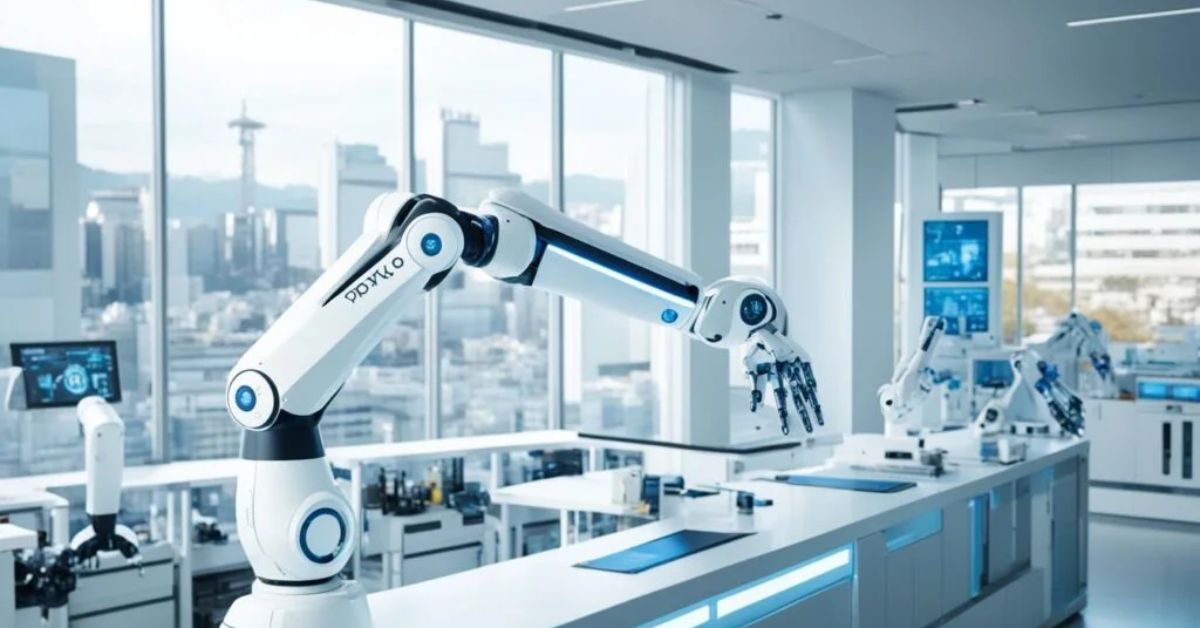

A group of former artificial intelligence researchers has launched a new venture in Japan that aims to reshape how machines learn and perform complex tasks in the real world.
The AI robotics startup Tokyo is positioning itself at the intersection of advanced artificial intelligence and industrial automation. The company, Integral AI Inc., was founded by engineers who previously worked on large-scale AI research and are now focused on building systems that allow robots to acquire new skills by observing demonstrations.
The effort reflects a broader shift in the technology sector. While many artificial intelligence breakthroughs in recent years have focused on language models and digital assistants, researchers are increasingly exploring how similar intelligence could operate in physical machines.
By bringing AI models into robotics, the founders believe machines can move beyond rigid programming and begin learning tasks more flexibly, similar to the way humans acquire new abilities.
The Vision Behind the AI Robotics Startup Tokyo
The founders of the AI robotics startup Tokyo believe the future of artificial intelligence lies not only in digital applications but also in physical systems capable of interacting with the world.
Traditional industrial robots are designed to perform highly specific tasks. They are typically programmed with precise instructions and operate in carefully controlled environments. While this approach has been successful in factories for decades, it limits the flexibility of machines when tasks change.
The new company is attempting to solve that limitation by creating AI models that allow robots to learn behaviors in a way that resembles human learning.
Instead of writing long sets of instructions, a human operator can demonstrate an activity once or twice while the robot observes. The system then analyzes the demonstration and attempts to reproduce the behavior independently.
The founders say this could significantly reduce the time and expertise required to deploy robots in industrial settings.
Teaching Machines Through Observation
One of the core concepts driving the AI robotics startup Tokyo is a technique known as demonstration learning.
In this approach, robots watch humans perform a task and then attempt to imitate the behavior using AI algorithms trained to understand motion, environment, and object interactions.
For example, a robot might observe a worker assembling a small component. The AI system analyzes how the person moves, how tools are used, and how objects interact with each other.
Once the robot understands the sequence, it attempts to replicate the process using its own sensors and mechanical arms.
This method allows machines to learn much faster than traditional programming, which requires engineers to specify every movement in advance.
The founders believe this could dramatically change how robots are introduced into workplaces.
Partnerships With Japan’s Industrial Leaders
The AI robotics startup Tokyo is already collaborating with industrial partners as it begins testing its technology.
One early collaboration involves a Japanese automotive supplier known for producing components used in global manufacturing. Engineers from the startup have worked with factory teams to demonstrate how robots can learn new assembly tasks simply by observing human workers.
Beyond this initial partnership, the company has begun discussions with several major Japanese manufacturers interested in exploring the technology’s potential.
The conversations include companies involved in automotive manufacturing, electronics production, and chemical engineering.
These industries rely heavily on automation but still require human workers to handle tasks that are difficult to program into traditional robotic systems.
If the technology proves successful, robots could learn many of those tasks directly from demonstrations, reducing the need for specialized programming.
Why Tokyo Is Becoming a Hub for Robotics Innovation
Japan has long been considered one of the world’s leaders in industrial robotics.
Factories across the country deploy large numbers of robotic systems, and Japanese manufacturers produce a significant share of the world’s industrial robots.
The founders chose Tokyo as the headquarters for the AI robotics startup Tokyo because of the country’s deep expertise in robotics hardware and manufacturing systems.
Japanese companies have decades of experience designing and producing robotic arms, sensors, and automation tools used in factories around the world.
By combining that hardware expertise with new advances in artificial intelligence, the startup hopes to accelerate the development of smarter machines.
The country’s manufacturing culture also offers an ideal testing ground for new automation technologies.
Combining Artificial Intelligence and Manufacturing
The emergence of the AI robotics startup Tokyo reflects a broader trend within the technology industry.
Artificial intelligence is increasingly being integrated into traditional industries such as manufacturing, logistics, and construction.
While AI has already transformed areas like language translation, digital search, and image recognition, many researchers believe the next stage of progress will involve machines that operate in physical environments.
These systems are often referred to as “physical AI.”
Physical AI systems must understand not only digital information but also spatial relationships, object movement, and environmental changes.
Developing this type of intelligence requires combining robotics engineering with advanced machine learning models.
The founders say this challenge is precisely what motivated them to launch the company.
The Technology Powering the AI Robotics Startup Tokyo
At the center of the AI robotics startup Tokyo is a new class of artificial intelligence models designed specifically for robotic systems.
These models analyze video demonstrations, sensor inputs, and environmental data to understand how tasks are performed.
The system then converts that understanding into instructions that robotic hardware can execute.
One of the key challenges in robotics is that physical environments are unpredictable. Objects may move, lighting conditions change, and equipment may vary between factories.
The company’s AI models are designed to adapt to those variations without requiring engineers to retrain the system from scratch.
This flexibility could allow robots to work in a much wider range of settings.
Language Instructions and Robot Learning
Another goal of the AI robotics startup Tokyo is to allow robots to learn from simple language instructions.
Instead of relying solely on demonstrations, a human operator could describe a task verbally.
For example, a technician might instruct a robot to assemble a component, sort packages, or prepare equipment for shipping.
The AI system interprets the instruction, analyzes the surrounding environment, and determines the steps needed to complete the task.
This combination of language understanding and robotics could make automation far more accessible to businesses.
Workers would not need advanced programming knowledge to teach robots new skills.
How Physical AI Could Transform Industry
The long-term ambitions of the AI robotics startup Tokyo extend far beyond factory automation.
If machines can learn new behaviors quickly, they could be deployed in many different industries.
Potential applications include logistics centers, healthcare environments, food preparation facilities, and maintenance operations.
Robots capable of adapting to new tasks could help companies respond more quickly to changing demand.
Manufacturers might be able to shift production lines rapidly without needing months of reprogramming.
In logistics, robots could learn new sorting methods or warehouse layouts simply by observing human workers.
The founders believe such flexibility could lead to a new era of intelligent automation.
Funding and Development Plans
The AI robotics startup Tokyo has already secured early funding from investors interested in artificial intelligence and robotics innovation.
The initial investment has allowed the company to build research teams and begin developing its first AI models.
Additional funding rounds are expected as the technology progresses.
The company is currently working toward the release of its first large-scale robotics AI system, which will be tested in real industrial environments.
If those tests are successful, the technology could be deployed in manufacturing facilities within the next few years.
The founders believe the combination of AI software and robotics hardware could create entirely new categories of automation.
The Future of Intelligent Machines
The rise of the AI robotics startup Tokyo reflects a broader transformation underway in the global technology landscape.
For decades, robots have performed repetitive tasks under strict programming. Artificial intelligence is now enabling machines to move beyond those limitations.
By teaching robots to observe, reason, and adapt, researchers hope to create systems capable of operating in dynamic environments.
Such machines could eventually assist humans in industries ranging from manufacturing to healthcare.
The founders say their goal is not to replace human workers but to build tools that make automation easier and more flexible.
If the technology succeeds, robots may soon be able to learn new tasks as easily as humans learn new skills.