

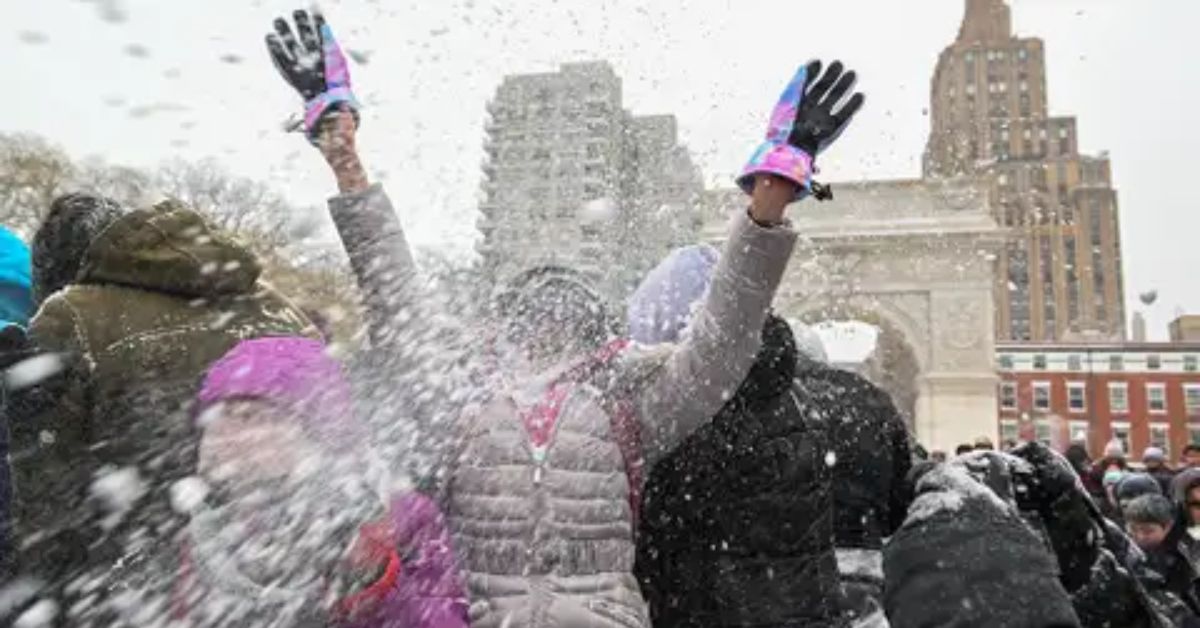

A winter gathering in New York City has unexpectedly evolved into a larger civic and political debate, drawing attention from officials, law enforcement, and the public alike.
The NYC Snowball moment, captured in viral videos and widely shared across social platforms, has become more than just a seasonal event. It now reflects deeper tensions about public behavior, policing, and leadership responses in one of the world’s most closely watched cities.
A Winter Day That Took an Unexpected Turn
A powerful snowstorm blanketed New York City, bringing daily routines to a halt. Schools closed, offices slowed, and residents stepped outside to experience the rare stillness that heavy snowfall brings. As the city adjusted to the conditions, young people began gathering in open public spaces, especially parks.
Washington Square Park quickly became a focal point. What began as spontaneous fun—people tossing snowballs, laughing, and recording moments—grew into a larger crowd as more individuals joined after seeing posts online.
The NYC Snowball gathering reflected a familiar pattern in modern urban life, where digital platforms can turn a small event into a citywide attraction within hours.
Social Media’s Role in Amplifying the NYC Snowball Event
The rapid spread of the NYC Snowball videos highlights how quickly events can scale in today’s connected environment. Social media posts encouraged participation, drawing hundreds of people to the same location.
Participants documented the event from multiple angles, creating a stream of content that reached audiences far beyond the park. While many viewers saw it as harmless fun, others began questioning whether the situation might become difficult to control.
The visibility of the NYC Snowball clips shaped the narrative early, influencing how both authorities and the public interpreted what was happening on the ground.
When Celebration Shifted Toward Concern
As the crowd grew, the energy began to change. What started as playful interaction slowly became more chaotic. Some individuals reportedly escalated their actions by throwing packed snow and ice rather than loose snow, increasing the risk of injury.
Witnesses described a shift in tone. The environment became louder, more unpredictable, and harder to manage. Some attendees chose to leave as the situation intensified, sensing that it was no longer just a lighthearted gathering.
The NYC Snowball situation, at this stage, moved beyond celebration into an area that raised questions about safety and crowd control.
Police Response and Escalation
Authorities were alerted to the growing crowd and its changing dynamics. Officers arrived at the scene to assess the situation and restore order if necessary. Their presence marked a turning point.
Instead of dispersing immediately, parts of the crowd redirected their attention toward the officers. Snowballs were thrown directly at law enforcement personnel, and videos show officers attempting to navigate through a dense and active crowd.
Several officers reportedly sustained minor injuries during the NYC Snowball incident. Although none of the injuries were severe, the situation prompted immediate concern within law enforcement circles.
Official Reactions From Law Enforcement
Police officials responded with strong statements, emphasizing that any act targeting officers—even with snow—should not be dismissed lightly. They argued that actions causing injury or disruption must be treated seriously to maintain order.
The NYC Snowball event was described by some officials as crossing a line between public celebration and unacceptable behavior. They stressed that allowing such incidents to go unchecked could lead to more serious situations in the future.
These reactions framed the incident not as an isolated moment but as part of a broader conversation about public safety and respect for authority.
A Contrasting Response From City Leadership
City leadership offered a notably different perspective. The mayor characterized the NYC Snowball gathering as an example of young people engaging in seasonal activity, suggesting that the response should be measured and contextual.
This approach focused on the intent behind the actions rather than the outcomes. The emphasis was on understanding the behavior within the setting of a snow day rather than immediately categorizing it as a public safety threat.
The contrast between this viewpoint and that of law enforcement created a visible divide, drawing attention from both local and national observers.
NYC Snowball Debate Reflects Broader Policy Differences
The NYC Snowball discussion has become a reflection of deeper policy differences. On one side, there is a call for strict enforcement to prevent escalation and ensure safety. On the other, there is an argument for proportional responses that consider context and intent.
This divide is not new. It mirrors ongoing debates about policing strategies, community engagement, and the balance between enforcement and flexibility.
The NYC Snowball situation has simply brought these issues into sharper focus, using a highly visible and relatable event as the catalyst.
Arrests and Legal Considerations
Following the incident, authorities initiated investigations to identify individuals involved in actions that led to injuries. Images and videos were reviewed, and steps were taken to hold specific participants accountable.
Two individuals were arrested in connection with the NYC Snowball event. Officials stated that their actions went beyond general participation and directly contributed to harm.
These developments reinforced the message that even during informal gatherings, certain actions carry legal consequences. The distinction between participation and misconduct became a central point in the aftermath.
Public Reaction and Divided Opinion
Public response to the NYC Snowball incident has been mixed. Some view it as an overreaction, arguing that moments of spontaneous fun should not be heavily policed. They see the situation as an example of youthful energy during an unusual day.
Others believe the incident highlights the need for clear boundaries. They argue that once actions result in injury or target individuals, particularly officers, the situation requires a firm response.
The NYC Snowball debate has therefore extended beyond the event itself, becoming a broader discussion about how society interprets behavior in shared public spaces.
The Role of Leadership in Shaping Narrative
Leadership responses play a critical role in shaping how events are understood. In the case of the NYC Snowball incident, differing messages from officials have influenced public perception in distinct ways.
Some statements emphasize accountability and enforcement, while others highlight context and restraint. These approaches reflect different priorities and philosophies regarding governance and public interaction.
The NYC Snowball narrative demonstrates how quickly a single event can evolve into a symbol of broader leadership challenges.
Implications for Future Public Gatherings
The outcome of the NYC Snowball situation may influence how similar events are managed in the future. Authorities may adopt new strategies for monitoring large gatherings organized through social media.
At the same time, city leadership may consider how to communicate expectations clearly while avoiding unnecessary escalation. Finding the right balance will be essential.
The NYC Snowball case serves as a reference point for how modern cities handle spontaneous, digitally driven events.
NYC Snowball and the Power of Viral Moments
One of the most significant aspects of the NYC Snowball incident is its rapid transformation into a widely discussed topic. Without social media, the event might have remained a local story.
Instead, it became a focal point for national conversation, illustrating how quickly narratives can form and spread. The combination of visual content and real-time sharing amplified its impact.
The NYC Snowball moment highlights the influence of digital platforms in shaping both events and their interpretations.
A Moment That Sparked a Larger Conversation
What began as a simple gathering has now become part of a larger conversation about behavior, authority, and governance. The NYC Snowball incident has revealed how quickly lines can blur between celebration and conflict.
It has also shown that public perception can differ significantly depending on perspective. For some, it represents harmless fun; for others, it signals a need for stronger boundaries.
These differing views ensure that the NYC Snowball discussion will continue beyond the immediate aftermath.
Conclusion
The NYC Snowball event started as a spontaneous reaction to a winter storm but has grown into a significant moment of reflection for the city. It has brought attention to the complexities of managing public behavior, interpreting intent, and maintaining safety.
As discussions continue, the focus will likely remain on how to balance freedom of expression with responsibility in shared spaces. The NYC Snowball situation serves as a reminder that even the simplest moments can evolve into meaningful public debates when viewed through the lens of leadership and policy.