

62 F
San Francisco
Thursday, June 11, 2026
Home Blog Page 22

Kuwait International Airport Struck Injuring Several People and Halting Flights

0

Quick Summary: Kuwait International Airport Struck Injuring Several People and Halting Flights

  • Kuwait International Airport was struck by drones, injuring several people and halting flights.
  • Iran’s lack of communication on ceasefire extensions raises concerns about prolonged disruptions.
  • Bahrain emphasizes aviation recovery despite regional instability and security threats.
  • Gulf airspace restrictions and reroutings are causing widespread travel disruptions.
  • Major Gulf carriers face operational challenges amid ongoing missile and drone threats.

The Gulf aviation sector is under siege, with Kuwait International Airport’s recent drone attack marking a dangerous escalation. This isn’t just about delayed flights anymore; it’s about airports becoming targets in the Iran-linked conflict. The strike on Kuwait’s airport injured several people and forced a suspension of flights, highlighting the vulnerability of civilian aviation in the region.

Iran’s decision to halt ceasefire talks adds another layer of uncertainty, leaving Gulf states in a precarious position. Bahrain, despite its efforts to project a recovery narrative, finds itself caught in this volatile environment. The region’s airports are not just dealing with airspace restrictions but are now potential targets in a broader military confrontation.

Contextually, this crisis is a stark reminder of the fragile balance between diplomacy and conflict in the Gulf. While some airlines have managed to resume limited operations, the threat of further attacks looms large. The aviation sector’s recovery is contingent not on operational readiness but on geopolitical stability.

7 million passengers between March 1 and April 30 despite operating a reduced schedule, and that by May 4 it had restored 96% of its global network. AP reported that Kuwait’s Defense Ministry spokesperson, Brig.

On the other, security and aviation analysts have warned that disruption could continue for “weeks or even months,” and the newest AP reporting says Iran has stopped communicating with mediators about extending a ceasefire, even as President Donald Trump said talks were continuing. Saud Abdulaziz Al-Otaibi, said “a number of hostile drones” struck the airport’s passenger building and caused injuries, while the attack came only hours after Iran and the United States traded missile strikes.

Bahrain’s position in the story is especially notable because its government has been publicly emphasizing recovery and long-term aviation expansion even as the security environment remains unstable. That disagreement over whether diplomacy is alive or collapsing is crucial because future flight schedules depend less on airline readiness than on whether the military confrontation cools or expands.

The central conflict is now clear: civilian aviation networks across the Gulf are being disrupted not only by airspace restrictions and reroutings, but by the risk that major airports themselves can become targets in the widening Iran-linked confrontation. Aviation International News reported that some UAE departures were able to resume using a “temporary and limited reopening of a corridor” through Oman, and that these limited corridors marked only the “first steps” in rebuilding a civil air bridge after tens of thousands of passengers were stranded.

” Yet Bahrain’s own Civil Aviation Affairs had also suspended all drone activities and approvals “until further notice” on April 14, underscoring how tightly security concerns still govern civil aviation decisions. What happens next for travelers depends on three immediate decision points over the next several days: whether Kuwait reopens commercial operations after damage assessment, whether Gulf states keep corridor-based access through Oman and adjacent airspace, and whether ceasefire mediation resumes or collapses after Wednesday’s exchange of strikes.

AP reported that Kuwait’s Defense Ministry spokesperson, Brig. On the other, security and aviation analysts have warned that disruption could continue for “weeks or even months,” and the newest AP reporting says Iran has stopped communicating with mediators about extending a ceasefire, even as President Donald Trump said talks were continuing.

The region’s airports are not just dealing with airspace restrictions but are now potential targets in a broader military confrontation. While some airlines have managed to resume limited operations, the threat of further attacks looms large.

Saud Abdulaziz Al-Otaibi, said “a number of hostile drones” struck the airport’s passenger building and caused injuries, while the attack came only hours after Iran and the United States traded missile strikes. Bahrain’s position in the story is especially notable because its government has been publicly emphasizing recovery and long-term aviation expansion even as the security environment remains unstable.

The scale and speed of this development has caught many observers off guard. Each new update adds another dimension to a story that is still unfolding, and the full picture will only become clear as more verified details emerge from the people and institutions directly involved.

Analysts who have tracked this issue closely say the current moment represents a genuine turning point. The decisions made in the coming weeks are expected to set the direction for months ahead, with ripple effects likely to extend well beyond the immediate actors in the story.

For those directly affected, the practical impact is already visible. People navigating this fast-changing situation are dealing with real consequences while new information continues to reshape what is known and what remains open to interpretation.

Historical parallels offer some context, though experts caution against drawing too close a comparison. Similar situations have played out before, but the specific combination of pressures, personalities, and timing here makes this moment distinct in ways that matter for how it ultimately resolves.

The political and economic dimensions of this story are deeply intertwined. What appears as a single event on the surface is in practice the convergence of multiple pressures that have been building quietly over a longer period than most public reporting has captured.

Read more on Digital Chew

Mayor Daniel Lurie Secures Major Primary Victory With Earthquake – Safety Bond Win

Quick Summary: Mayor Daniel Lurie Secures Major Primary Victory With Earthquake – Safety Bond Win

  • Mayor Daniel Lurie achieved a significant victory in the June 2 primary, with his earthquake-safety bond passing overwhelmingly.
  • Lurie’s allies retained key Board of Supervisors seats, reinforcing his political agenda.
  • Voter turnout was low at about 20%, yet Lurie’s measures received decisive support.
  • Both competing business-tax measures were rejected by voters, indicating a complex political landscape.
  • The November 3, 2026 general election will feature a showdown between Scott Wiener and Connie Chan for a congressional seat.

In a resounding victory, Mayor Daniel Lurie has solidified his political influence in San Francisco following the June 2 primary. His earthquake-safety bond, a cornerstone of his agenda, passed with overwhelming support, despite low voter turnout. This result not only underscores Lurie’s political strength but also signals a shift in the city’s governance priorities.

Lurie’s allies maintained control of crucial Board of Supervisors seats, ensuring that his vision for public safety and institutional reform continues to gain traction. The failure of both business-tax measures further highlights the city’s complex political dynamics, as voters rejected the most visible policy confrontation on the ballot.

This election marks a pivotal moment for San Francisco, as it grapples with issues of crime, downtown decline, and business flight. Lurie’s victory suggests a mandate for practical reform and public-safety-first governance. Meanwhile, the upcoming November general election will test different Democratic visions for the city’s future in Washington, with Scott Wiener and Connie Chan set to face off.

The results of this primary not only reinforce Lurie’s political agenda but also set the stage for future battles over San Francisco’s governance. As the city moves forward, the focus will be on whether these outcomes translate into lasting change at City Hall.

Turnout was only about 20% on Tuesday evening, which makes the scale of that margin especially notable because it suggests decisive support among the voters who did show up. For federal politics, the next phase is the November 3, 2026 general election, where Wiener and Chan are positioned to test two different Democratic visions of how San Francisco should wield influence in Washington.

San Francisco’s June 2 primary delivered a clear election-night win for Mayor Daniel Lurie’s agenda, with his allies holding key Board of Supervisors seats and his marquee earthquake-safety bond passing overwhelmingly while the city rejected both competing business-tax measures. 98%, despite opposition from heavyweight San Francisco political figures including former mayors Willie Brown and Art Agnos, former judge Quentin Kopp, and former state Sen.

San Francisco and California officials will keep updating totals during the canvass, and the statewide results page says the election will be certified by July 10, 2026. 78%, far above the two-thirds threshold required to pass.

In the nonpartisan race for Judge of the Superior Court, Seat 16, Phoebe H. That means voters rejected both sides of the city’s most high-profile tax clash rather than picking one camp’s answer.

The surprising twist is that voters did not simply choose between those rival tax measures; they rejected both, even though they were the ballot’s most visible policy confrontation. Axios reported that Pelosi’s late endorsement helped reshape the race in Chan’s favor, and Chan said plainly, “Nancy Pelosi’s endorsement absolutely turned the tide for us.

Voter turnout was low at about 20%, yet Lurie’s measures received decisive support. The November 3, 2026 general election will feature a showdown between Scott Wiener and Connie Chan for a congressional seat.

78%, far above the two-thirds threshold required to pass. Quick Summary: Mayor Daniel Lurie Secures Major Primary Victory With Earthquake – Safety Bond Win Mayor Daniel Lurie achieved a significant victory in the June 2 primary, with his earthquake-safety bond passing overwhelmingly.

In a resounding victory, Mayor Daniel Lurie has solidified his political influence in San Francisco following the June 2 primary. Both competing business-tax measures were rejected by voters, indicating a complex political landscape.

The scale and speed of this development has caught many observers off guard. Each new update adds another dimension to a story that is still unfolding, and the full picture will only become clear as more verified details emerge from the people and institutions directly involved.

Analysts who have tracked this issue closely say the current moment represents a genuine turning point. The decisions made in the coming weeks are expected to set the direction for months ahead, with ripple effects likely to extend well beyond the immediate actors in the story.

For those directly affected, the practical impact is already visible. People navigating this fast-changing situation are dealing with real consequences while new information continues to reshape what is known and what remains open to interpretation.

Historical parallels offer some context, though experts caution against drawing too close a comparison. Similar situations have played out before, but the specific combination of pressures, personalities, and timing here makes this moment distinct in ways that matter for how it ultimately resolves.

The political and economic dimensions of this story are deeply intertwined. What appears as a single event on the surface is in practice the convergence of multiple pressures that have been building quietly over a longer period than most public reporting has captured.
Read more on Digital Chew

Johnson & Johnson Reveals Promise Potential Precision – Medicine Breakthrough

0

Quick Summary: Johnson & Johnson Reveals Promise Potential Precision – Medicine Breakthrough

  • Johnson & Johnson’s nipocalimab shows promise in high-antibody Sjögren’s patients, according to new analyses.
  • The Phase 2 DAHLIAS trial revealed greater clinical response rates in patients with elevated autoantibody and IgG levels.
  • Nipocalimab cut IgG by more than 77%, with significant improvement in salivary flow in 33% of high-dose patients.
  • The findings were presented at the 2026 EULAR Congress, highlighting a potential precision-medicine breakthrough.
  • J&J’s strategy may focus on high-autoantibody patients, but regulatory and clinical acceptance remains uncertain.

Johnson & Johnson’s latest update on its experimental Sjögren’s drug, nipocalimab, could mark a turning point in the treatment of this challenging autoimmune disease. The company has revealed that patients with high levels of autoantibodies and immunoglobulin G (IgG) responded more favorably to the drug, a discovery that could redefine treatment strategies.

Presented at the 2026 EULAR Congress in London, the findings from the Phase 2 DAHLIAS trial show that nipocalimab significantly reduced IgG levels by over 77%. More impressively, 33% of patients on a high dose experienced a 50% improvement in salivary flow, compared to just 16% on placebo. These results suggest that targeting patients with elevated antibody levels could enhance treatment efficacy.

This development is not just about efficacy; it’s a strategic move by J&J to position nipocalimab as a frontrunner in the competitive field of Sjögren’s treatment. With rivals like Novartis also vying for attention, the focus on high-antibody patients could be J&J’s key differentiator. However, the challenge lies in convincing regulators and clinicians of the drug’s targeted benefits.

In February 2026, J&J also reported positive topline Phase 2b data in systemic lupus erythematosus and launched a Phase 3 program there. The key new development came in a Johnson & Johnson announcement tied to the 2026 EULAR Congress in London, where the company said fresh exploratory analyses from the Phase 2 DAHLIAS trial showed “participants with elevated autoantibody and immunoglobulin G (IgG) levels” had greater clinical response rates on nipocalimab.

In additional analyses, the company said the drug cut IgG by more than 77%, and in one objective gland-related measure, at least 50% improvement in salivary flow was seen in 33% of patients on the high dose versus 16% on placebo. On June 3, 2026, J&J issued the biomarker announcement and tied it to an oral EULAR presentation in London the same day.

Nipocalimab is no longer just a one-indication experimental asset: Johnson & Johnson already markets it as IMAAVY in generalized myasthenia gravis, and in March 2026 the company said it had filed a supplemental Biologics License Application seeking approval in warm autoimmune hemolytic anemia. Johnson & Johnson’s newest Sjögren’s update is that its experimental FcRn blocker nipocalimab appears to work best in the patients with the highest autoantibody and IgG burden, a biomarker-driven result unveiled on June 3, 2026 that sharpens the drug’s pitch in a disease where companies are racing to define which patients will benefit most.

Hal Scofield of the University of Oklahoma and Oklahoma Medical Research Foundation said the data “provide important insight into the potential role of pathogenic immunoglobulin G autoantibodies in disease activity,” framing the result as evidence that the sickest, most antibody-driven patients may be the clearest target for treatment. The EULAR 2026 program lists the oral session as “Biomarker-Driven Insights to Clinical Response in DAHLIAS: a Nipocalimab Trial for Sjögren’s Disease,” scheduled for June 3 in London, which gives the update extra weight because it is being aired in a competitive scientific forum rather than only in a corporate filing or investor deck.

The company’s earlier major Sjögren’s milestones came on October 24, 2025, when DAHLIAS results were published in The Lancet, and before that on November 14, 2024, when additional Phase 2 analyses highlighted over 77% IgG reduction. J&J has not, in the latest materials surfaced today, announced a new Phase 3 Sjögren’s trial start or a regulatory filing for this indication, so the next meaningful step will be whether the company converts these biomarker findings into a registrational strategy, likely by enriching enrollment around the antibody-heavy subgroup it now says responds best.

The findings were presented at the 2026 EULAR Congress, highlighting a potential precision-medicine breakthrough. Presented at the 2026 EULAR Congress in London, the findings from the Phase 2 DAHLIAS trial show that nipocalimab significantly reduced IgG levels by over 77%.

More impressively, 33% of patients on a high dose experienced a 50% improvement in salivary flow, compared to just 16% on placebo. Johnson & Johnson’s newest Sjögren’s update is that its experimental FcRn blocker nipocalimab appears to work best in the patients with the highest autoantibody and IgG burden, a biomarker-driven result unveiled on June 3, 2026 that sharpens the drug’s pitch in a disease where companies are racing to define which patients will benefit most.

The scale and speed of this development has caught many observers off guard. Each new update adds another dimension to a story that is still unfolding, and the full picture will only become clear as more verified details emerge from the people and institutions directly involved.

Analysts who have tracked this issue closely say the current moment represents a genuine turning point. The decisions made in the coming weeks are expected to set the direction for months ahead, with ripple effects likely to extend well beyond the immediate actors in the story.

For those directly affected, the practical impact is already visible. People navigating this fast-changing situation are dealing with real consequences while new information continues to reshape what is known and what remains open to interpretation.

Historical parallels offer some context, though experts caution against drawing too close a comparison. Similar situations have played out before, but the specific combination of pressures, personalities, and timing here makes this moment distinct in ways that matter for how it ultimately resolves.

The political and economic dimensions of this story are deeply intertwined. What appears as a single event on the surface is in practice the convergence of multiple pressures that have been building quietly over a longer period than most public reporting has captured.
Read more on Digital Chew

India Secures 100% Duty – Free Access Under Oman Trade Agreement

0

Quick Summary: India Secures 100% Duty – Free Access Under Oman Trade Agreement

  • India-Oman CEPA took effect on June 1, 2026.
  • India gains 100% duty-free access on 98.08% of tariff lines.
  • Bilateral trade rose to $11.18 billion in FY 2025-26.
  • DGFT issued electronic certificates of origin on May 29.
  • The agreement, signed on December 18, 2025, in Muscat, was a result of intense negotiations between India’s Commerce Minister Piyush Goyal and Oman’s Minister of Commerce, Industry and Investment Promotion, Qais bin Mohammed Al Yousef.

India and Oman have embarked on a transformative journey with the launch of the India-Oman Comprehensive Economic Partnership Agreement (CEPA), effective June 1, 2026. This isn’t just another trade deal; it’s a strategic overhaul designed to redefine economic ties between the two nations. With India securing 100% duty-free access on a staggering 98.08% of tariff lines, this agreement is poised to be a game-changer. The stakes are high, as bilateral trade had already soared to $11.18 billion in the fiscal year 2025-26.

The formal activation of the India-Oman CEPA marks a significant milestone. The first shipments, including agriculture and gems, left major Indian ports like Mumbai, Kolkata, and Chennai, symbolizing a tangible shift in trade relations. India’s Commerce Minister Piyush Goyal and Oman’s ambassador to India, Issa Saleh Al Shibani, were present to mark this occasion. The Directorate General of Foreign Trade (DGFT) facilitated this by issuing electronic certificates of origin, ensuring smooth customs processing.

This monumental agreement is the result of intense negotiations aimed at boosting India’s export growth and supply-chain resilience. Signed on December 18, 2025, in Muscat, the pact underscores high-level commitment, witnessed by Prime Minister Narendra Modi and Sultan Haitham bin Tarik Al Said. It’s a part of India’s broader economic diplomacy to diversify markets and create jobs while protecting sensitive domestic sectors.

The pact had originally been signed on December 18, 2025, in Muscat by Piyush Goyal and Oman’s Minister of Commerce, Industry and Investment Promotion, Qais bin Mohammed Al Yousef, in the presence of Prime Minister Narendra Modi and Sultan Haitham bin Tarik Al Said. On May 29, 2026, DGFT issued the trade notice enabling electronic certificates of origin for Oman-bound exports.

The big new development is that the India-Oman CEPA formally took effect on June 1, 2026, and India immediately began shipping the first preferential-tariff consignments under the pact, turning what had been a signed agreement into a live commercial channel with real cargo moving out of Mumbai, Kolkata and Chennai. 61 billion in FY 2024-25, giving exporters a bigger base to build on just as the agreement becomes operational.

06/2026-2027 on May 29 to roll out electronic preferential certificates of origin from June 1 through the Trade Connect ePlatform. 8 billion, with a projected capacity of nearly 31 mmscmd of gas to Gujarat while bypassing the Strait of Hormuz.

On June 1, 2026, the agreement officially entered into force after both sides completed internal procedures, and the first consignments were flagged off the same day. According to the Press Information Bureau, the agreement was operationalized in the presence of Goyal and Oman’s ambassador to India, Issa Saleh Al Shibani, and the first consignments using the new tariff benefits included agriculture and gems and jewellery exports.

Business Standard reported that about 10 consignments were shipped under preferential tariffs as the pact came into force, a small number in volume but a symbolic signal that customs systems and exporter uptake are already live. Modi amplified Goyal’s public case for the deal on June 1 through the PMO channel, underscoring how closely the government is tying this agreement to jobs, market diversification and broader economic diplomacy.

Signed on December 18, 2025, in Muscat, the pact underscores high-level commitment, witnessed by Prime Minister Narendra Modi and Sultan Haitham bin Tarik Al Said. The agreement, signed on December 18, 2025, in Muscat, was a result of intense negotiations between India’s Commerce Minister Piyush Goyal and Oman’s Minister of Commerce, Industry and Investment Promotion, Qais bin Mohammed Al Yousef.

On May 29, 2026, DGFT issued the trade notice enabling electronic certificates of origin for Oman-bound exports. The big new development is that the India-Oman CEPA formally took effect on June 1, 2026, and India immediately began shipping the first preferential-tariff consignments under the pact, turning what had been a signed agreement into a live commercial channel with real cargo moving out of Mumbai, Kolkata and Chennai.

61 billion in FY 2024-25, giving exporters a bigger base to build on just as the agreement becomes operational. 06/2026-2027 on May 29 to roll out electronic preferential certificates of origin from June 1 through the Trade Connect ePlatform.

8 billion, with a projected capacity of nearly 31 mmscmd of gas to Gujarat while bypassing the Strait of Hormuz. On June 1, 2026, the agreement officially entered into force after both sides completed internal procedures, and the first consignments were flagged off the same day.

The scale and speed of this development has caught many observers off guard. Each new update adds another dimension to a story that is still unfolding, and the full picture will only become clear as more verified details emerge from the people and institutions directly involved.

Analysts who have tracked this issue closely say the current moment represents a genuine turning point. The decisions made in the coming weeks are expected to set the direction for months ahead, with ripple effects likely to extend well beyond the immediate actors in the story.

For those directly affected, the practical impact is already visible. People navigating this fast-changing situation are dealing with real consequences while new information continues to reshape what is known and what remains open to interpretation.

Historical parallels offer some context, though experts caution against drawing too close a comparison. Similar situations have played out before, but the specific combination of pressures, personalities, and timing here makes this moment distinct in ways that matter for how it ultimately resolves.

The political and economic dimensions of this story are deeply intertwined. What appears as a single event on the surface is in practice the convergence of multiple pressures that have been building quietly over a longer period than most public reporting has captured.
Read more on Digital Chew

Roberto Rodriguez Noted Indicating a Massive Turnout

0

Quick Summary: Roberto Rodriguez Noted Indicating a Massive Turnout

  • Roberto Rodriguez from Miami-Dade elections noted a historical trend of 500,000 early voters, indicating a massive turnout.
  • Nationally, early voting is part of a broader debate on election access and trust.
  • Nearly 1.2 million Floridians voted by mail before Election Day, with 144,000 from Miami-Dade.
  • Broward County saw over 108,000 ballots, while Palm Beach exceeded 130,000.
  • Pre-Election Day voting totals are strategically significant, reshaping campaign efforts.

Miami-Dade County is witnessing an unprecedented surge in early voting, fundamentally altering the dynamics of the upcoming election. With over 144,000 ballots already cast before Election Day, this shift is not merely a statistical anomaly but a strategic game-changer. Roberto is at the center of this development.

The sheer volume of early voters in Miami-Dade, coupled with similar trends in Broward and Palm Beach counties, underscores a broader national movement towards early and mail voting. This trend challenges the traditional notion of a singular Election Day, as campaigns now pivot to managing a rolling electorate.

Historically, Miami-Dade sees around 500,000 early voters in presidential elections. This year, the county is on track for even higher numbers, reflecting a significant change in voter behavior. The implications are profound, as election officials must adapt to this front-loaded turnout, ensuring smooth operations and timely ballot processing.

As early voting becomes a critical component of the electoral process, the focus shifts to ensuring ballots are received and processed on time. The strategic importance of early voting is clear: campaigns must now prioritize early voter engagement and ballot curing to secure votes long before the polls close.

Roberto Rodriguez, a spokesperson for the Miami-Dade elections department, said that “historically, around 500,000 Miami-Dade residents vote early in-person in presidential elections,” which suggests the county was already building toward a massive pre-Election Day turnout well before polls opened for the final stretch. 2 million Floridians had already voted by mail before Election Day as early in-person voting began, including more than 300,000 voters in the Miami metro area.

Nationally, early and mail voting remain wrapped up in a broader debate over access, trust, and election administration. That is the hidden conflict driving stories like this one: the real contest increasingly becomes who banks votes early, who fixes rejected ballots fastest, and who still has persuadable voters left by Election Day.

The operational tension in the story is whether election officials can handle this front-loaded turnout smoothly and whether voters waiting until the last minute risk delays or ballot problems. that day, with almost 124,000 voting by mail and about 20,000 showing up for in-person early voting.

Broward County had topped 108,000 ballots cast, while Palm Beach County was over 130,000. That context helps explain why local officials are emphasizing return deadlines, vote-center access, and ballot tracking: the election is no longer concentrated in one day, and campaigns as well as administrators now have to manage a rolling electorate.

In Miami-Dade, 144,000 ballots cast before the main day is not just a turnout curiosity; it is the beginning of the result. If you want, I can keep digging and pull the exact AOL version of this story, plus the newest county-by-county numbers and any updates from the last 48 hours.

Nationally, early and mail voting remain wrapped up in a broader debate over access, trust, and election administration. Nationally, early voting is part of a broader debate on election access and trust.

With over 144,000 ballots already cast before Election Day, this shift is not merely a statistical anomaly but a strategic game-changer. Historically, Miami-Dade sees around 500,000 early voters in presidential elections.

that day, with almost 124,000 voting by mail and about 20,000 showing up for in-person early voting. Broward County had topped 108,000 ballots cast, while Palm Beach County was over 130,000.

The scale and speed of this development has caught many observers off guard. Each new update adds another dimension to a story that is still unfolding, and the full picture will only become clear as more verified details emerge from the people and institutions directly involved.

Analysts who have tracked this issue closely say the current moment represents a genuine turning point. The decisions made in the coming weeks are expected to set the direction for months ahead, with ripple effects likely to extend well beyond the immediate actors in the story.

For those directly affected, the practical impact is already visible. People navigating this fast-changing situation are dealing with real consequences while new information continues to reshape what is known and what remains open to interpretation.

Historical parallels offer some context, though experts caution against drawing too close a comparison. Similar situations have played out before, but the specific combination of pressures, personalities, and timing here makes this moment distinct in ways that matter for how it ultimately resolves.

The political and economic dimensions of this story are deeply intertwined. What appears as a single event on the surface is in practice the convergence of multiple pressures that have been building quietly over a longer period than most public reporting has captured.
Read more on Digital Chew

Ossoff’s Campaign Momentum Triggers Georgia Runoff Amid GOP Challenges

Quick Summary: Ossoff’s Campaign Momentum Triggers Georgia Runoff Amid GOP Challenges

  • Georgia’s May 19 primary left Republicans without a clear winner in Senate and governor races, forcing a runoff.
  • Over $125 million was spent on the governor’s race primary, with Rick Jackson’s campaign contributing more than $66 million.
  • Ossoff has over $30 million on hand, providing a financial advantage as Republicans continue to drain resources.
  • Ossoff is the only Senate Democrat running in a state Trump carried in 2024, yet he shows confidence and momentum.
  • Ossoff and Bottoms are campaigning together, focusing on issues like Medicaid expansion and cost-of-living concerns.

In the political theater of Georgia, Jon Ossoff is making a bold statement: while Republicans are mired in a runoff quagmire, he and gubernatorial nominee Keisha Lance Bottoms are striding confidently toward November. The Democrats are not just campaigning; they are orchestrating a narrative of unity and forward momentum, starkly contrasting with the GOP’s internal strife.

The numbers tell a compelling story. Georgia’s May 19 primary saw no Republican candidate clear the 50% threshold in key races, leading to a June 16 runoff. Meanwhile, Ossoff stands strong with over $30 million in campaign funds, a stark contrast to the Republicans’ resource-draining battle. This financial cushion allows Ossoff to focus on defining his opponents and rallying his base, while the GOP scrambles to unify.

Ossoff’s strategy is clear: capitalize on the Republicans’ delay and frame the race around pressing issues like healthcare and cost-of-living, areas where Democrats believe they can resonate with voters. By campaigning alongside Bottoms, Ossoff is not only reinforcing his message but also projecting an image of a cohesive Democratic front ready to tackle Georgia’s challenges.

The stakes are high. Ossoff is the only Senate Democrat seeking reelection in a state Trump carried in 2024, a position that should make him vulnerable. Yet, his confident campaigning suggests a different narrative, one where the Democrats are not just defending but advancing. As Republicans continue to battle internally, Ossoff’s early start could prove decisive in shaping the general election landscape.

Georgia’s May 19 primary failed to produce a Republican winner in the marquee Senate or governor’s races because no candidate cleared the 50% threshold required to avoid a runoff. In the governor’s contest alone, more than $125 million had already been spent on advertising during the primary, including more than $66 million from Rick Jackson’s campaign, according to figures cited by ABC via AdImpact.

Meanwhile, The Guardian reported that Ossoff entered the stretch with more than $30 million on hand, a huge financial cushion as Republicans keep draining resources against one another. There is also a broader electoral twist here: Ossoff is the only Senate Democrat seeking reelection this year in a state Donald Trump carried in 2024, which should in theory make him highly vulnerable, yet the freshest reporting shows him operating from a position of visible confidence.

Bottoms, who is trying to become Georgia’s first Democratic governor in more than 20 years, is using that message to frame the Republican field as tied to a stale, Trump-era politics rather than offering a state-level alternative. On May 27, Georgia Public Broadcasting reported both parties were gearing up for the June 16 runoff; on June 1, AP, GPB, Axios Atlanta, and CBS Atlanta all focused on the Atlanta rally and the Democrats’ attempt to capitalize on their head start; and on June 8, early voting begins for the Republican runoff electorate that will choose Ossoff’s Senate opponent and Bottoms’ gubernatorial opponent.

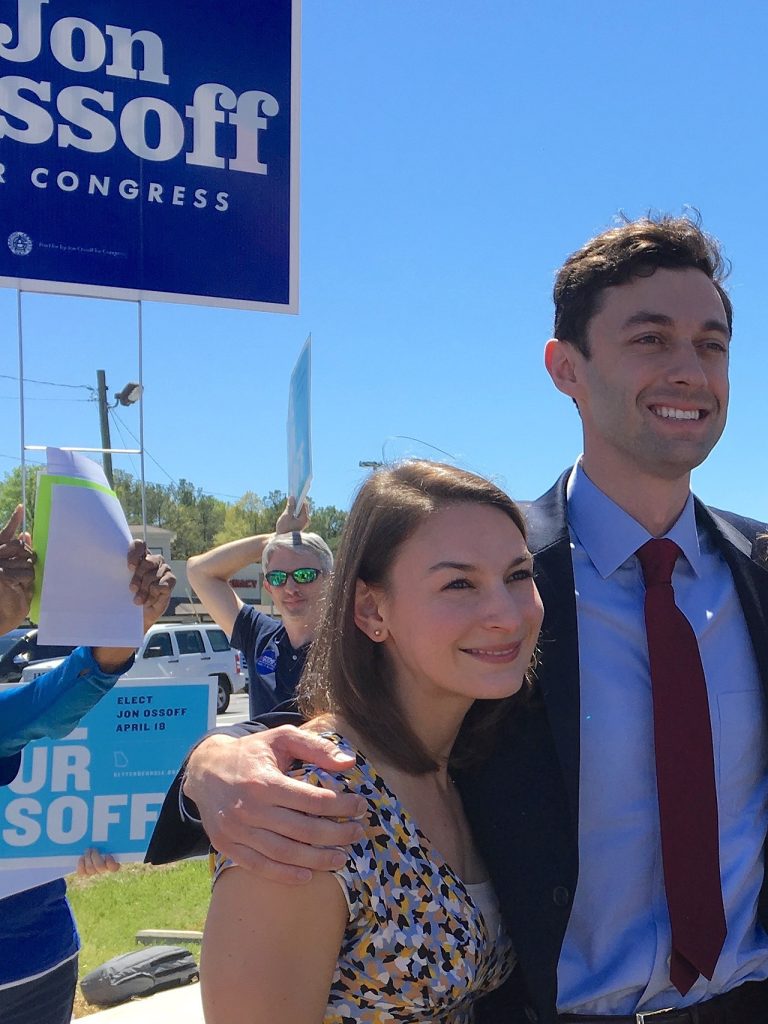
Jon Ossoff and gubernatorial nominee Keisha Lance Bottoms appearing together in Atlanta while Republicans were still attacking each other in dual June 16 runoffs for Senate and governor, a split-screen that underscored the biggest new development in the race: Democrats are already running a general-election message while the GOP is still burning time and money in intraparty combat. Republicans are still locked in a June 16 runoff for the Senate nomination between Collins and Dooley, and a separate gubernatorial runoff that will determine who faces Bottoms in November.

That means the GOP is spending the first half of June fighting internally while Ossoff, who was unopposed for renomination, and Bottoms, who already won the Democratic gubernatorial nomination on May 19, are free to consolidate donors, define their opponents, and energize base voters statewide. Ossoff used the moment to dismiss the Republican Senate runoff as irrelevant to his broader attack, telling supporters of Rep.

Meanwhile, The Guardian reported that Ossoff entered the stretch with more than $30 million on hand, a huge financial cushion as Republicans keep draining resources against one another. Over $125 million was spent on the governor’s race primary, with Rick Jackson’s campaign contributing more than $66 million.

There is also a broader electoral twist here: Ossoff is the only Senate Democrat seeking reelection this year in a state Donald Trump carried in 2024, which should in theory make him highly vulnerable, yet the freshest reporting shows him operating from a position of visible confidence. Quick Summary: Ossoff’s Campaign Momentum Triggers Georgia Runoff Amid GOP Challenges Georgia’s May 19 primary left Republicans without a clear winner in Senate and governor races, forcing a runoff.

Ossoff has over $30 million on hand, providing a financial advantage as Republicans continue to drain resources. Georgia’s May 19 primary saw no Republican candidate clear the 50% threshold in key races, leading to a June 16 runoff.

The scale and speed of this development has caught many observers off guard. Each new update adds another dimension to a story that is still unfolding, and the full picture will only become clear as more verified details emerge from the people and institutions directly involved.

Analysts who have tracked this issue closely say the current moment represents a genuine turning point. The decisions made in the coming weeks are expected to set the direction for months ahead, with ripple effects likely to extend well beyond the immediate actors in the story.

For those directly affected, the practical impact is already visible. People navigating this fast-changing situation are dealing with real consequences while new information continues to reshape what is known and what remains open to interpretation.

Historical parallels offer some context, though experts caution against drawing too close a comparison. Similar situations have played out before, but the specific combination of pressures, personalities, and timing here makes this moment distinct in ways that matter for how it ultimately resolves.

The political and economic dimensions of this story are deeply intertwined. What appears as a single event on the surface is in practice the convergence of multiple pressures that have been building quietly over a longer period than most public reporting has captured.
Read more on Digital Chew

Graham Platner Reported Escalating Internal Democratic Concerns

Quick Summary: Graham Platner Reported Escalating Internal Democratic Concerns

  • Graham Platner’s campaign has not denied allegations of exchanging explicit messages with women post-marriage.
  • Major media outlets reported the scandal on May 31, escalating internal Democratic concerns.
  • Despite the controversy, Bernie Sanders continues to support Platner, highlighting party divisions.
  • Platner’s wife, Amy Gertner, initially raised the alarm but now defends him publicly.
  • The scandal’s impact on the crucial Maine Senate race remains uncertain.

The Graham Platner scandal is a political storm that threatens to upend the Democratic strategy in a critical Senate race. Reports of Platner exchanging explicit messages with multiple women have not been denied by his campaign, leaving the party grappling with a potential electoral liability.

As the scandal broke on May 31, Democrats were forced to confront the uncomfortable truth: can they afford to back a candidate embroiled in such controversy? Bernie Sanders has chosen to stand by Platner, but this decision has only deepened the rift within the party, as others question the candidate’s viability.

The situation is further complicated by Platner’s wife, Amy Gertner, who initially alerted campaign aides about the messages but has since taken a public stance in her husband’s defense. This reversal adds another layer of complexity to an already fraught situation, raising questions about the campaign’s transparency and judgment.

With the Maine Senate seat at stake, the Democratic Party faces a critical decision. Do they rally behind Platner, risking the scandal’s fallout, or seek an alternative candidate? The outcome of this dilemma will have significant implications for their chances against Republican Senator Susan Collins.

As the story unfolds, the focus remains on whether Platner can maintain support within his party and among voters. The scandal has become a litmus test for Democratic unity and strategy, with the potential to reshape the political landscape in Maine.

The biggest new turn is that Graham Platner is not retreating after reports that he sent sexually explicit texts to other women while married; instead, he is going to Washington on Tuesday, June 2, for meetings with Democratic senators and fundraisers even as senior Democrats openly question whether the scandal is survivable in one of the party’s most important 2026 Senate races. The core revelation driving the story is that Platner’s campaign has not denied the central allegation reported over the weekend: that after marrying Amy Gertner in late 2023, he exchanged explicit messages with other women, and that Gertner herself told a senior aide about it last year.

” The reporting also places the disclosure on a specific timeline: Amy Gertner reportedly informed then-political director Genevieve McDonald about the messages ahead of a Labor Day rally last fall, meaning aides were allegedly aware of the matter months before it blew up publicly at the end of May 2026. On Saturday, May 31, major outlets published the initial reports about the sexually explicit texts and the prior internal warning to aides.

By Monday, June 1, Sanders had publicly stood by him, and by Tuesday, June 2, Axios reported he was still scheduled for meetings with senators in Washington. Axios reported that Democrats are now debating whether this was the “final embarrassment – or merely its latest,” while AP said Sanders is still backing him despite the uproar.

Andy Kim said, “the character and the transparency about the different candidates is going to come out,” and “the voters will decide” whether they can trust candidates. ” Forbes similarly said he dismissed the reports as “gossip” before later acknowledging that he and his wife “went through something hard” because of him.

AP reported that she called the coverage “shameful,” and said Platner posted a weekend video taken by Gertner as part of the damage-control effort. The broader stakes are explicit in the latest reporting, which frames Maine as a crucial Senate battleground and Platner as the presumptive Democratic nominee trying to unseat Collins.

The core revelation driving the story is that Platner’s campaign has not denied the central allegation reported over the weekend: that after marrying Amy Gertner in late 2023, he exchanged explicit messages with other women, and that Gertner herself told a senior aide about it last year. Major media outlets reported the scandal on May 31, escalating internal Democratic concerns.

On Saturday, May 31, major outlets published the initial reports about the sexually explicit texts and the prior internal warning to aides. By Monday, June 1, Sanders had publicly stood by him, and by Tuesday, June 2, Axios reported he was still scheduled for meetings with senators in Washington.

The situation is further complicated by Platner’s wife, Amy Gertner, who initially alerted campaign aides about the messages but has since taken a public stance in her husband’s defense. With the Maine Senate seat at stake, the Democratic Party faces a critical decision.

The scale and speed of this development has caught many observers off guard. Each new update adds another dimension to a story that is still unfolding, and the full picture will only become clear as more verified details emerge from the people and institutions directly involved.

Analysts who have tracked this issue closely say the current moment represents a genuine turning point. The decisions made in the coming weeks are expected to set the direction for months ahead, with ripple effects likely to extend well beyond the immediate actors in the story.

For those directly affected, the practical impact is already visible. People navigating this fast-changing situation are dealing with real consequences while new information continues to reshape what is known and what remains open to interpretation.

Historical parallels offer some context, though experts caution against drawing too close a comparison. Similar situations have played out before, but the specific combination of pressures, personalities, and timing here makes this moment distinct in ways that matter for how it ultimately resolves.

The political and economic dimensions of this story are deeply intertwined. What appears as a single event on the surface is in practice the convergence of multiple pressures that have been building quietly over a longer period than most public reporting has captured.
Read more on Digital Chew

Tina Peters Released Early as Trump – Backed Pressure Sparks Colorado Political Clash

Quick Summary: Tina Peters Released Early as Trump – Backed Pressure Sparks Colorado Political Clash

  • Tina Peters released from Colorado prison after serving less than two years of a nine-year sentence.
  • Governor Jared Polis commuted her sentence, citing concerns over protected speech.
  • Peters immediately resumed election-fraud claims, thanking Trump for his support.
  • Trump’s pressure campaign played a significant role in Peters’s early release.
  • Colorado Democrats censured Governor Polis, intensifying political tensions.

Tina Peters’s release from a Colorado prison has reignited a fierce debate over election integrity and political influence. After serving less than two years of a nearly nine-year sentence for allowing unauthorized access to election equipment, Peters walked free, thanks to a commutation by Governor Jared Polis. But rather than retreat into obscurity, she immediately resumed her election-fraud claims, thanking former President Donald Trump for his support.

Governor Polis’s decision to commute Peters’s sentence was met with severe backlash, particularly from his own party. The Colorado Democratic Party voted to censure him, a rare and striking rebuke for a sitting governor. Polis defended his decision, arguing that the original sentence was excessively harsh and influenced by Peters’s protected speech. However, Peters’s immediate return to the spotlight, fueled by Trump’s pressure campaign, has only intensified the controversy.

This development has broader implications for the political landscape in Colorado and beyond. Peters’s release and her subsequent actions have emboldened the election denial movement, raising questions about accountability and the influence of political figures like Trump. Colorado Secretary of State Jena Griswold warned that Peters’s release sends a dangerous message about election integrity and accountability.

As Peters continues to appeal her conviction and plans to advocate for what she calls “election integrity,” the political and legal ramifications of her release are just beginning to unfold. The next few weeks will be critical in determining whether her reemergence will further damage Governor Polis’s standing, energize Trump-aligned activists, and shape Colorado’s political battles over election administration and the governor’s legacy.

The next pressure point is whether her reemergence as a public election-fraud advocate deepens the damage to Polis, energizes Trump-aligned activists, and shapes Colorado’s 2026 political fights over election administration and the governor’s legacy. The key hard number is that Peters had been serving a nearly nine-year state prison sentence imposed in 2024 for allowing unauthorized access to Mesa County election equipment after the 2020 election, and Polis cut that punishment roughly in half, making her eligible for release on June 1, 2026.

The sharpest new development is that Tina Peters walked out of a Colorado prison on Monday, June 1, and almost immediately used her first public appearance to revive the same election-fraud claims that led to her conviction, undercutting Governor Jared Polis’s argument that clemency was about sentence fairness rather than absolution. Peters is still appealing her conviction to the Colorado Supreme Court, according to CPR, and she said she plans to spend “the next few weeks recuperating with family” while continuing, in her words, to support “election integrity” through legal means.

Rather than step back, Peters thanked Trump directly, saying, “I want to tell him thank you for the efforts he put in to draw attention also to my situation,” and said the only two letters she wrote in prison were both to him. ” Colorado Politics reported that a supporter outside the prison said, “It’s a happy, happy day,” while about two dozen people, including media and supporters from as far away as Grand Junction, waited for her exit.

What happens next is less about another immediate court hearing than about the political and legal aftershocks. The central conflict now is no longer just Peters versus the state; it is whether a Democratic governor effectively rewarded a national election denier after a pressure campaign by President Donald Trump.

Polis defended the commutation on May 15 by saying, “She committed a crime,” and stressing that he was not pardoning her, only correcting what he saw as an excessive sentence shaped by protected speech concerns. A surprising and story-defining wrinkle is that even some officials and observers who oppose Peters’s election lies have focused on a narrower legal issue: whether the trial judge relied too heavily on her speech and beliefs in imposing sentence.

After serving less than two years of a nearly nine-year sentence for allowing unauthorized access to election equipment, Peters walked free, thanks to a commutation by Governor Jared Polis. But rather than retreat into obscurity, she immediately resumed her election-fraud claims, thanking former President Donald Trump for his support.

Colorado Secretary of State Jena Griswold warned that Peters’s release sends a dangerous message about election integrity and accountability. Quick Summary: Tina Peters Released Early as Trump – Backed Pressure Sparks Colorado Political Clash Tina Peters released from Colorado prison after serving less than two years of a nine-year sentence.

Peters immediately resumed election-fraud claims, thanking Trump for his support. Rather than step back, Peters thanked Trump directly, saying, “I want to tell him thank you for the efforts he put in to draw attention also to my situation,” and said the only two letters she wrote in prison were both to him.

Governor Jared Polis commuted her sentence, citing concerns over protected speech. Colorado Democrats censured Governor Polis, intensifying political tensions.

The scale and speed of this development has caught many observers off guard. Each new update adds another dimension to a story that is still unfolding, and the full picture will only become clear as more verified details emerge from the people and institutions directly involved.

Analysts who have tracked this issue closely say the current moment represents a genuine turning point. The decisions made in the coming weeks are expected to set the direction for months ahead, with ripple effects likely to extend well beyond the immediate actors in the story.

For those directly affected, the practical impact is already visible. People navigating this fast-changing situation are dealing with real consequences while new information continues to reshape what is known and what remains open to interpretation.

Historical parallels offer some context, though experts caution against drawing too close a comparison. Similar situations have played out before, but the specific combination of pressures, personalities, and timing here makes this moment distinct in ways that matter for how it ultimately resolves.

The political and economic dimensions of this story are deeply intertwined. What appears as a single event on the surface is in practice the convergence of multiple pressures that have been building quietly over a longer period than most public reporting has captured.
Read more on Digital Chew

Georgia Runoff Set for June 16 as Mike Collins Targets Jon Ossoff in Debate

Quick Summary: Georgia Runoff Set for June 16 as Mike Collins Targets Jon Ossoff in Debate

  • More than 2 million Georgians voted in the primaries, with the runoff set for June 16.
  • Mike Collins focused on attacking Democrat Jon Ossoff during the debate, ignoring rival Derek Dooley.
  • Derek Dooley criticized Collins’ ethics and conduct, aiming to make it a referendum on character.
  • Collins dismissed Dooley’s attacks, calling them a “nothing burger” filed by an anonymous complaint.
  • The debate highlighted little policy difference between Collins and Dooley, focusing instead on character.

In a heated Georgia runoff debate, Republican Senate front-runner Mike Collins chose to target Democratic Senator Jon Ossoff rather than engage his immediate rival, Derek Dooley. This strategic decision suggests Collins is already looking past the primary, aiming directly at the general election.

Despite finishing a close second in the May 19 primary, Dooley used the debate stage to challenge Collins on ethics, questioning his refusal to pledge term limits and his involvement in stock trading. Dooley’s approach was to paint himself as the cleaner, outsider candidate, contrasting Collins’ approach of projecting strength and inevitability.

The debate, which revealed little ideological difference between Collins and Dooley, has turned into a battle of character and ethics rather than policy. With no Trump endorsement and a lack of major policy splits, the runoff is shaping up to be a test of personality and voter enthusiasm.

As early voting approaches, the key question remains whether Dooley’s focus on ethics will sway voters or if Collins’ strategy of bypassing his rival to attack Ossoff will prove effective. The outcome could hinge on late endorsements or shifts in voter sentiment.

Early voting for the June 16 Senate runoff begins June 9, according to GPB, and the winner will move on to face Ossoff in November. The AJC’s latest report says more than 2 million Georgians voted in last month’s statewide primaries, but the next decisive date is June 16, when voters return for the runoff that will settle several marquee November matchups.

” That matters because Republicans see Ossoff as a top target in 2026, especially after Donald Trump carried Georgia in 2024. Georgia’s June 16 runoff fight snapped into focus after Sunday’s Atlanta Press Club debate marathon, where Republican Senate front-runner Mike Collins largely ignored rival Derek Dooley and trained his fire on Democratic Sen.

Dooley, who finished a close second to Collins in the May 19 primary, used the debate to make the runoff a referendum on Collins’ conduct rather than ideology. representative from Jackson, behaved “as if the race were already over,” according to the AJC, spending much of the debate attacking Ossoff rather than engaging Dooley.

The AJC reported that Dooley accused Collins of refusing to pledge to serve only two terms and to forgo stock and cryptocurrency trading if elected. The AJC’s reporting suggests there is little daylight between Collins and Dooley on policy, and said the debate “did not reveal much” ideological difference between them.

According to the AJC, Jackson cited a scheduling conflict, while Jones mocked the explanation by saying he had turned down a White House invitation to make the debate. Collins’ sharpest line was aimed straight at the incumbent Democrat: “Our current senator, Jon Ossoff, he doesn’t represent us.

In a heated Georgia runoff debate, Republican Senate front-runner Mike Collins chose to target Democratic Senator Jon Ossoff rather than engage his immediate rival, Derek Dooley. Georgia’s June 16 runoff fight snapped into focus after Sunday’s Atlanta Press Club debate marathon, where Republican Senate front-runner Mike Collins largely ignored rival Derek Dooley and trained his fire on Democratic Sen.

Dooley, who finished a close second to Collins in the May 19 primary, used the debate to make the runoff a referendum on Collins’ conduct rather than ideology. The debate, which revealed little ideological difference between Collins and Dooley, has turned into a battle of character and ethics rather than policy.

representative from Jackson, behaved “as if the race were already over,” according to the AJC, spending much of the debate attacking Ossoff rather than engaging Dooley. The AJC’s reporting suggests there is little daylight between Collins and Dooley on policy, and said the debate “did not reveal much” ideological difference between them.

The scale and speed of this development has caught many observers off guard. Each new update adds another dimension to a story that is still unfolding, and the full picture will only become clear as more verified details emerge from the people and institutions directly involved.

Analysts who have tracked this issue closely say the current moment represents a genuine turning point. The decisions made in the coming weeks are expected to set the direction for months ahead, with ripple effects likely to extend well beyond the immediate actors in the story.

For those directly affected, the practical impact is already visible. People navigating this fast-changing situation are dealing with real consequences while new information continues to reshape what is known and what remains open to interpretation.

Historical parallels offer some context, though experts caution against drawing too close a comparison. Similar situations have played out before, but the specific combination of pressures, personalities, and timing here makes this moment distinct in ways that matter for how it ultimately resolves.

The political and economic dimensions of this story are deeply intertwined. What appears as a single event on the surface is in practice the convergence of multiple pressures that have been building quietly over a longer period than most public reporting has captured.

Read more on Digital Chew

Illinois Senate Passes Stadium Bill Leaving Bears’ Future Uncertain

Quick Summary: Illinois Senate Passes Stadium Bill Leaving Bears’ Future Uncertain

  • The Illinois Senate passed a stadium bill on June 1, but the House adjourned without voting, leaving the Bears’ future uncertain.
  • Mayor Johnson’s push to keep the Bears in Chicago disrupted broader state projects, complicating legislative support.
  • The Bears have narrowed their stadium options to Arlington Heights and Hammond, Indiana, signaling a decision soon.
  • Governor Pritzker criticized Mayor Johnson’s lack of a concrete plan and opposed public funding for stadium construction.
  • State Rep. Kelly Cassidy argued against taxpayer-funded stadiums, emphasizing corporate responsibility.

The Illinois Senate’s last-minute push to pass a stadium bill aimed at keeping the Chicago Bears in the state has hit a wall, as the House adjourned without a vote. This legislative inaction has left the Bears’ future hanging in the balance, with the team now focusing on suburban options.

Mayor Brandon Johnson’s attempts to revive Chicago’s candidacy for the Bears’ new stadium have stirred controversy and disrupted broader state initiatives. Despite his efforts, the Bears remain firm in their stance, considering only Arlington Heights and Hammond, Indiana, for their new home.

Governor JB Pritzker has openly criticized Johnson’s approach, highlighting the absence of a solid plan to keep the team in Chicago. He remains steadfast in his opposition to using public funds for stadium construction, focusing instead on taxpayer protection.

As the legislative session concluded without a resolution, the Bears are poised to make a decision based on their own timeline. With Arlington Heights and Hammond as the only contenders, the pressure mounts on Illinois officials to act swiftly if they hope to retain the team.

” The most consequential detail in the latest reporting is that the compromise legislation passed the Illinois Senate early Monday, June 1, but died for now when the House ended its spring session without taking it up. Early Monday, June 1, the Senate passed it, but the House never followed.

Sun-Times reporting from the past week said Johnson’s effort to revive Chicago as an option actually pulled support from the broader Illinois “megaprojects” push, with Senate sponsor Bill Cunningham saying the mayor’s lobbying “breathed life” into the claim that Chicago still had a chance. 4 billion in public support and went nowhere in Springfield.

The most specific mechanics of the Senate compromise came into focus in ABC7’s reporting late Sunday, June 1. On Sunday night, June 1, the Senate filed the compromise bill in the final hours before adjournment.

AP reported that this would have created a pathway for the Bears to stay in Illinois without direct state stadium construction money, but the legislative window closed before the House acted. In one statement reported by the Sun-Times, the team said, “The Chicago Bears have exhausted every opportunity to stay in Chicago, which was our initial goal.

Kelly Cassidy said, “At the end of the day, a billion-dollar corporation can build their own stadium, pay their taxes, and leave us out of it,” neatly capturing the fairness argument that helped stall the measure. The central fight is now a three-sided conflict between the Bears, Mayor Brandon Johnson, and Gov.

Governor Pritzker criticized Mayor Johnson’s lack of a concrete plan and opposed public funding for stadium construction. Mayor Brandon Johnson’s attempts to revive Chicago’s candidacy for the Bears’ new stadium have stirred controversy and disrupted broader state initiatives.

The scale and speed of this development has caught many observers off guard. Each new update adds another dimension to a story that is still unfolding, and the full picture will only become clear as more verified details emerge from the people and institutions directly involved.

Analysts who have tracked this issue closely say the current moment represents a genuine turning point. The decisions made in the coming weeks are expected to set the direction for months ahead, with ripple effects likely to extend well beyond the immediate actors in the story.

For those directly affected, the practical impact is already visible. People navigating this fast-changing situation are dealing with real consequences while new information continues to reshape what is known and what remains open to interpretation.

Historical parallels offer some context, though experts caution against drawing too close a comparison. Similar situations have played out before, but the specific combination of pressures, personalities, and timing here makes this moment distinct in ways that matter for how it ultimately resolves.

The political and economic dimensions of this story are deeply intertwined. What appears as a single event on the surface is in practice the convergence of multiple pressures that have been building quietly over a longer period than most public reporting has captured.

Read more on Digital Chew