

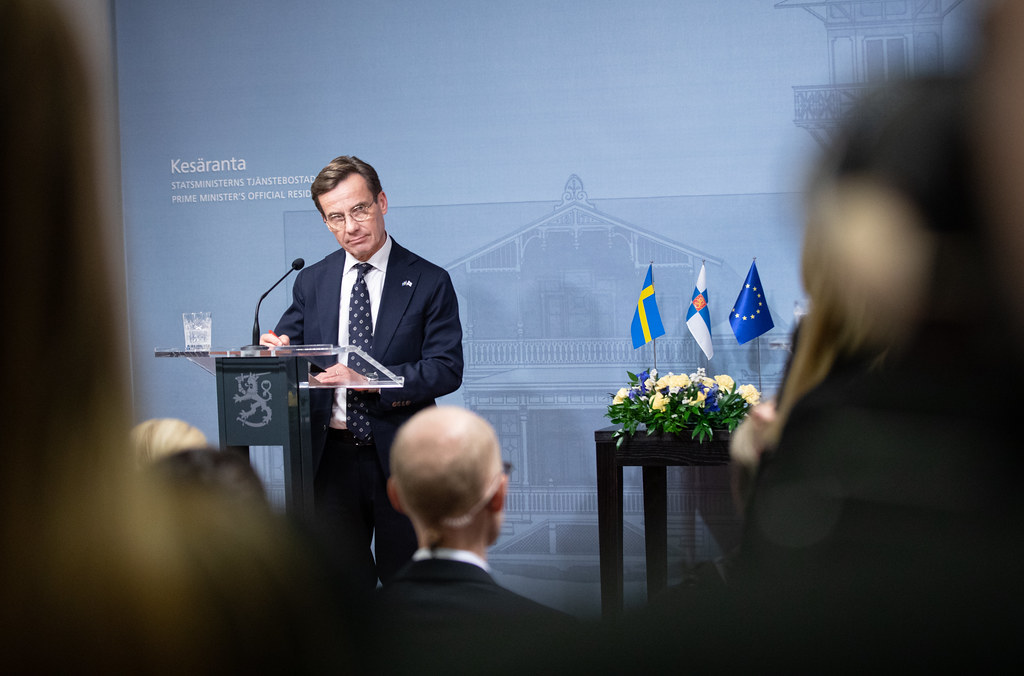

Quick Summary: Prime Minister Kristersson Faces Backlash Over Far
- Prime Minister Ulf Kristersson has opened the door to the Sweden Democrats joining the government, indicating a significant political shift.
- The Sweden Democrats, with roots in neo-Nazi movements, could move from parliamentary support to holding cabinet positions.
- This development follows the AfD’s 44% victory in Saxony-Anhalt, Germany, raising fears of a broader far-right breakthrough in Europe.
- Le Monde reported allegations against a Sweden Democrats employee for spreading pro-Russian disinformation, adding controversy.
- Sweden’s election on September 13 will determine if the far right gains formal executive power, impacting European politics.
Source: Open external resource
Source: Read original article
In a political landscape already fraught with tension, Sweden’s Prime Minister Ulf Kristersson has shocked many by potentially bringing the Sweden Democrats into the heart of government. This move, just days before the election, could see a party with neo-Nazi roots transition from parliamentary support to holding cabinet positions. Far is at the center of this development.
The Sweden Democrats’ potential rise comes hot on the heels of the AfD’s staggering 44% victory in Saxony-Anhalt, Germany, which sent ripples of concern across Europe. This victory has been a stark reminder of the far-right’s growing influence, and Sweden’s election could be a pivotal moment in this trend.
Adding fuel to the fire, an investigation by the magazine Expo has alleged that a Sweden Democrats employee, Polina Malaberg, spread pro-Russian disinformation. This revelation is particularly explosive given Sweden’s recent NATO membership and the ongoing geopolitical tensions with Russia.
As Sweden heads to the polls on September 13, the stakes couldn’t be higher. The election will not only decide the next government but also test Europe’s ability to resist the rising tide of far-right politics. The outcome could either embolden or halt the far-right’s momentum across the continent.
Sweden’s election is more than a local affair; it is a litmus test for Europe’s political future. Whether the Sweden Democrats gain formal power or not, the implications will resonate far beyond Sweden’s borders.
According to that report, she worked from 2017 to 2024 for the party in parliament and later became a political expert tied to the Constitutional Committee; the issue became more explosive because she is the partner of Gustav Gellerbrant, described as one of the key architects of the coalition arrangement and seconded to the government’s general secretariat since 2022. Le Monde reported that on Thursday, September 3, the anti-racist magazine Expo published an investigation into Polina Malaberg, a Sweden Democrats employee and former parliamentary assistant, alleging she had spread pro-Russian disinformation over more than a decade while holding roles with access to sensitive material.
Sweden’s election has been jolted by a last-minute normalization of the far right: Prime Minister Ulf Kristersson has now explicitly opened the door to bringing the Sweden Democrats into government if his bloc wins on Sunday, September 13, a step that would move a party with roots in neo-Nazi movements from outside support to the cabinet table. AP reported that Kristersson said on Wednesday that his Moderates would allow the Sweden Democrats into a future government, after the Liberals made a similar shift last month.
6 million are now eligible to decide whether that influence becomes formal executive power. ” That shift comes only a week after the AfD’s shock 44% victory in Saxony-Anhalt in Germany, where the party finished nearly 27 points ahead of the CDU and pushed Europe-wide fears of a broader far-right breakthrough.
Le Monde said the questions are serious because Malaberg had access to files of “particular interest” to Russia, according to Swedish intelligence concerns cited in the report. Across Europe, officials will also be watching the spillover effect from Germany, where after the AfD’s 44% result in Saxony-Anhalt, two more state elections are due on September 20 in Berlin and Mecklenburg-Western Pomerania, giving this Swedish vote added weight as a test of whether the far-right surge is still accelerating or has hit resistance.
The most vivid reporting this week has focused on how deeply the Sweden Democrats have already reshaped political debate before even entering government. Munir Niazi said, “It’s a kind of Pandora’s box that has been opened,” while another activist said the party had used its leverage to steer policy on migration and crime.
Le Monde reported that on Thursday, September 3, the anti-racist magazine Expo published an investigation into Polina Malaberg, a Sweden Democrats employee and former parliamentary assistant, alleging she had spread pro-Russian disinformation over more than a decade while holding roles with access to sensitive material. This development follows the AfD’s 44% victory in Saxony-Anhalt, Germany, raising fears of a broader far-right breakthrough in Europe.
The Sweden Democrats’ potential rise comes hot on the heels of the AfD’s staggering 44% victory in Saxony-Anhalt, Germany, which sent ripples of concern across Europe. Sweden’s election has been jolted by a last-minute normalization of the far right: Prime Minister Ulf Kristersson has now explicitly opened the door to bringing the Sweden Democrats into government if his bloc wins on Sunday, September 13, a step that would move a party with roots in neo-Nazi movements from outside support to the cabinet table.
” That shift comes only a week after the AfD’s shock 44% victory in Saxony-Anhalt in Germany, where the party finished nearly 27 points ahead of the CDU and pushed Europe-wide fears of a broader far-right breakthrough. In a political landscape already fraught with tension, Sweden’s Prime Minister Ulf Kristersson has shocked many by potentially bringing the Sweden Democrats into the heart of government.
Across Europe, officials will also be watching the spillover effect from Germany, where after the AfD’s 44% result in Saxony-Anhalt, two more state elections are due on September 20 in Berlin and Mecklenburg-Western Pomerania, giving this Swedish vote added weight as a test of whether the far-right surge is still accelerating or has hit resistance. This revelation is particularly explosive given Sweden’s recent NATO membership and the ongoing geopolitical tensions with Russia.
The scale and speed of this development has caught many observers off guard. Each new update adds another dimension to a story that is still unfolding, and the full picture will only become clear as more verified details emerge from the people and institutions directly involved.
Analysts who have tracked this issue closely say the current moment represents a genuine turning point. The decisions made in the coming weeks are expected to set the direction for months ahead, with ripple effects likely to extend well beyond the immediate actors in the story.
For those directly affected, the practical impact is already visible. People navigating this fast-changing situation are dealing with real consequences while new information continues to reshape what is known and what remains open to interpretation.
Historical parallels offer some context, though experts caution against drawing too close a comparison. Similar situations have played out before, but the specific combination of pressures, personalities, and timing here makes this moment distinct in ways that matter for how it ultimately resolves.
The political and economic dimensions of this story are deeply intertwined. What appears as a single event on the surface is in practice the convergence of multiple pressures that have been building quietly over a longer period than most public reporting has captured.