

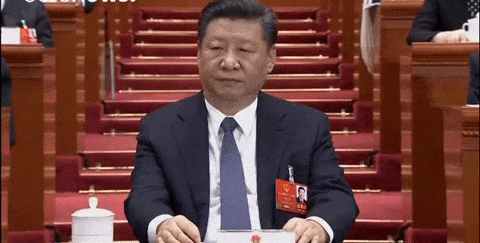

Quick Summary: Xi Jinping Advocates for SCO’s Role in Shaping Global Rules
- Xi Jinping urged the SCO to reshape global governance, aiming for a more equitable system.
- At the SCO summit, Xi emphasized building partnerships over alliances to distinguish from Western blocs.
- Xi highlighted the SCO’s demographic and economic scale, claiming it represents half of the world’s population.
- The summit included key figures like Putin and Modi, highlighting geopolitical tensions and alliances.
- Xi’s call for economic and technological coordination suggests a shift beyond security symbolism.
Source: Open external resource
Source: Read original article
Xi Jinping’s recent address at the Shanghai Cooperation Organization summit was a bold declaration for change. On September 1, Xi called on the SCO to be a force in creating a more just global governance system, challenging the current Western-centric order.
Xi’s speech was not just a call for reform but a strategic move to position the SCO as a counterbalance to U.S. influence. With the organization comprising major non-Western powers like China, Russia, and India, Xi argued that it has the scale to influence global rules.
The summit, attended by leaders such as Vladimir Putin and Narendra Modi, underscored the geopolitical complexities within the SCO. While Xi promoted unity, differing national priorities on issues like regional rivalry and war were evident.
Xi’s emphasis on economic and technological collaboration marks a potential evolution of the SCO’s role. By advocating for infrastructure and tech development, Xi aims to transform the SCO into a platform for broader cooperation.
As the summit concluded, the real question remains whether Xi’s vision will translate into concrete actions or remain aspirational rhetoric. The coming months will reveal if member states align with Xi’s call for a multipolar world.
He also said member states should remain committed to “building partnerships rather than alliances, and engaging in dialogue rather than confrontation,” a line clearly designed to distinguish the SCO from formal Western military blocs even as critics are likely to see it as an effort to build parallel influence structures under another name. On August 31, leaders gathered in Bishkek ahead of the formal sessions; on September 1, Xi delivered the SCO Plus speech and separately took part in the summit proper; AP reported that bilateral meetings involving Putin, Xi and Modi were taking place on the sidelines the same week.
The core conflict driving the story is the widening contest over who writes international rules and whether the existing system should remain Western-centered. Xi said the SCO now brings together “half of the world’s population and a quarter of the global economy,” a claim meant to bolster his argument that the organization has the scale to shape global governance rather than simply comment on it.
Xi appeared in Bishkek alongside Russian President Vladimir Putin and Indian Prime Minister Narendra Modi, while Iranian President Masoud Pezeshkian was also expected for talks. Xi Jinping’s latest push at the Shanghai Cooperation Organization summit in Bishkek was a blunt call to use the SCO as a vehicle for reshaping global rules, with Xi arguing on September 1 that the bloc should help make global governance “more just and equitable” while amplifying the political weight of the Global South.
Separate reporting from AP describes the SCO as a 10-nation grouping that now includes China, Russia, India, Iran, Pakistan, Belarus, Kazakhstan, Kyrgyzstan, Tajikistan and Uzbekistan, giving Xi a ready-made audience of major non-Western powers and rivals of the United States. ” That wording is significant because it turns a routine summit speech into a direct challenge to the Western-led balance of influence in global institutions.
The main figures around this week’s summit reinforce that split between grand rhetoric and messy reality. A notable twist is that Xi paired sweeping ideological language with a narrower, highly practical pitch for economic and technological coordination.
On August 31, leaders gathered in Bishkek ahead of the formal sessions; on September 1, Xi delivered the SCO Plus speech and separately took part in the summit proper; AP reported that bilateral meetings involving Putin, Xi and Modi were taking place on the sidelines the same week. On September 1, Xi called on the SCO to be a force in creating a more just global governance system, challenging the current Western-centric order.
Xi said the SCO now brings together “half of the world’s population and a quarter of the global economy,” a claim meant to bolster his argument that the organization has the scale to shape global governance rather than simply comment on it. Xi Jinping’s latest push at the Shanghai Cooperation Organization summit in Bishkek was a blunt call to use the SCO as a vehicle for reshaping global rules, with Xi arguing on September 1 that the bloc should help make global governance “more just and equitable” while amplifying the political weight of the Global South.
Xi highlighted the SCO’s demographic and economic scale, claiming it represents half of the world’s population. The summit included key figures like Putin and Modi, highlighting geopolitical tensions and alliances.
The scale and speed of this development has caught many observers off guard. Each new update adds another dimension to a story that is still unfolding, and the full picture will only become clear as more verified details emerge from the people and institutions directly involved.
Analysts who have tracked this issue closely say the current moment represents a genuine turning point. The decisions made in the coming weeks are expected to set the direction for months ahead, with ripple effects likely to extend well beyond the immediate actors in the story.
For those directly affected, the practical impact is already visible. People navigating this fast-changing situation are dealing with real consequences while new information continues to reshape what is known and what remains open to interpretation.
Historical parallels offer some context, though experts caution against drawing too close a comparison. Similar situations have played out before, but the specific combination of pressures, personalities, and timing here makes this moment distinct in ways that matter for how it ultimately resolves.
The political and economic dimensions of this story are deeply intertwined. What appears as a single event on the surface is in practice the convergence of multiple pressures that have been building quietly over a longer period than most public reporting has captured.