

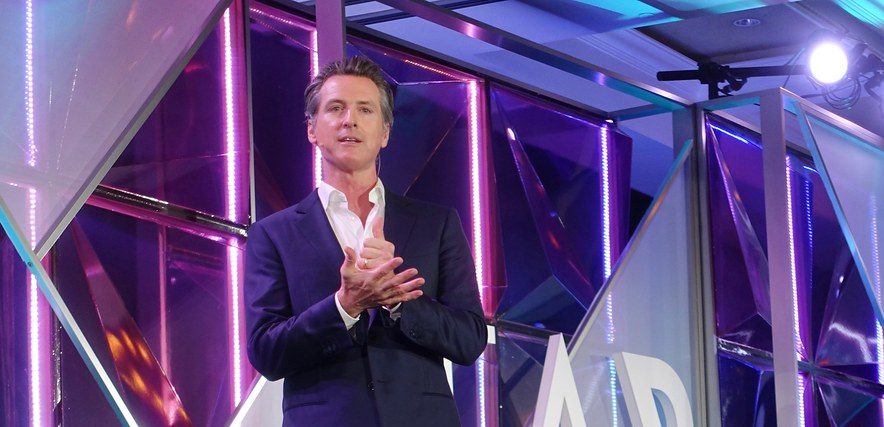

Quick Summary: Gavin Newsoms Executive Order Signals Ais Rising Political Stakes
- Gavin Newsom issued an executive order on AI, highlighting 2028 political stakes.
- Democratic candidate Cait Conley gained support by opposing AI data centers.
- Chris Murphy emphasized the need for Democrats to earn voter trust on AI.
- Senate Majority Leader John Thune is working on a proposal for AI regulation.
- Mentions of AI by 2028 candidates have increased sixfold, showing its rising political importance.
Source: Open external resource
Source: Read original article
The Democratic Party is waking up to the AI challenge, and it’s about time. While Donald Trump dismisses the need for federal oversight, potential Democratic candidates are racing to position themselves as the party that takes AI threats seriously. This sudden pivot isn’t just rhetoric; it’s a strategic move to capture voter trust and address what they see as an urgent national-security issue. Political is at the center of this development.
Gavin Newsom’s recent executive order on AI signals a bold political swing, with other Democrats like Josh Shapiro and Jon Ossoff following suit. They’re not just talking; they’re proposing concrete measures like pausing advanced AI development and demanding stronger federal oversight. Meanwhile, Trump continues to downplay the risks, framing AI as a realm for acceleration rather than caution.
This political scramble reflects a broader concern: voters in battleground districts don’t trust either party on AI, with 71% of independents expressing skepticism. Democrats see this as an opening to redefine their stance, but the challenge is to translate alarm into actionable policy. Senate Majority Leader John Thune’s proposal for AI regulation could be a turning point if it gains traction.
As the AI debate heats up, Democrats are expected to push sharper anti-AI messages in key races, especially where tech influence is a liability. The question is whether they can move beyond talk and deliver real legislative change before it’s too late.
” On September 18, Axios reported that Gavin Newsom issued an executive order, making what it described as “big AI swings” that put 2028 politics squarely in view. The biggest new development is that Democrats with 2028 ambitions are suddenly converging around a far more aggressive AI-safety message, with Gavin Newsom, Josh Shapiro, Jon Ossoff and Elizabeth Warren all escalating their rhetoric this week while Donald Trump continues to wave off calls for a slowdown and stronger federal oversight.
The Post also reported internal polling presented by strategist Jesse Ferguson showing that 71 percent of independents in battleground districts trust neither party to handle AI, while 86 percent want Congress to act. The Post reported that in New York’s 17th Congressional District, Democratic candidate Cait Conley drew cheers at a Wednesday rally by vowing to ban the data centers that power AI and cloud computing.
The Post reported that Chris Murphy said, “For a lot of voters right now they’re not clear which party is taking the threat more seriously,” while also warning Democrats need to work harder to earn trust. Legislatively, the pressure point is whether Congress can move beyond talk toward a bill governing advanced AI capabilities; recent Post reporting said a proposal being worked on by Senate Majority Leader John Thune and Sen.
The Washington Post’s latest reporting says mentions of AI, OpenAI or Anthropic by high-profile likely 2028 candidates were six times as common last week as a month earlier, a sharp sign that the issue has broken into the center of Democratic positioning. The Post reported that Trump said the industry should not slow development and that the only guardrail it needs is a “smart” president.
On September 14, The Post reported that major AI firms had discussed creating a new safety body even as Trump opposed a slowdown. ” That quote captures the core divide: Trump is framing AI as something to accelerate, while Democrats are trying to cast it as an urgent national-security and public-safety threat.
The Post reported that in New York’s 17th Congressional District, Democratic candidate Cait Conley drew cheers at a Wednesday rally by vowing to ban the data centers that power AI and cloud computing. Mentions of AI by 2028 candidates have increased sixfold, showing its rising political importance.
This political scramble reflects a broader concern: voters in battleground districts don’t trust either party on AI, with 71% of independents expressing skepticism. The Post reported that Chris Murphy said, “For a lot of voters right now they’re not clear which party is taking the threat more seriously,” while also warning Democrats need to work harder to earn trust.
Legislatively, the pressure point is whether Congress can move beyond talk toward a bill governing advanced AI capabilities; recent Post reporting said a proposal being worked on by Senate Majority Leader John Thune and Sen. The Washington Post’s latest reporting says mentions of AI, OpenAI or Anthropic by high-profile likely 2028 candidates were six times as common last week as a month earlier, a sharp sign that the issue has broken into the center of Democratic positioning.
On September 14, The Post reported that major AI firms had discussed creating a new safety body even as Trump opposed a slowdown. While Donald Trump dismisses the need for federal oversight, potential Democratic candidates are racing to position themselves as the party that takes AI threats seriously.
The scale and speed of this development has caught many observers off guard. Each new update adds another dimension to a story that is still unfolding, and the full picture will only become clear as more verified details emerge from the people and institutions directly involved.
Analysts who have tracked this issue closely say the current moment represents a genuine turning point. The decisions made in the coming weeks are expected to set the direction for months ahead, with ripple effects likely to extend well beyond the immediate actors in the story.
For those directly affected, the practical impact is already visible. People navigating this fast-changing situation are dealing with real consequences while new information continues to reshape what is known and what remains open to interpretation.
Historical parallels offer some context, though experts caution against drawing too close a comparison. Similar situations have played out before, but the specific combination of pressures, personalities, and timing here makes this moment distinct in ways that matter for how it ultimately resolves.
The political and economic dimensions of this story are deeply intertwined. What appears as a single event on the surface is in practice the convergence of multiple pressures that have been building quietly over a longer period than most public reporting has captured.