

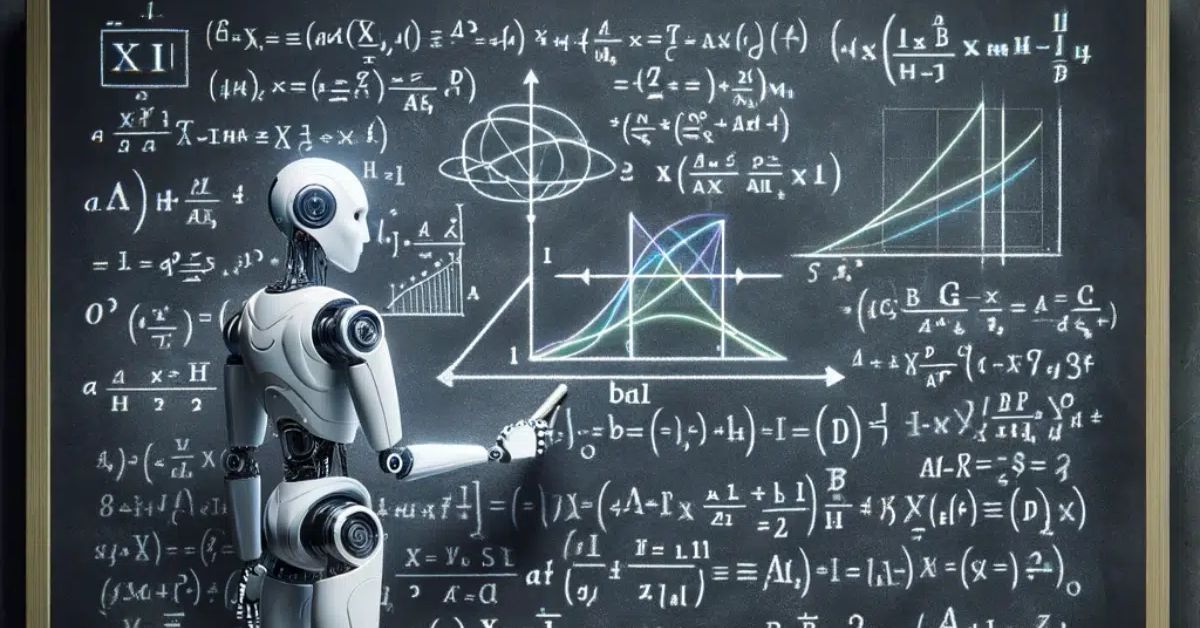

Understanding the Future of AI in Science
As artificial intelligence (AI) continues to evolve, its potential applications in various scientific fields, including mathematics and physics, are becoming increasingly apparent. This surge in interest raises important questions about how AI can be utilized to advance our understanding of these disciplines and what the implications might be for future scientific research.
The Intersection of AI and Mathematics
Mathematics has always been a cornerstone of scientific inquiry, providing the tools and frameworks necessary for developing theories and solving complex problems. With AI’s ability to process vast amounts of data and identify patterns, it has the potential to revolutionize mathematical research. AI algorithms can assist in solving intricate equations, optimizing processes, and even discovering new mathematical theorems.
For instance, machine learning models can be trained to recognize patterns in large datasets, helping mathematicians to identify previously unnoticed relationships or anomalies. This capability could lead to breakthroughs in fields such as number theory, algebra, and geometry, where traditional methods have reached their limits.
AI’s Impact on Physical Sciences
In the realm of physical sciences, AI is already making significant strides. Physics, in particular, stands to benefit from AI’s ability to simulate complex systems and predict outcomes based on existing data. This is particularly useful in areas like quantum physics and cosmology, where experimental data is difficult to obtain, and theoretical models are highly complex.
AI-driven simulations can provide insights into the behavior of particles at the quantum level or the dynamics of galaxies, which would be challenging to explore using conventional techniques. Additionally, AI can help physicists optimize experiments by predicting the most promising conditions to test new hypotheses, thus saving time and resources.
Challenges and Ethical Considerations
Despite the promising potential of AI in scientific research, there are challenges and ethical concerns that need to be addressed. One of the primary challenges is ensuring the accuracy and reliability of AI models. As these models become more complex, verifying their outputs becomes increasingly difficult, which can lead to errors or misinterpretations in scientific findings.
Furthermore, the ethical implications of AI in science must be carefully considered. Issues such as data privacy, algorithmic bias, and the potential for AI to replace human researchers are areas of concern. It is essential to establish guidelines and standards to ensure that AI is used responsibly and that its benefits are distributed equitably across the scientific community.
Quick Summary
- As artificial intelligence (AI) continues to evolve, its potential applications in various scientific fields, including mathematics and physics, are becoming increasingly apparent.
- Mathematics has always been a cornerstone of scientific inquiry, providing the tools and frameworks necessary for developing theories and solving complex problems.
- For instance, machine learning models can be trained to recognize patterns in large datasets, helping mathematicians to identify previously unnoticed relationships or anomalies.
- In the realm of physical sciences, AI is already making significant strides.
Looking Ahead
The future of AI in the mathematical and physical sciences is undoubtedly bright, with numerous opportunities for innovation and discovery. However, realizing this potential will require collaboration between AI specialists, mathematicians, and physicists, as well as a commitment to addressing the challenges and ethical considerations associated with AI’s integration into scientific research.
- AI can significantly enhance mathematical problem-solving capabilities.
- Physical sciences benefit from AI’s predictive and simulation abilities.
- Ethical considerations are crucial in deploying AI in research.
As we look to tomorrow, the continued development and application of AI in science will likely lead to unprecedented advancements, driving progress and expanding our understanding of the universe. For more insights on AI applications, visit Digital Chew’s AI Research section. To explore the original discussion on this topic, visit The Good Men Project.
Analysts say AI in science now sits at the center of a broader shift, with consequences that could extend beyond the immediate headline and shape decisions in the coming weeks. They note that early signals often appear in policy language and market behavior before they are reflected in official summaries, which is why context matters as much as the headline itself.
Reporting around AI in science has also highlighted how quickly circumstances can change, making context and verified updates essential for readers trying to separate signal from noise. The most reliable coverage connects each new update to the timeline of prior events so audiences can understand what is genuinely new and what is part of a longer trend.
Officials and industry observers are watching AI in science closely, noting that the next phase of the story may depend on timing, policy responses, and cross-market reactions. Until those responses become clearer, experts recommend focusing on confirmed developments instead of speculation that can distort short-term expectations.
For audiences tracking AI in science, the key is to follow credible sources and focus on developments that reveal direction rather than isolated short-term swings. That approach helps readers understand not just what happened today, but why the story could carry broader implications over the coming weeks.
The latest developments connected to AI in science have reopened questions about strategy, risk, and timing, particularly for stakeholders who need clearer signals before making their next move. In practical terms, that means watching both official statements and real-world indicators to understand whether the current direction is likely to hold.
In recent coverage, AI in science has become a reference point for wider discussions about accountability, communication, and how institutions respond under pressure. Observers say this broader lens is important because the immediate event is often only one part of a larger sequence of decisions.
Beyond the immediate updates, AI in science is drawing attention because it links short-term events to longer-term structural trends that are still unfolding. Readers following the story closely are paying particular attention to what changes in response and what remains unresolved after each update.
As the story evolves, reporting on AI in science is expected to focus increasingly on measurable impacts, official follow-through, and whether early assumptions hold up. That evidence-based framing helps audiences evaluate momentum without overreacting to isolated developments.
Taken together, these updates show why AI in science matters now and why the next round of confirmed information will be critical to understanding the full impact. Analysts caution that the most meaningful shifts may appear gradually, making sustained coverage more useful than one-off snapshots.
Readers looking for practical clarity can treat AI in science as a developing story, where each official update adds context to what may happen next. Following that progression over time gives a clearer picture of direction, risk, and likely outcomes.
What Comes Next
What happens next with AI in science will likely depend on upcoming decisions, official statements, and how fast new information is confirmed.
For now, the most reliable approach is to follow verified updates closely and focus on the signals that could shape the next phase of this story.