

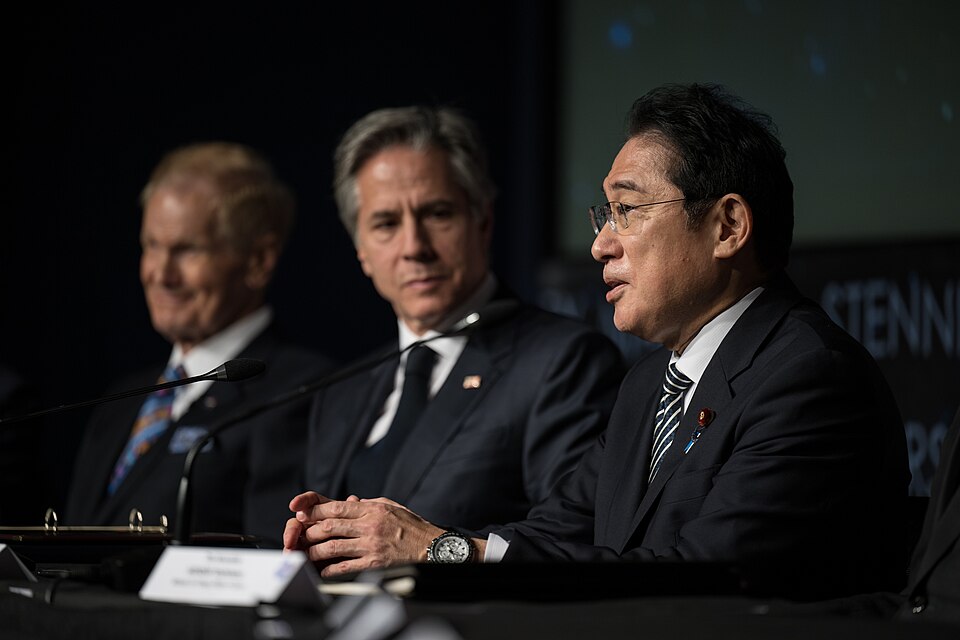

Quick Summary: Japan Commits Strategic Tech Alliance with US
- Japan commits $500 million to the U.S. Genesis Mission, marking a strategic tech alliance.
- The U.S.-Japan partnership aims to invest $1 billion over five years in advanced AI and quantum tech.
- This collaboration is seen as a counterbalance to China’s growing tech influence.
- Japan is the first foreign partner in the U.S. Genesis Mission, a project initiated by President Trump.
- The initiative focuses on AI-driven science, quantum computing, and biotechnology.
Source: Read original article
In a bold move to cement its position in the global tech race, Japan has officially joined the U.S. government’s Genesis Mission. This strategic partnership involves a substantial $500 million commitment from Japan, matched by the United States, to fuel a $1 billion investment in cutting-edge AI, quantum technology, nuclear fusion, and biotechnology over five years.
The Genesis Mission, originally launched by President Trump, is designed to accelerate scientific discovery through advanced AI. Japan’s entry into this initiative is more than symbolic; it signifies a concerted effort to counter China’s burgeoning tech prowess. By becoming the first foreign partner, Japan is aligning itself with the U.S. to form a formidable tech alliance aimed at maintaining technological supremacy.
This collaboration focuses on frontier science fields with dual-use implications, such as AI for scientific research and quantum computing. The U.S. Department of Energy and Japan’s education and science sectors, alongside major computing companies, are at the forefront of this endeavor. The initiative’s rapid timeline, aiming for initial operational capability within nine months, underscores the urgency of this tech race.
Japan’s involvement in the Genesis Mission is a clear signal of Washington’s intent to internationalize its AI-science stack before China can consolidate its own ecosystem. As Reflection AI’s CEO Misha Laskin aptly put it, “You can’t do scientific discovery on a closed model.” This statement highlights the ongoing debate over open versus closed AI models, adding another layer of complexity to this geopolitical and technological saga.
That matters because Genesis Mission was originally launched by President Donald Trump through a November 24, 2025 executive order directing the Department of Energy and national labs to build a centralized digital platform for scientific data and enlist companies and universities to solve engineering, energy, and national-security problems. That inference is supported by the timing of Reflection’s deal, announced on May 22, 2026, just days before the latest reports on Japan’s finalized entry.
-Japan investment of roughly $1 billion over five years in AI-driven science, quantum technology, nuclear fusion, and biotechnology, turning what had looked like a research partnership into an explicitly China-focused technology bloc. Current reports say Japan will put in about $500 million, matched by the United States for a total near $1 billion over five years, and the work will focus not on consumer chatbots but on frontier science fields with dual-use implications: AI for scientific research, quantum computing, fusion, and biotech.
On June 1, fresh reporting said Japan had finalized plans to join the initiative, with the financial commitment and China-balancing rationale now front and center. The next thing to watch is whether Tokyo and Washington publicly announce the deal with formal budget language, agency sign-offs, or named projects, because earlier Genesis reporting said the Department of Energy would define priority science challenges and move rapidly toward deployment.
In the most important Genesis-related reporting of the past week, Reflection AI’s CEO Misha Laskin, whose company is partnering with the Department of Energy to provide models for the mission, told Axios: “You can’t do scientific discovery on a closed model. Department of Energy, America’s national laboratories, Japan’s education and science bureaucracy, and a cluster of heavyweight computing companies.
Parallel reporting in January said Japan had become the first partner country in Genesis Mission after discussions in Osaka, and highlighted Fujitsu-Nvidia cooperation as one of the industrial pillars behind the diplomatic move. Another striking operational detail from reporting on the Genesis framework is that the platform aims to show an initial operating capability within nine months against at least one of the Department of Energy’s priority scientific challenges, giving the initiative a far shorter runway than many international R&D compacts.
That inference is supported by the timing of Reflection’s deal, announced on May 22, 2026, just days before the latest reports on Japan’s finalized entry. -Japan partnership aims to invest $1 billion over five years in advanced AI and quantum tech.
This strategic partnership involves a substantial $500 million commitment from Japan, matched by the United States, to fuel a $1 billion investment in cutting-edge AI, quantum technology, nuclear fusion, and biotechnology over five years. The Genesis Mission, originally launched by President Trump, is designed to accelerate scientific discovery through advanced AI.
On June 1, fresh reporting said Japan had finalized plans to join the initiative, with the financial commitment and China-balancing rationale now front and center. In the most important Genesis-related reporting of the past week, Reflection AI’s CEO Misha Laskin, whose company is partnering with the Department of Energy to provide models for the mission, told Axios: “You can’t do scientific discovery on a closed model.
Department of Energy and Japan’s education and science sectors, alongside major computing companies, are at the forefront of this endeavor. Department of Energy, America’s national laboratories, Japan’s education and science bureaucracy, and a cluster of heavyweight computing companies.
The scale and speed of this development has caught many observers off guard. Each new update adds another dimension to a story that is still unfolding, and the full picture will only become clear as more verified details emerge from the people and institutions directly involved.
Analysts who have tracked this issue closely say the current moment represents a genuine turning point. The decisions made in the coming weeks are expected to set the direction for months ahead, with ripple effects likely to extend well beyond the immediate actors in the story.
For those directly affected, the practical impact is already visible. People navigating this fast-changing situation are dealing with real consequences while new information continues to reshape what is known and what remains open to interpretation.
Historical parallels offer some context, though experts caution against drawing too close a comparison. Similar situations have played out before, but the specific combination of pressures, personalities, and timing here makes this moment distinct in ways that matter for how it ultimately resolves.
The political and economic dimensions of this story are deeply intertwined. What appears as a single event on the surface is in practice the convergence of multiple pressures that have been building quietly over a longer period than most public reporting has captured.