

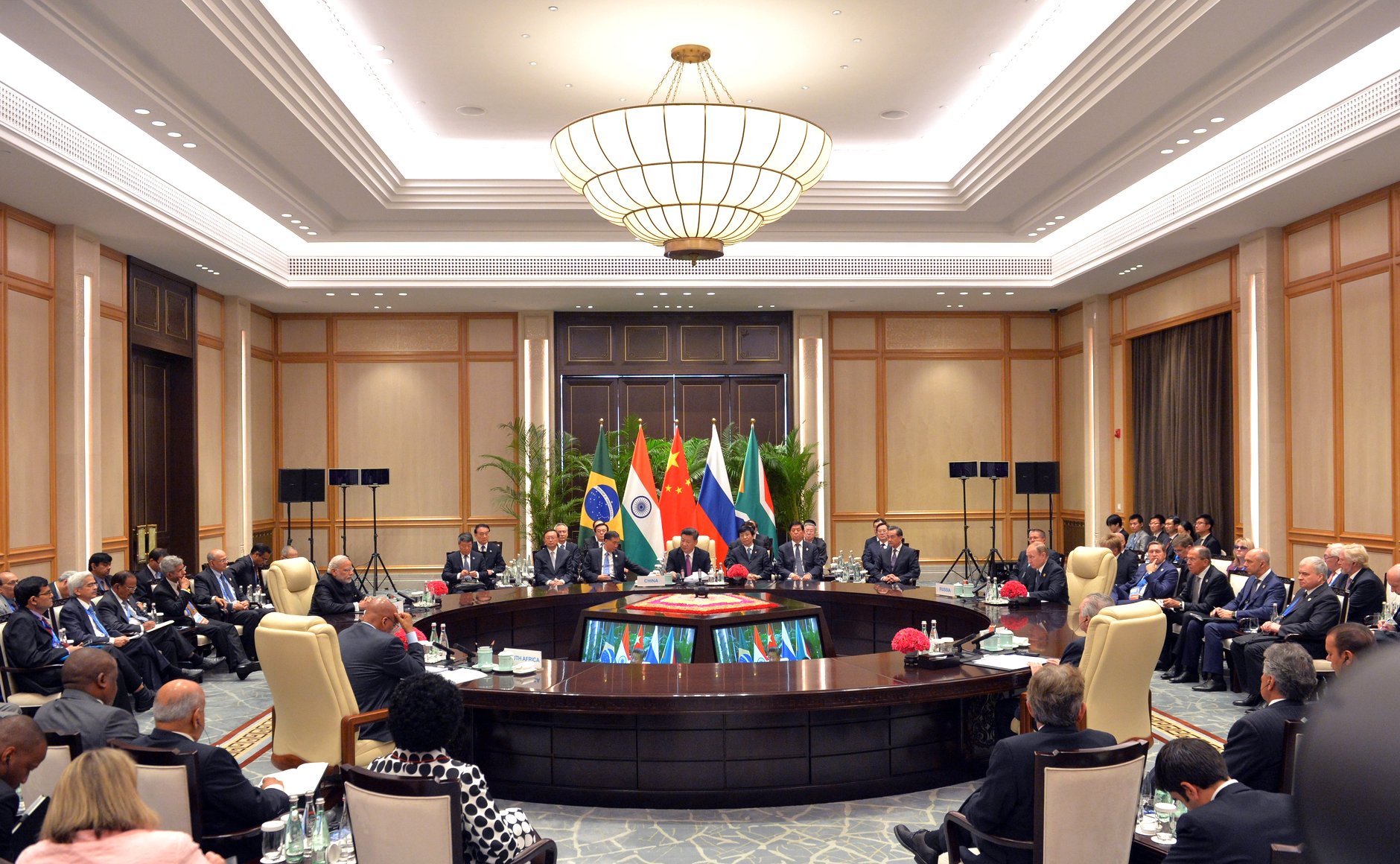

Quick Summary: Ramaphosa Pushes for Fairer Global Order at BRICS Summit
- Cyril Ramaphosa urged for a ‘fairer, more accountable and development-oriented’ global order at the BRICS summit, emphasizing multilateralism.
- The summit saw BRICS leaders condemning unilateral sanctions not authorized by the U.N., highlighting a collective stance against Western coercive measures.
- BRICS announced a new disease early-warning system, marking one of the few tangible policy initiatives from the summit.
- Internal tensions among BRICS members, such as between India and China, challenge the bloc’s ability to act cohesively.
- Ramaphosa aims to leverage the summit for South Africa’s trade and investment goals, aligning with the African Continental Free Trade Area.
Source: Open external resource
Source: Read original article
In a bold move at the BRICS summit, Cyril Ramaphosa called for a global order that is not only fairer but also more accountable and development-focused. This appeal came amidst a backdrop of rising geopolitical tensions and a collective challenge against Western dominance.
The summit was not just a platform for abstract discussions but a stage for direct confrontation with current global conflicts. Leaders, including Ramaphosa, voiced strong opposition to unilateral sanctions, particularly those not sanctioned by the United Nations, marking a significant stance against Western powers.
Adding to the summit’s agenda, BRICS announced the creation of an integrated early-warning system for infectious diseases, showcasing a commitment to practical initiatives. However, the bloc’s internal dynamics, with geopolitical rivals like India and China, pose challenges to its unity and decision-making capabilities.
For South Africa, the summit was more than diplomatic rhetoric. Ramaphosa’s participation was tied to concrete goals, including boosting intra-BRICS trade and investment, which aligns with broader continental economic strategies. This focus on tangible outcomes underscores South Africa’s strategic positioning within the bloc.
As the dust settles from the summit, the real test lies in BRICS’ ability to translate its bold declarations into actionable reforms within the global system. Ramaphosa’s call for multilateralism is not just a ceremonial gesture but a crucial step in redefining global governance in favor of a more balanced world order.
Modi also announced that BRICS had agreed to create an integrated early warning system for infectious diseases, one of the few tangible policy initiatives to emerge from the summit’s public sessions. Narendra Modi, speaking on September 13, warned that “the number of conflicts and tensions in the world is continuously increasing” and that “weaponization of technology and critical minerals” could obstruct development and shared prosperity.
In the immediate term, the bloc’s new disease early-warning initiative, its common language on sanctions, and any follow-through from bilateral meetings in New Delhi will be watched for substance. AP reported that the gathering in New Delhi was strained by the difficulty of reconciling the interests of India, China, Russia, Iran and others, with host India trying to balance ties with China and Russia against expanding partnerships with the United States and other Western powers.
Ramaphosa, meanwhile, linked South Africa’s participation to practical goals beyond messaging: the presidency said Pretoria is using the summit to push intra-BRICS trade and investment, industrialization, value addition and infrastructure investment aligned with the African Continental Free Trade Area. That makes Ramaphosa’s appeal for a rules-based multilateral order more than ceremonial: in this week’s context, it became part of an argument over who gets to define legality, security and legitimacy in a world where BRICS members increasingly challenge Western interpretations of those terms.
” The significance of that language is that it was delivered at the 18th BRICS Leaders’ Summit in New Delhi as the enlarged bloc now stands at 11 members, a scale that gives its demands more heft but also exposes internal fractures. ” He took part in the BRICS Business Forum on September 11, attended the closed leaders’ session on “Inclusive Global Governance and Strengthening Multilateralism” on September 12, and was scheduled to address the open session on September 13 at 10:15 GMT.
The summit itself ran from September 12 to September 13, with bilateral meetings and business engagements layered around the formal program, underscoring that South Africa is trying to convert diplomatic positioning into trade and investment gains. The most concrete outcome around Ramaphosa’s message is that the summit’s politics quickly moved from rhetoric about reform to direct confrontation with current conflicts.
BRICS announced a new disease early-warning system, marking one of the few tangible policy initiatives from the summit. Adding to the summit’s agenda, BRICS announced the creation of an integrated early-warning system for infectious diseases, showcasing a commitment to practical initiatives.
In the immediate term, the bloc’s new disease early-warning initiative, its common language on sanctions, and any follow-through from bilateral meetings in New Delhi will be watched for substance. Ramaphosa, meanwhile, linked South Africa’s participation to practical goals beyond messaging: the presidency said Pretoria is using the summit to push intra-BRICS trade and investment, industrialization, value addition and infrastructure investment aligned with the African Continental Free Trade Area.
That makes Ramaphosa’s appeal for a rules-based multilateral order more than ceremonial: in this week’s context, it became part of an argument over who gets to define legality, security and legitimacy in a world where BRICS members increasingly challenge Western interpretations of those terms. Internal tensions among BRICS members, such as between India and China, challenge the bloc’s ability to act cohesively.
Ramaphosa aims to leverage the summit for South Africa’s trade and investment goals, aligning with the African Continental Free Trade Area. In a bold move at the BRICS summit, Cyril Ramaphosa called for a global order that is not only fairer but also more accountable and development-focused.
The scale and speed of this development has caught many observers off guard. Each new update adds another dimension to a story that is still unfolding, and the full picture will only become clear as more verified details emerge from the people and institutions directly involved.
Analysts who have tracked this issue closely say the current moment represents a genuine turning point. The decisions made in the coming weeks are expected to set the direction for months ahead, with ripple effects likely to extend well beyond the immediate actors in the story.
For those directly affected, the practical impact is already visible. People navigating this fast-changing situation are dealing with real consequences while new information continues to reshape what is known and what remains open to interpretation.
Historical parallels offer some context, though experts caution against drawing too close a comparison. Similar situations have played out before, but the specific combination of pressures, personalities, and timing here makes this moment distinct in ways that matter for how it ultimately resolves.
The political and economic dimensions of this story are deeply intertwined. What appears as a single event on the surface is in practice the convergence of multiple pressures that have been building quietly over a longer period than most public reporting has captured.