


Quick Summary: Russia Eyes $100 Billion Trade With India By 2030 Amid BRICS Expansion
- Putin invited 2,000 young leaders from 120 countries to Russia’s World Youth Festival Assembly, emphasizing future-building and cooperation.
- Russia has prioritized Africa in its foreign policy, aiming for a $100 billion trade target with India by 2030.
- At the BRICS summit, Putin advocated for a global growth platform outside Western rules, highlighting a shift towards economic partnerships.
- The expanded BRICS bloc now represents half the world’s population, though internal divisions remain a challenge.
- Russia’s outreach to young leaders coincides with its efforts to break strategic isolation amid Western sanctions over Ukraine.
Source: Open external resource
Source: Read original article
Vladimir Putin’s invitation to young global leaders is more than a diplomatic gesture; it’s a strategic move in Russia’s broader campaign to reshape the global order. By hosting 2,000 young leaders from 120 countries at the World Youth Festival Assembly, Putin is leveraging youth diplomacy to build alliances beyond Western influence. BRICS is at the center of this development.
This initiative aligns with Russia’s intensified focus on Africa and emerging markets, as evidenced by its ambitious goal to increase trade with India to $100 billion by 2030. At the recent BRICS summit, Putin pushed for the bloc to become a new platform for global growth, free from Western constraints, signaling a pivot from geopolitics to practical economic partnerships.
Despite these efforts, the expanded BRICS bloc, now comprising 11 members and representing half the world’s population, faces internal divisions that could hinder cohesive action. Nevertheless, Russia’s outreach to young leaders is part of a dual strategy to engage future elites while countering Western sanctions and diplomatic isolation over the Ukraine conflict.
In this context, Putin’s invitation is not merely symbolic; it’s a calculated effort to foster a multipolar world order through structured forums and programs. Whether this strategy will yield tangible results remains to be seen, but it underscores Russia’s determination to assert its influence on the global stage.
MyJoyOnline’s reporting on Russia’s Africa strategy says Moscow has elevated Africa ties to an “unconditional priority” in its foreign policy, while this week’s Reuters reporting says India and Russia want bilateral trade to hit $100 billion by 2030, up from nearly $70 billion in 2024-25. On September 8, AP reported Putin assuring Donald Trump through the Kremlin that Moscow had no aggressive plans toward Europe.
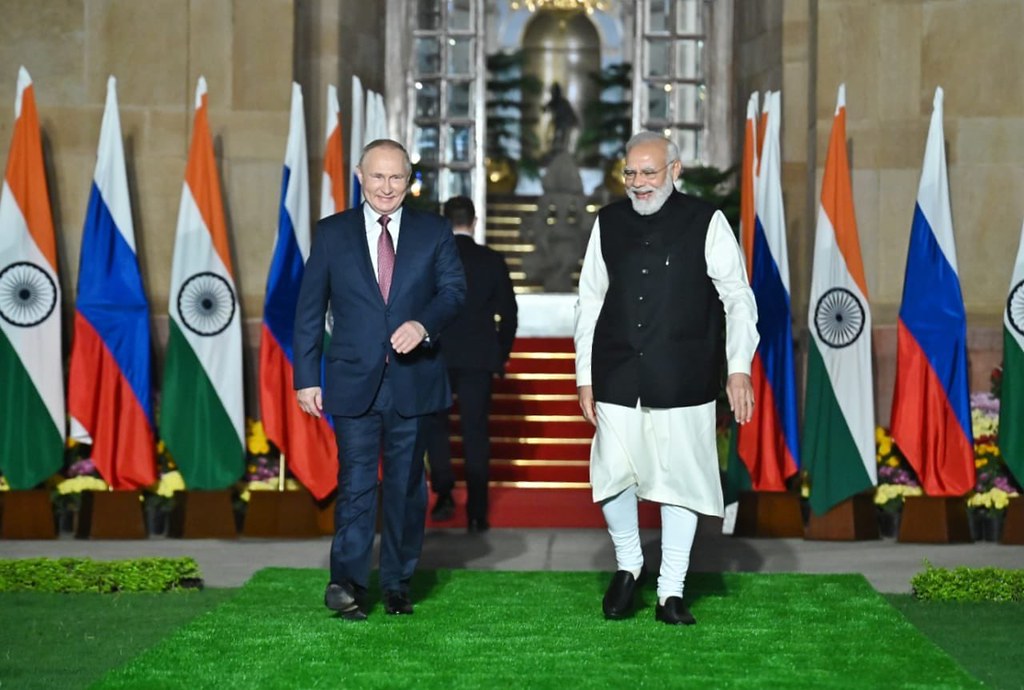
On September 11, Reuters reporting said Putin told Modi that BRICS should help build global growth outside Western rules, while AP reported leaders gathering in New Delhi for the summit of the now 11-member bloc. The MyJoyOnline report itself centers on Russia’s World Youth Festival Assembly in Nizhny Novgorod, where 2,000 young leaders from 120 countries were gathered under a program explicitly framed around “future-building” and cross-border cooperation, with BRICS and Global South participation highlighted and a BRICS International Business Mentoring Programme launched for delegates.
At talks connected to this week’s BRICS summit in New Delhi, Reuters reporting carried by MarketScreener said Putin pushed for BRICS to become “a new platform for global growth free from Western rules,” while envoy Kirill Dmitriev said the bloc was moving from geopolitics toward a more practical economic partnership focused on businesses, technology, investors, payments and infrastructure. AP also notes BRICS has expanded from five founding members to 11, a scale that gives Putin a much larger audience for this anti-Western, post-unipolar pitch even if consensus inside the bloc is uneven.
Those developments followed earlier Kremlin remarks on September 1 framing multipolarity as a historic shift, showing a steady escalation from ideological messaging to summit-level coalition building. If not, the main story becomes the opposite: that Moscow can stage impressive gatherings with 2,000 delegates from 120 countries but still struggle to turn symbolism into durable geopolitical results.
AP’s latest reporting on the expanded 11-member BRICS says the bloc now represents about half the world’s population, but that its growing size has also exposed deep divisions among members with competing foreign-policy and economic interests. The central conflict driving the story is the clash between Russia’s attempt to present itself as a champion of the Global South and the fact that it is simultaneously isolated by the West over Ukraine and sanctions.
Russia has prioritized Africa in its foreign policy, aiming for a $100 billion trade target with India by 2030. This initiative aligns with Russia’s intensified focus on Africa and emerging markets, as evidenced by its ambitious goal to increase trade with India to $100 billion by 2030.
On September 8, AP reported Putin assuring Donald Trump through the Kremlin that Moscow had no aggressive plans toward Europe. On September 11, Reuters reporting said Putin told Modi that BRICS should help build global growth outside Western rules, while AP reported leaders gathering in New Delhi for the summit of the now 11-member bloc.
The MyJoyOnline report itself centers on Russia’s World Youth Festival Assembly in Nizhny Novgorod, where 2,000 young leaders from 120 countries were gathered under a program explicitly framed around “future-building” and cross-border cooperation, with BRICS and Global South participation highlighted and a BRICS International Business Mentoring Programme launched for delegates. By hosting 2,000 young leaders from 120 countries at the World Youth Festival Assembly, Putin is leveraging youth diplomacy to build alliances beyond Western influence.
Despite these efforts, the expanded BRICS bloc, now comprising 11 members and representing half the world’s population, faces internal divisions that could hinder cohesive action. At talks connected to this week’s BRICS summit in New Delhi, Reuters reporting carried by MarketScreener said Putin pushed for BRICS to become “a new platform for global growth free from Western rules,” while envoy Kirill Dmitriev said the bloc was moving from geopolitics toward a more practical economic partnership focused on businesses, technology, investors, payments and infrastructure.
The scale and speed of this development has caught many observers off guard. Each new update adds another dimension to a story that is still unfolding, and the full picture will only become clear as more verified details emerge from the people and institutions directly involved.
Analysts who have tracked this issue closely say the current moment represents a genuine turning point. The decisions made in the coming weeks are expected to set the direction for months ahead, with ripple effects likely to extend well beyond the immediate actors in the story.
For those directly affected, the practical impact is already visible. People navigating this fast-changing situation are dealing with real consequences while new information continues to reshape what is known and what remains open to interpretation.
Historical parallels offer some context, though experts caution against drawing too close a comparison. Similar situations have played out before, but the specific combination of pressures, personalities, and timing here makes this moment distinct in ways that matter for how it ultimately resolves.
The political and economic dimensions of this story are deeply intertwined. What appears as a single event on the surface is in practice the convergence of multiple pressures that have been building quietly over a longer period than most public reporting has captured.