

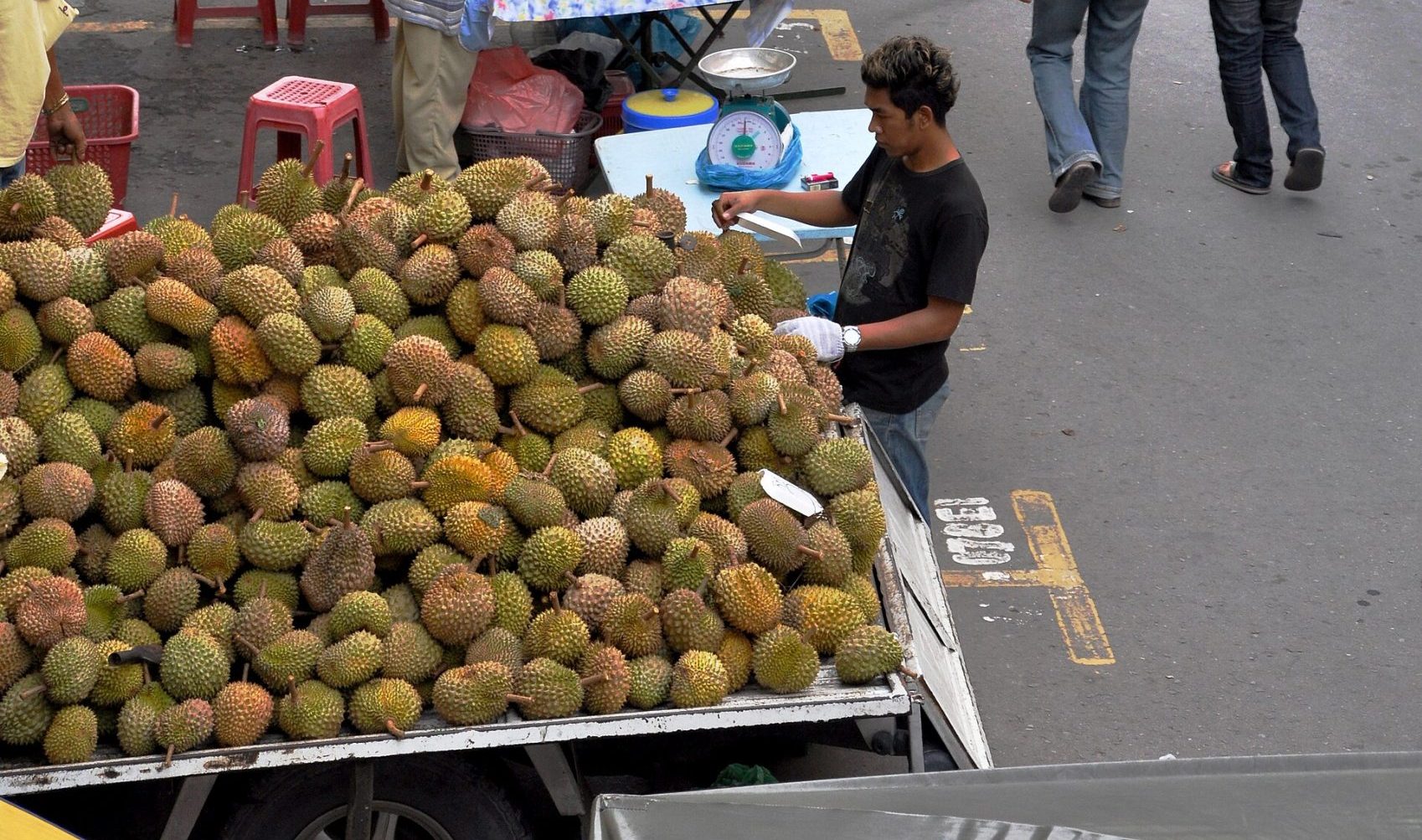

Quick Summary: FAMA Steps In as Malaysian Farmers Face Durian Price Slump
- On June 24, 2026, FAMA reported kampung durian prices dropped to RM1-RM4/kg, while Musang King fell below RM30/kg, impacting farmers’ earnings.
- Thailand dominated over 50% of China’s durian market by value in 2025, with an 81% share in the first half of 2026, overshadowing Malaysia’s market efforts.
- Malaysia’s fresh durian exports to China surged by over 500% from US$5 million to US$37 million in 2025, yet farmers still faced a price slump.
- China imported 1.87 million tonnes of fresh durian worth US$7.5 billion in 2025, with Malaysia’s share quadrupling in early 2026, highlighting export growth but local distress.
- FAMA intervened by purchasing 1,000 tonnes worth RM7 million and supporting 1,199 tonnes worth RM3.28 million to stabilize the market.
Source: Open external resource
Source: Read original article
Malaysia’s durian industry is at a crossroads, as the recent glut reveals a deeper issue than just supply and demand. Despite a booming export market to China, with fresh durian exports growing over 500% in 2025, local farmers are seeing their profits squeezed. Prices have plummeted, with kampung durian selling for as low as RM1 per kilogram, and even the premium Musang King variety dropping below RM30.
Thailand remains a dominant force in China’s durian market, holding over 50% market share by value in 2025, and an 81% share in the first half of 2026. Malaysia’s strategy of focusing on quality over quantity is being tested. The country has seen its exports quadruple, yet the benefits aren’t trickling down to the farmers.
FAMA has stepped in, purchasing significant quantities to stabilize prices, but the core issue remains: Malaysia’s durian industry needs to rethink its approach. The focus must shift from mere expansion to enhancing logistics, processing, and branding to protect its niche market. Without this shift, the industry risks repeating the same cycle of growth without profit.
On June 24, 2026, FAMA deputy director-general Faizal Iswardi Ismail said kampung durian prices in some areas had slumped to between RM1 and RM4 per kilogramme, while premium Musang King had fallen below RM30 per kilogramme. Thailand still held more than half of China’s durian market by value in 2025, while a South China Morning Post video report from October 3 said Thailand had 81 per cent market share in the first half of 2026.
Sahar, Malaysia’s trade commissioner in Beijing, said on July 5 that “Fresh durian exports grew by more than 500 per cent” from about US$5 million to US$37 million in 2025, and added, “We are not competing on price. The sharpest new takeaway comes from The Business Times piece published on Monday, October 5, 2026, which argues that the real failure is not demand but value capture: Malaysia won access to China’s market, exports surged, yet output rose even faster and producers still got squeezed.
5 billion in 2025, and that the value of China’s fresh durian imports from Malaysia quadrupled in the first half of 2026 versus a year earlier. 28 million and opened 90 fruit sales locations, mainly in Pahang, Perak and Selangor.
3 million, in durian exports to China by 2030 and an ambition to lift Malaysia’s share of China’s durian market from about 4 to 5 per cent to 8 to 10 per cent. The freshest reporting says Malaysia’s durian glut has become a test of whether the country can turn booming demand and headline growth into actual earnings for farmers, with prices in parts of the market falling by more than half even after China opened its doors to fresh Malaysian durian in 2024.
” He also said Malaysia’s durians are exported to China within 48 hours after naturally ripening and falling from the tree. The numbers from Malaysian officials show how aggressively the government had to step in when the glut hit.
Thailand dominated over 50% of China’s durian market by value in 2025, with an 81% share in the first half of 2026, overshadowing Malaysia’s market efforts. Malaysia’s fresh durian exports to China surged by over 500% from US$5 million to US$37 million in 2025, yet farmers still faced a price slump.
5 billion in 2025, with Malaysia’s share quadrupling in early 2026, highlighting export growth but local distress. Despite a booming export market to China, with fresh durian exports growing over 500% in 2025, local farmers are seeing their profits squeezed.
Thailand remains a dominant force in China’s durian market, holding over 50% market share by value in 2025, and an 81% share in the first half of 2026. 5 billion in 2025, and that the value of China’s fresh durian imports from Malaysia quadrupled in the first half of 2026 versus a year earlier.
The scale and speed of this development has caught many observers off guard. Each new update adds another dimension to a story that is still unfolding, and the full picture will only become clear as more verified details emerge from the people and institutions directly involved.
Analysts who have tracked this issue closely say the current moment represents a genuine turning point. The decisions made in the coming weeks are expected to set the direction for months ahead, with ripple effects likely to extend well beyond the immediate actors in the story.
For those directly affected, the practical impact is already visible. People navigating this fast-changing situation are dealing with real consequences while new information continues to reshape what is known and what remains open to interpretation.
Historical parallels offer some context, though experts caution against drawing too close a comparison. Similar situations have played out before, but the specific combination of pressures, personalities, and timing here makes this moment distinct in ways that matter for how it ultimately resolves.
The political and economic dimensions of this story are deeply intertwined. What appears as a single event on the surface is in practice the convergence of multiple pressures that have been building quietly over a longer period than most public reporting has captured.