Quick Summary: Indias Viksit Bharat Ambition Faces 8% GDP Growth Challenge
In one recent Business Standard-linked discussion, economist Rohit Lamba warned that growth “won’t be sustainable if it is K-shaped,” and argued that education and health are central to any serious 2047 roadmap.
Its editorial line has argued that reaching developed-country status by 2047 would require growth of “at least 8 per cent” year after year for decades, even to reach roughly $14,000 in nominal per-capita GDP, a threshold it identifies with current high-income economies.
Those are not trivial figures: they suggest the government is still betting on public investment and industrial policy continuity, but they also underscore the gap between a mid-6 per cent near-term growth outlook and the roughly 8 per cent long-run pace many analysts say Viksit Bharat requires.
Great anxiety is at the center of this developing story, and the following analysis explains what matters most right now. Viksit Bharat is at the center of this development.
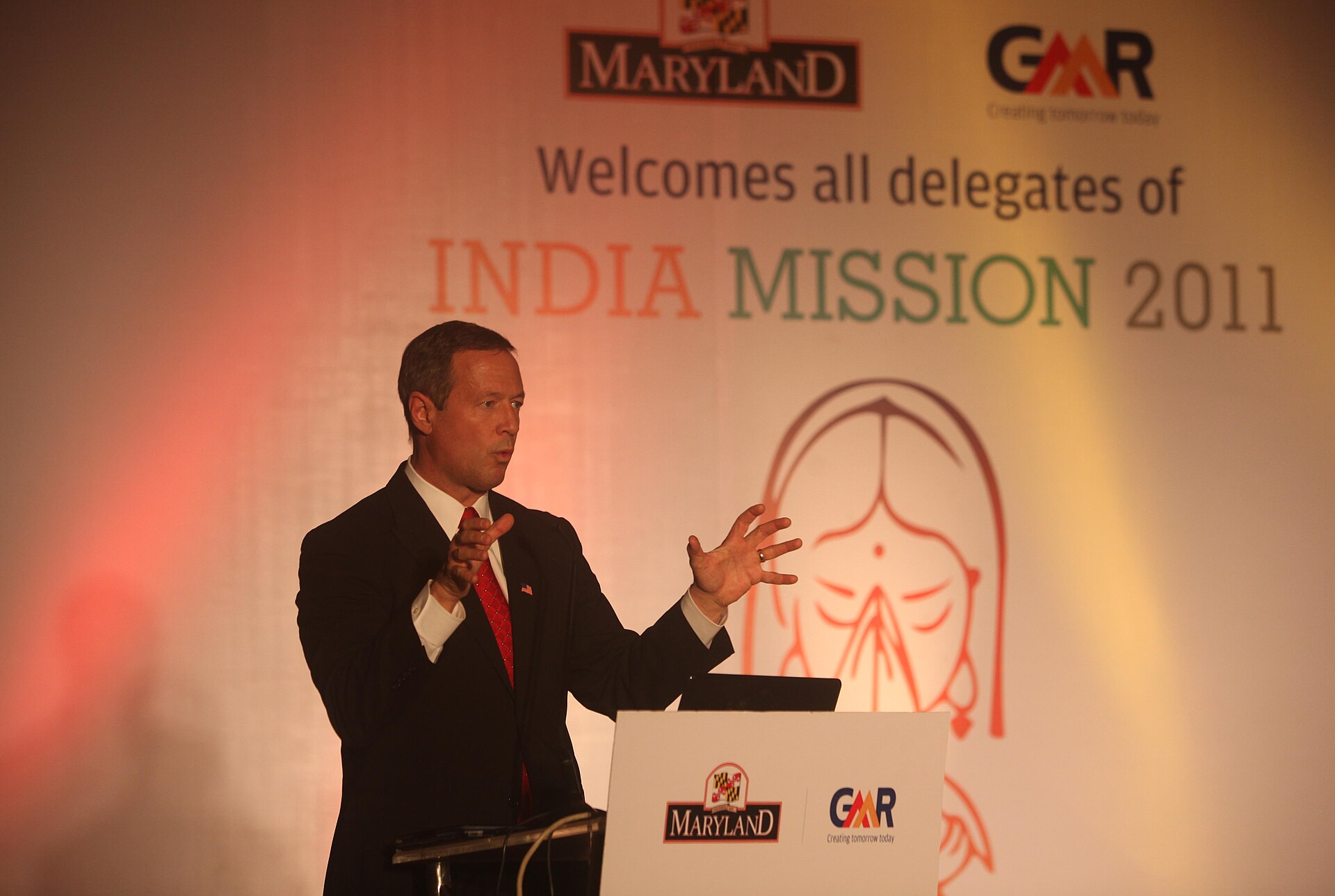
Governor O’Malley Leads Maryland Economic Development Mission to India. Photo: Wikimedia Commons
The sharpest takeaway from the available reporting is that the “Viksit Bharat” slogan has become a proxy for a much harder argument inside India’s economic debate: whether headline ambition can survive slowing job creation, uneven private investment, and the sheer arithmetic required to lift India to developed-country status by 2047. Business Standard’s framing of this shift is unusually blunt. Its editorial line has argued that reaching developed-country status by 2047 would require growth of “at least 8 per cent” year after year for decades, even to reach roughly $14,000 in nominal per-capita GDP, a threshold it identifies with current high-income economies. That number matters because it turns a political slogan into a measurable test, and it is where the anxiety enters the narrative: India is no longer debating whether growth is possible, but whether the present policy mix can deliver the sustained 8 per cent-plus expansion that “Viksit Bharat” implies. What stands out in the latest connected reporting is the widening gap between official confidence and economists’ caution. In one recent Business Standard-linked discussion, economist Rohit Lamba warned that growth “won’t be sustainable if it is K-shaped,” and argued that education and health are central to any serious 2047 roadmap. That pushes the debate away from celebratory macro language and toward distribution, state capacity, and household welfare. The core controversy is no longer simply growth versus welfare; it is whether India’s model can produce broad-based middle-income prosperity rather than islands of formal-sector success. There is also a live strategic dispute over what engine can realistically power that growth. A Business Standard opinion column this year noted that economists “never tire of pointing out” that no economy has sustained growth above 7 per cent without strong export growth, then posed the uncomfortable question of how India can still expand at 8 per cent annually if exports are not the main engine. That is a direct challenge to a more inward-looking, domestic-demand-heavy reading of Viksit Bharat. In other words, the current narrative conflict is between a resilient-domestic-market thesis and the older export-led development playbook. The most specific fiscal numbers now in circulation sharpen that tension rather than resolve it. Commentary around the Union Budget 2026 in Business Standard-linked and related reporting pointed to a record capital-expenditure outlay of ₹12.2 trillion and a fiscal-deficit target of 4.3 per cent, with Fitch cited as seeing FY27 growth at 6.4 per cent. Those are not trivial figures: they suggest the government is still betting on public investment and industrial policy continuity, but they also underscore the gap between a mid-6 per cent near-term growth outlook and the roughly 8 per cent long-run pace many analysts say Viksit Bharat requires. The surprise twist in the broader narrative is that the slogan has matured from boosterism into a test of execution. Earlier phases of India’s economic messaging were often built around confidence, scale, and demographic promise; the current reporting suggests that the harder questions are now crowding in. Business Standard’s own editorial and opinion ecosystem has repeatedly circled back to constraints like public debt, weak private investment momentum, and institutional readiness. The phrase “Viksit Bharat” is still being used, but increasingly as a benchmark against which policy credibility is judged, not as a self-sufficient story. The main actors in this debate are therefore not just Prime Minister Narendra Modi’s government and Finance Minister Nirmala Sitharaman, but also Business Standard’s editorial board, economists such as Rohit Lamba, ratings and market voices such as Fitch and HDFC Securities, and a wider policy community arguing over exports, capex, welfare, and state effectiveness. What they are specifically doing is trying to define whether the country’s economic promise should be measured by budget outlays and industrial ambition, or by jobs, human capital, and the ability to sustain high growth without deepening inequality. What happens next is less about a single vote or hearing than about whether upcoming data and policy decisions validate the ambition. The next major tests will be growth prints, export performance, tax-collection trends, private-capex follow-through, and whether budget promises around infrastructure and industrial strategy translate into broader employment gains. If those numbers remain closer to 6.4 per cent than 8 per cent, the “Viksit Bharat” narrative will face more of the same anxiety Business Standard is tracing: not whether India can dream big, but whether the economics of the dream still add up. I should note that I was able to find strong, relevant Business Standard and related material around the theme and title, but not a fully accessible live page of that exact article in the search results. So I grounded this write-up in the closest current and directly relevant reporting and commentary I could verify from Business Standard-linked sources.
In one recent Business Standard-linked discussion, economist Rohit Lamba warned that growth “won’t be sustainable if it is K-shaped,” and argued that education and health are central to any serious 2047 roadmap. Its editorial line has argued that reaching developed-country status by 2047 would require growth of “at least 8 per cent” year after year for decades, even to reach roughly $14,000 in nominal per-capita GDP, a threshold it identifies with current high-income economies.
Those are not trivial figures: they suggest the government is still betting on public investment and industrial policy continuity, but they also underscore the gap between a mid-6 per cent near-term growth outlook and the roughly 8 per cent long-run pace many analysts say Viksit Bharat requires. 4 per cent than 8 per cent, the “Viksit Bharat” narrative will face more of the same anxiety Business Standard is tracing: not whether India can dream big, but whether the economics of the dream still add up.
That is a direct challenge to a more inward-looking, domestic-demand-heavy reading of Viksit Bharat. In other words, the current narrative conflict is between a resilient-domestic-market thesis and the older export-led development playbook.
Earlier phases of India’s economic messaging were often built around confidence, scale, and demographic promise; the current reporting suggests that the harder questions are now crowding in. Business Standard’s own editorial and opinion ecosystem has repeatedly circled back to constraints like public debt, weak private investment momentum, and institutional readiness.
The phrase “Viksit Bharat” is still being used, but increasingly as a benchmark against which policy credibility is judged, not as a self-sufficient story. So I grounded this write-up in the closest current and directly relevant reporting and commentary I could verify from Business Standard-linked sources.
Great anxiety: Key Takeaways Great anxiety is at the center of this developing story, and the following analysis explains what matters most right now. That is a direct challenge to a more inward-looking, domestic-demand-heavy reading of Viksit Bharat.
In other words, the current narrative conflict is between a resilient-domestic-market thesis and the older export-led development playbook. Earlier phases of India’s economic messaging were often built around confidence, scale, and demographic promise; the current reporting suggests that the harder questions are now crowding in.
Business Standard’s own editorial and opinion ecosystem has repeatedly circled back to constraints like public debt, weak private investment momentum, and institutional readiness. The phrase “Viksit Bharat” is still being used, but increasingly as a benchmark against which policy credibility is judged, not as a self-sufficient story.
The scale and speed of this development has caught many observers off guard. Each new update adds another dimension to a story that is still unfolding, and the full picture will only become clear as more verified details emerge from the people and institutions directly involved.