

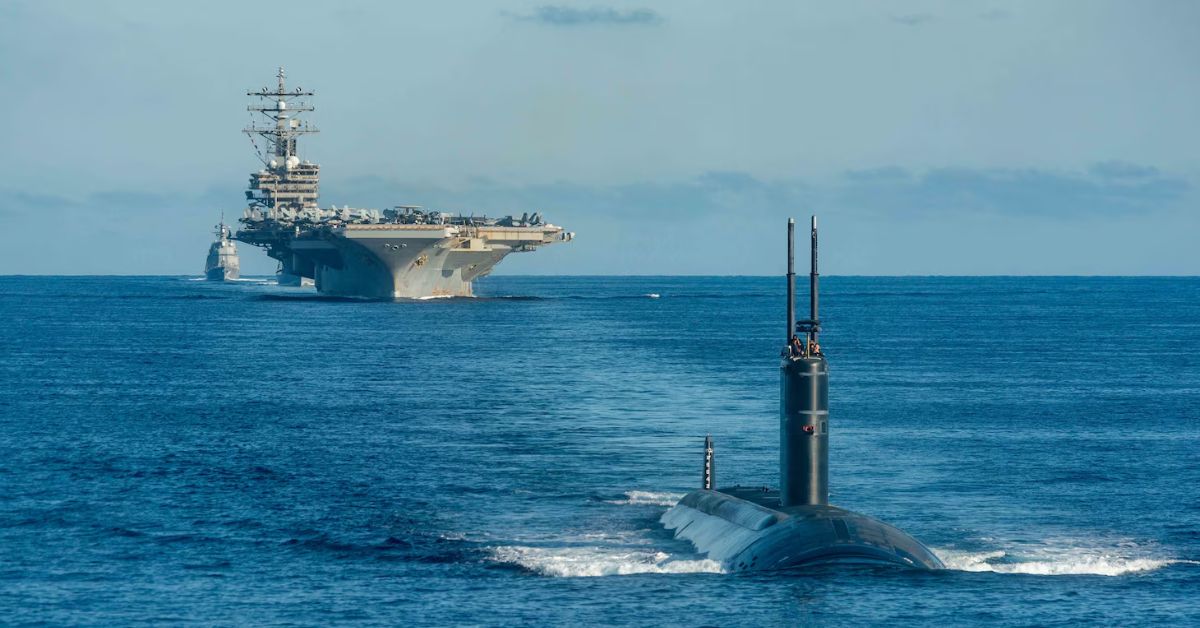

The sinking of an Iranian naval vessel by an American submarine has dramatically heightened tensions across the Middle East, marking one of the most consequential naval confrontations between the United States and Iran in decades.
Military officials confirmed that a US submarine fired a torpedo that struck the Iranian warship IRIS Dena while it was operating in international waters. The attack triggered an explosion near the vessel’s stern before the ship began taking on water and eventually sank, according to officials familiar with the incident.
US submarine operations rarely become public so quickly after a combat action. However, the unusual circumstances surrounding the sinking including the number of casualties and the geopolitical implications quickly turned the event into a major international development.
Rising Tensions in International Waters
The moment a US submarine sinks Iranian warship capabilities in open waters represents a dramatic escalation in military activity across the region. Analysts say the event underscores how fragile security conditions have become in maritime corridors connecting the Indian Ocean, Gulf of Oman, and Persian Gulf.
Officials familiar with the situation said the Iranian vessel IRIS Dena was operating several thousand miles from Iran’s coastline when the incident occurred. The warship reportedly transmitted a distress signal shortly after the explosion.
Regional maritime authorities began receiving emergency communications indicating the ship had sustained catastrophic damage.
Naval observers say the sinking highlights how submarine warfare remains one of the most decisive elements of modern military strategy.
US Submarine Sinks Iranian Warship IRIS Dena
Defense officials confirmed that a US submarine sinks Iranian warship IRIS Dena after firing a torpedo during an encounter in international waters.
Pentagon leadership later addressed the situation publicly during a press briefing, confirming that the Iranian vessel had been struck by a torpedo launched from an American submarine.
According to military officials, the weapon detonated near the rear of the vessel, triggering a massive blast and structural damage that rapidly compromised the ship’s stability.
Video footage reviewed by defense analysts reportedly showed flames and debris rising from the water shortly after the explosion.
The confirmation that a US submarine sinks Iranian warship IRIS Dena quickly spread across international media outlets, drawing attention from governments and military analysts worldwide.
Pentagon Confirms Torpedo Attack
During a Pentagon briefing, defense leaders described the operation as a direct engagement that unfolded in international waters.
Officials stated that the submarine crew identified the vessel and executed a torpedo launch that successfully struck the target.
According to the defense department, the decision to fire was made after evaluating operational risks and strategic conditions in the region.
The confirmation that a US submarine sinks Iranian warship IRIS Dena has placed submarine warfare back into the spotlight as a central component of maritime defense strategy.
Military analysts say submarine capabilities allow forces to operate with stealth while maintaining the ability to strike targets with precision.
Rescue Operations and Casualty Reports
Following the explosion and sinking of the vessel, regional authorities began coordinating rescue efforts.
Sri Lankan naval forces responded after receiving a distress call from the ship, dispatching vessels and aircraft to search the surrounding waters.
Officials later confirmed that dozens of survivors had been rescued from the sea.
However, the scale of the tragedy quickly became apparent as recovery teams began locating bodies in the water.
Authorities involved in the operation reported recovering dozens of deceased crew members during search efforts.
Early reports suggested that roughly 130 personnel were believed to have been aboard the Iranian vessel when the attack occurred.
Rescue operations continued for hours as teams searched the surrounding waters for additional survivors.
Iran Condemns the Naval Strike
Iranian officials strongly condemned the incident after confirmation that a US submarine sinks Iranian warship IRIS Dena in international waters.
Tehran described the attack as a serious act of aggression and warned that such actions could have consequences for regional stability.
Iran’s foreign minister publicly criticized the strike, stating that the United States had set what he called a dangerous precedent by engaging an Iranian naval vessel far from its home waters.
Iranian officials have not yet released a detailed casualty list, but the government has vowed to investigate the circumstances surrounding the sinking.
The statement further emphasized that Iran would consider its response carefully.
Strategic Importance of the IRIS Dena
The IRIS Dena is one of the Iranian navy’s larger surface combatants and had been part of several naval missions.
Naval analysts say the vessel played an important role in Iran’s maritime operations.
Its presence in international waters was believed to be part of a broader naval deployment.
Experts note that the fact a US submarine sinks Iranian warship IRIS Dena highlights the vulnerability of surface ships when confronted by stealth submarine platforms.
Submarines are designed to remain hidden while tracking enemy vessels.
Once positioned, they can launch torpedoes capable of destroying even heavily armed warships.
Naval Warfare and Submarine Strategy
The ability of a US submarine sinks Iranian warship capability demonstrates the strategic value of undersea warfare.
Submarines are among the most difficult military platforms to detect, giving them a significant advantage over surface ships.
Modern submarines use advanced sonar systems, stealth technology, and guided torpedoes to track and attack enemy vessels.
When a submarine operates undetected beneath the surface, surface ships may not even realize they are being tracked.
This advantage is what allows a US submarine sinks Iranian warship scenario to unfold with devastating effectiveness.
Naval strategists say such engagements show why submarines remain central to modern naval doctrine.
Historical Context of US Submarine Combat
Although submarines play a critical role in military operations, combat torpedo attacks are relatively rare in modern history.
During World War II, American submarines frequently engaged enemy vessels across the Pacific.
Hundreds of ships were sunk during the conflict as submarine warfare became a major factor in naval strategy.
In the decades that followed, submarine engagements became less common as geopolitical conflicts shifted toward air power and missile systems.
That is why the confirmation that a US submarine sinks Iranian warship IRIS Dena has drawn particular attention from military historians.
Some analysts believe the incident represents one of the most significant submarine combat actions in modern times.
Global Reactions to the Incident
Governments around the world are closely watching developments following confirmation that a US submarine sinks Iranian warship IRIS Dena.
Diplomatic observers say the event could have far-reaching consequences for international relations.
Some governments have urged restraint, calling for efforts to prevent further escalation.
Others have emphasized the importance of maintaining freedom of navigation and maritime security.
International organizations are also monitoring the situation as rescue and recovery operations continue.
The incident has already sparked intense debate among defense analysts about the implications for global security.
Concerns Over Escalation in the Middle East
The confirmation that a US submarine sinks Iranian warship IRIS Dena has raised concerns among experts who study regional security dynamics.
Naval confrontations in international waters carry the risk of triggering broader conflict if tensions continue to rise.
Military analysts warn that any retaliation or additional engagements could further destabilize an already fragile geopolitical environment.
At the same time, governments are working behind the scenes through diplomatic channels to prevent further escalation.
As investigations continue into the sinking of the vessel, the international community remains focused on preventing the situation from spiraling into a wider confrontation.
For now, the dramatic moment when a US submarine sinks Iranian warship IRIS Dena has become one of the most closely watched developments in global security.